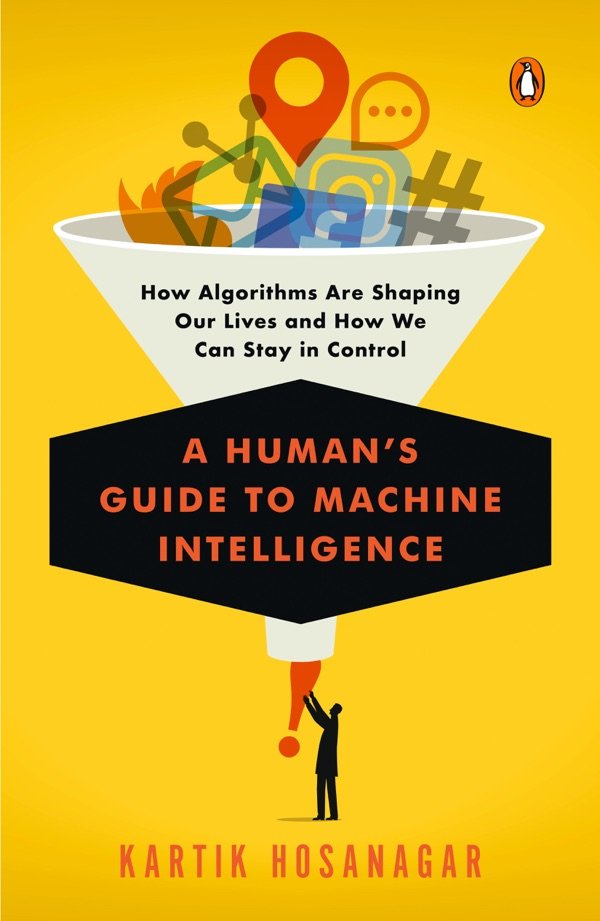
A Human's Guide to Machine Intelligence: How Algorithms Are Shaping Our Lives and How We Can Stay in Control
by Kartik Hosanagar
Take the simple ability to link supply and demand, automate it, provide the scale the internet allows, and you have a winning business. Its online radio service emerged from the Music Genome Project, in which musicologists listened to individual tracks and assigned more than 450 attributes to each. These range from the obvious, such as the extent of instrumentation in the music, to the esoteric, such as “rhythmic syncopation.” Once you indicate that you like a song on Pandora, the algorithm finds other songs that have similar musical qualities.
Take the simple ability to link supply and demand, automate it, provide the scale the internet allows, and you have a winning business.
The more immediate reason behind the recent explosion in machine learning is the advances in deep learning, a term for digital neural networks arranged in several layers. In deep learning, programmers don’t specify what patterns to look for: the algorithm evaluates the training data in different ways to identify the patterns that truly matter—patterns that human programmers might not even notice.
Microsoft’s experiences with Tay and Zo offer a valuable lesson about rogue algorithmic behavior: sometimes the problem with algorithms may be that they are simply hanging out with bad data. Or as Yuan Zhang, the avid XiaoIce user I mentioned in the Introduction, put it following the Tay disaster: “Tay is the child of all her users. We should become better parents.”
There lies before us, if we choose, continual progress in happiness, knowledge, and wisdom. Shall we, instead, choose death, because we cannot forget our quarrels? We appeal as human beings to human beings: Remember your humanity, and forget the rest. If you can do so, the way opens to a new Paradise; if you cannot, there lies before you the risk of universal death.
Ultimately, Polanyi’s paradox argues that decision systems that are codified and articulable must by their very nature be limited. They are usually brittle systems—easily breakable, that is to say. When they are confronted with examples or challenges that their instructions aren’t designed to handle, predictable systems fail miserably.
"Take the simple ability to link supply and demand, automate it, provide the scale the internet allows, and you have a winning business."
"Its online radio service emerged from the Music Genome Project, in which musicologists listened to individual tracks and assigned more than 450 attributes to each. These range from the obvious, such as the extent of instrumentation in the music, to the esoteric, such as “rhythmic syncopation.” Once you indicate that you like a song on Pandora, the algorithm finds other songs that have similar musical qualities."
"The more immediate reason behind the recent explosion in machine learning is the advances in deep learning, a term for digital neural networks arranged in several layers. In deep learning, programmers don’t specify what patterns to look for: the algorithm evaluates the training data in different ways to identify the patterns that truly matter—patterns that human programmers might not even notice."
"Microsoft’s experiences with Tay and Zo offer a valuable lesson about rogue algorithmic behavior: sometimes the problem with algorithms may be that they are simply hanging out with bad data. Or as Yuan Zhang, the avid XiaoIce user I mentioned in the Introduction, put it following the Tay disaster: “Tay is the child of all her users. We should become better parents.”"
"There lies before us, if we choose, continual progress in happiness, knowledge, and wisdom. Shall we, instead, choose death, because we cannot forget our quarrels? We appeal as human beings to human beings: Remember your humanity, and forget the rest. If you can do so, the way opens to a new Paradise; if you cannot, there lies before you the risk of universal death."
"Ultimately, Polanyi’s paradox argues that decision systems that are codified and articulable must by their very nature be limited. They are usually brittle systems—easily breakable, that is to say. When they are confronted with examples or challenges that their instructions aren’t designed to handle, predictable systems fail miserably."
"Swanson’s experience reveals how knowledge is often hidden in plain sight. If A (fish oil) is related to B (blood flow) and B is related to C (Raynaud’s symptoms), then there may be a potential relationship between A and C. The challenge, then, if the connections exist in the data, is to find them in a systematic way."
- →Swanson’s experience reveals how knowledge is often hidden in plain sight. If A (fish oil) is related to B (blood flow) and B is related to C (Raynaud’s symptoms), then there may be a potential relationship between A and C. The challenge, then, if the connections exist in the data, is to find them in a systematic way.
- →AI and machine learning, their capabilities and their footprint have expanded. They now touch our lives every day, from how we choose products to purchase (Amazon’s “People who bought this also bought”) and movies to watch (Netflix’s recommendations) to whom we date or marry (Match.com or Tinder matches).
- →Sound strange? Because XiaoIce is not human. In fact, she/it is a chatbot created in the avatar of an eighteen-year-old girl by Microsoft to entertain people with stories, jokes, and casual conversation.
- →Today, some of the most accurate machine learning models that computer scientists can build are also the most opaque. As machines become more intelligent and dynamic they also become more unpredictable.
Looking for something similar?
Describe your situation. The search finds the right book from the entire library.