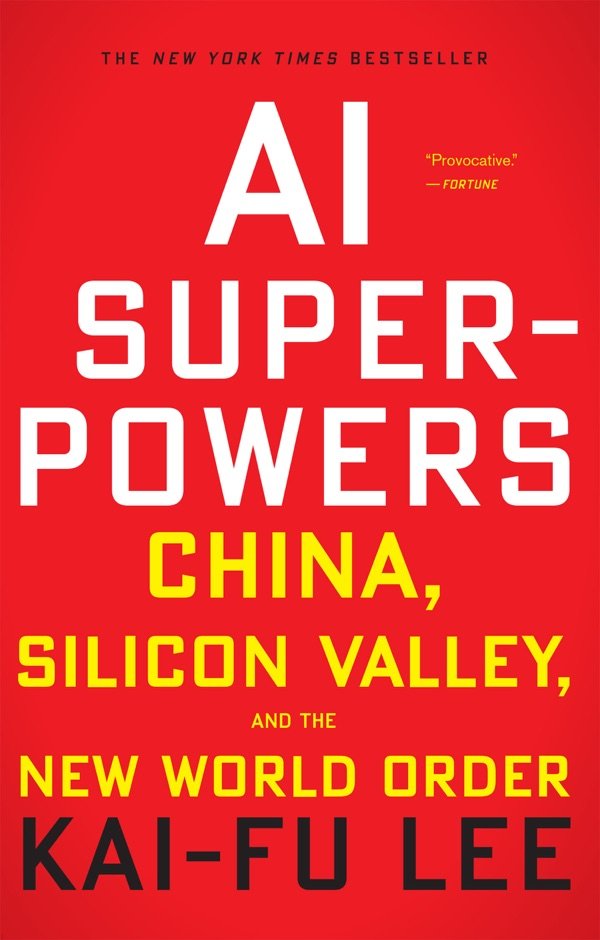
AI Superpowers: China, Silicon Valley, and the New World Order
by Kai-Fu Lee
The AI world order will combine winner-take-all economics with an unprecedented concentration of wealth in the hands of a few companies in China and the United States. This, I believe, is the real underlying threat posed by artificial intelligence: tremendous social disorder and political collapse stemming from widespread unemployment and gaping inequality. The dramatic transformation that deep learning promises to bring to the global economy won’t be delivered by isolated researchers producing novel academic results in the elite computer science labs of MIT or Stanford. Instead, it will be delivered by down-to-earth, profit-hungry entrepreneurs teaming up with AI experts to bring the transformative power of deep learning to bear on real-world industries.
The AI world order will combine winner-take-all economics with an unprecedented concentration of wealth in the hands of a few companies in China and the United States. This, I believe, is the real underlying threat posed by artificial intelligence: tremendous social disorder and political collapse stemming from widespread unemployment and gaping inequality.
PricewaterhouseCoopers estimates AI deployment will add $15.7 trillion to global GDP by 2030. China is predicted to take home $7 trillion of that total, nearly double North America’s $3.7 trillion in gains. As the economic balance of power tilts in China’s favor, so too will political influence and “soft power,” the country’s cultural and ideological footprint around the globe.
To do this, I propose we explore the creation not of a UBI but of what I call a social investment stipend. The stipend would be a decent government salary given to those who invest their time and energy in those activities that promote a kind, compassionate, and creative society. These would include three broad categories: care work, community service, and education.
They see the primary job in China as marketing their existing products to Chinese users. In reality, they need to put in real work tailoring their products for Chinese users or building new products from the ground up to meet market demands. Resistance to localization slows down product iteration and makes local teams feel like cogs in a clunky machine.
Silicon Valley prides itself on its aversion to copying, but this often leads to complacency. The first mover is simply ceded a new market because others don’t want to be seen as unoriginal. Chinese entrepreneurs have no such luxury. If they succeed in building a product that people want, they don’t get to declare victory. They have to declare war.
"The AI world order will combine winner-take-all economics with an unprecedented concentration of wealth in the hands of a few companies in China and the United States. This, I believe, is the real underlying threat posed by artificial intelligence: tremendous social disorder and political collapse stemming from widespread unemployment and gaping inequality."
"The dramatic transformation that deep learning promises to bring to the global economy won’t be delivered by isolated researchers producing novel academic results in the elite computer science labs of MIT or Stanford. Instead, it will be delivered by down-to-earth, profit-hungry entrepreneurs teaming up with AI experts to bring the transformative power of deep learning to bear on real-world industries."
"Data from mobile payments is currently generating the richest maps of consumer activity the world has ever known, far exceeding the data from traditional credit-card purchases or online activity captured by e-commerce players like Amazon or platforms like Google and Yelp. That mobile payment data will prove invaluable in building AI-driven companies in retail, real estate, and a range of other sectors."
"PricewaterhouseCoopers estimates AI deployment will add $15.7 trillion to global GDP by 2030. China is predicted to take home $7 trillion of that total, nearly double North America’s $3.7 trillion in gains. As the economic balance of power tilts in China’s favor, so too will political influence and “soft power,” the country’s cultural and ideological footprint around the globe."
"To do this, I propose we explore the creation not of a UBI but of what I call a social investment stipend. The stipend would be a decent government salary given to those who invest their time and energy in those activities that promote a kind, compassionate, and creative society. These would include three broad categories: care work, community service, and education."
"They see the primary job in China as marketing their existing products to Chinese users. In reality, they need to put in real work tailoring their products for Chinese users or building new products from the ground up to meet market demands. Resistance to localization slows down product iteration and makes local teams feel like cogs in a clunky machine."
"Silicon Valley prides itself on its aversion to copying, but this often leads to complacency. The first mover is simply ceded a new market because others don’t want to be seen as unoriginal. Chinese entrepreneurs have no such luxury. If they succeed in building a product that people want, they don’t get to declare victory. They have to declare war."
- →The messy markets and dirty tricks of China’s “copycat” era produced some questionable companies, but they also incubated a generation of the world’s most nimble, savvy, and nose-to-the-grindstone entrepreneurs. These entrepreneurs will be the secret sauce that helps China become the first country to cash in on AI’s age of implementation.
- →This is the synthesis on which I believe we must build our shared future: on AI’s ability to think but coupled with human beings’ ability to love. If we can create this synergy, it will let us harness the undeniable power of artificial intelligence to generate prosperity while also embracing our essential humanity.
- →Today, the greatest advantage of manufacturing in China isn’t the cheap labor—countries like Indonesia and Vietnam offer lower wages. Instead, it’s the unparalleled flexibility of the supply chains and the armies of skilled industrial engineers who can make prototypes of new devices and build them at scale.
- →One reason why ICT may differ from the steam engine and electrification is because of its “skill bias.” While the two other GPTs ramped up productivity by deskilling the production of goods, ICT is instead often—though not always—skill biased in favor of high-skilled workers.
Looking for something similar?
Describe your situation. The search finds the right book from the entire library.