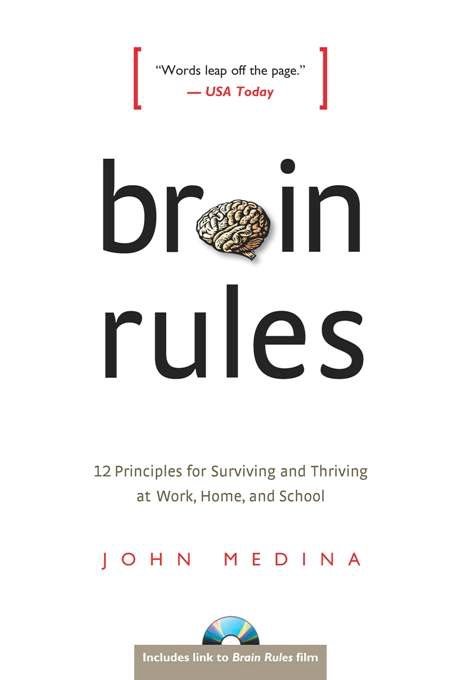
Brain Rules: 12 Principles for Surviving and Thriving at Work, Home, and School (Book & DVD)
by John Medina
Since the 10-minute rule had been known for many years, I decided the modules would last only 10 minutes. Each segment would cover a single core concept—always large, always general, always filled with “gist,” and always explainable in one minute. Each class was 50 minutes, so I could easily burn through five large concepts in a single period. If someone does not feel safe with a teacher or boss, he or she may not be able to perform as well. If a student feels misunderstood because the teacher cannot connect with the way the student learns, the student may become isolated.
Since the 10-minute rule had been known for many years, I decided the modules would last only 10 minutes. Each segment would cover a single core concept—always large, always general, always filled with “gist,” and always explainable in one minute. Each class was 50 minutes, so I could easily burn through five large concepts in a single period.
If someone does not feel safe with a teacher or boss, he or she may not be able to perform as well. If a student feels misunderstood because the teacher cannot connect with the way the student learns, the student may become isolated.
Regardless of who you are, the brain pays a great deal of attention to these questions: “Can I eat it? Will it eat me?” “Can I mate with it? Will it mate with me?” “Have I seen it before?”
The brain acts like a muscle: The more activity you do, the larger and more complex it can become. Whether that leads to more intelligence is another issue, but one fact is indisputable: What you do in life physically changes what your brain looks like. You can wire and rewire yourself with the simple choice of which musical instrument—or professional sport—you play.
Deliberately re-expose yourself to the information if you want to retrieve it later. Deliberately re-expose yourself to the information more elaborately if you want the retrieval to be of higher quality. Deliberately re-expose yourself to the information more elaborately, and in fixed, spaced intervals, if you want the retrieval to be the most vivid it can be.
"Since the 10-minute rule had been known for many years, I decided the modules would last only 10 minutes. Each segment would cover a single core concept—always large, always general, always filled with “gist,” and always explainable in one minute. Each class was 50 minutes, so I could easily burn through five large concepts in a single period."
"If someone does not feel safe with a teacher or boss, he or she may not be able to perform as well. If a student feels misunderstood because the teacher cannot connect with the way the student learns, the student may become isolated."
"Regardless of who you are, the brain pays a great deal of attention to these questions: “Can I eat it? Will it eat me?” “Can I mate with it? Will it mate with me?” “Have I seen it before?”"
"The brain acts like a muscle: The more activity you do, the larger and more complex it can become. Whether that leads to more intelligence is another issue, but one fact is indisputable: What you do in life physically changes what your brain looks like. You can wire and rewire yourself with the simple choice of which musical instrument—or professional sport—you play."
"Deliberately re-expose yourself to the information if you want to retrieve it later. Deliberately re-expose yourself to the information more elaborately if you want the retrieval to be of higher quality. Deliberately re-expose yourself to the information more elaborately, and in fixed, spaced intervals, if you want the retrieval to be the most vivid it can be."
"The Paleomammalian brain appears in you the same way it does in many mammals, such as house cats, which is how it got its name. It has more to do with your animal survival than with your human potential. Most of its functions involve what some researchers call the “four F’s”: fighting, feeding, fleeing, and … reproductive behavior."
"Recall the performance envelope: The brain appears to be designed to (1) solve problems (2) related to surviving (3) in an unstable outdoor environment, and (4) to do so in nearly constant motion. The brain adapted this way simply as a survival strategy, to help us live long enough to pass our genes on to the next generation."
- →Since the 10-minute rule had been known for many years, I decided the modules would last only 10 minutes. Each segment would cover a single core concept—always large, always general, always filled with “gist,” and always explainable in one minute. Each class was 50 minutes, so I could easily burn through five large concepts in a single period.
- →If someone does not feel safe with a teacher or boss, he or she may not be able to perform as well. If a student feels misunderstood because the teacher cannot connect with the way the student learns, the student may become isolated.
- →The Paleomammalian brain appears in you the same way it does in many mammals, such as house cats, which is how it got its name. It has more to do with your animal survival than with your human potential. Most of its functions involve what some researchers call the “four F’s”: fighting, feeding, fleeing, and … reproductive behavior.
- →Recall the performance envelope: The brain appears to be designed to (1) solve problems (2) related to surviving (3) in an unstable outdoor environment, and (4) to do so in nearly constant motion. The brain adapted this way simply as a survival strategy, to help us live long enough to pass our genes on to the next generation.
Looking for something similar?
Describe your situation. The search finds the right book from the entire library.