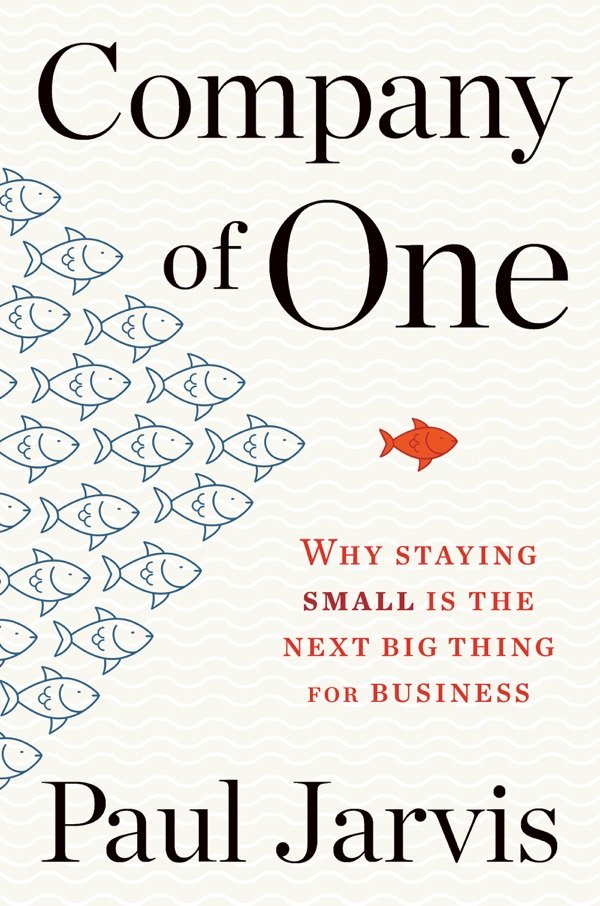
Company Of One: Why Staying Small Is the Next Big Thing for Business
by Paul Jarvis
A study done by the Startup Genome Project, which analyzed more than 3,200 high-growth tech startups, found that 74 percent of those businesses failed, not because of competition or bad business plans, but because they scaled up too quickly. In many quickly growing companies, however, leaders feel that they are required to detach from human relationships and focus on using people as resources to achieve necessary growth by any means necessary. The problem is that a leader who stops feeling what is either motivating or demotivating within their team stops being able to lead.
A study done by the Startup Genome Project, which analyzed more than 3,200 high-growth tech startups, found that 74 percent of those businesses failed, not because of competition or bad business plans, but because they scaled up too quickly.
In many quickly growing companies, however, leaders feel that they are required to detach from human relationships and focus on using people as resources to achieve necessary growth by any means necessary. The problem is that a leader who stops feeling what is either motivating or demotivating within their team stops being able to lead.
I doubled my rates over and over until the demand only slightly exceeded the time I had available to do the work. In doing so, I didn’t need to hire more people to grow profits; I just needed to focus on doing better and better work—putting in the same number of hours but vastly increasing the revenue generated from the work I did.
If you’re overvaluing your plan because it’s your plan (known as the “endowment effect”), then you should probably quit.
Do we really need to push our workers and ourselves to work longer hours to see better results? Or do we just need to get better at working the same amount or less? The value of leading a company of one is your ability to stay agile and nimble.
"A study done by the Startup Genome Project, which analyzed more than 3,200 high-growth tech startups, found that 74 percent of those businesses failed, not because of competition or bad business plans, but because they scaled up too quickly."
"In many quickly growing companies, however, leaders feel that they are required to detach from human relationships and focus on using people as resources to achieve necessary growth by any means necessary. The problem is that a leader who stops feeling what is either motivating or demotivating within their team stops being able to lead."
"I doubled my rates over and over until the demand only slightly exceeded the time I had available to do the work. In doing so, I didn’t need to hire more people to grow profits; I just needed to focus on doing better and better work—putting in the same number of hours but vastly increasing the revenue generated from the work I did."
"If you’re overvaluing your plan because it’s your plan (known as the “endowment effect”), then you should probably quit."
"Since my practically nonexistent ability to lead could easily be a detriment to my company of one, I only work with freelancers and contractors who don’t require management of any kind. They’re A-players who know exactly how to get their work done. I simply need to provide them with the parameters and let them do their work. I give the people I hire full autonomy to do their jobs so I can do mine, with no need for meetings, or check-ins, or management. I ask them to let me know if a problem comes up; if I don’t hear from them, I assume that their silence means they’re accomplishing their tasks. I let my perceived shortcomings, like being awkward or bad at managing others, work for my business, not against it. My leadership style may require that I spend more when I hire (A-players come at a premium), but their work is always worth it and nets a positive return for my business."
"Do we really need to push our workers and ourselves to work longer hours to see better results? Or do we just need to get better at working the same amount or less? The value of leading a company of one is your ability to stay agile and nimble."
"Does your company need glossy business cards if most of your connections are made online? Does it even need a printer if contracts and documents are all sent digitally? These are all examples of “nice to haves” that can come later, after your business is up and running."
- →A study done by the Startup Genome Project, which analyzed more than 3,200 high-growth tech startups, found that 74 percent of those businesses failed, not because of competition or bad business plans, but because they scaled up too quickly.
- →In many quickly growing companies, however, leaders feel that they are required to detach from human relationships and focus on using people as resources to achieve necessary growth by any means necessary. The problem is that a leader who stops feeling what is either motivating or demotivating within their team stops being able to lead.
- →I doubled my rates over and over until the demand only slightly exceeded the time I had available to do the work. In doing so, I didn’t need to hire more people to grow profits; I just needed to focus on doing better and better work—putting in the same number of hours but vastly increasing the revenue generated from the work I did.
- →If you’re overvaluing your plan because it’s your plan (known as the “endowment effect”), then you should probably quit.
Looking for something similar?
Describe your situation. The search finds the right book from the entire library.