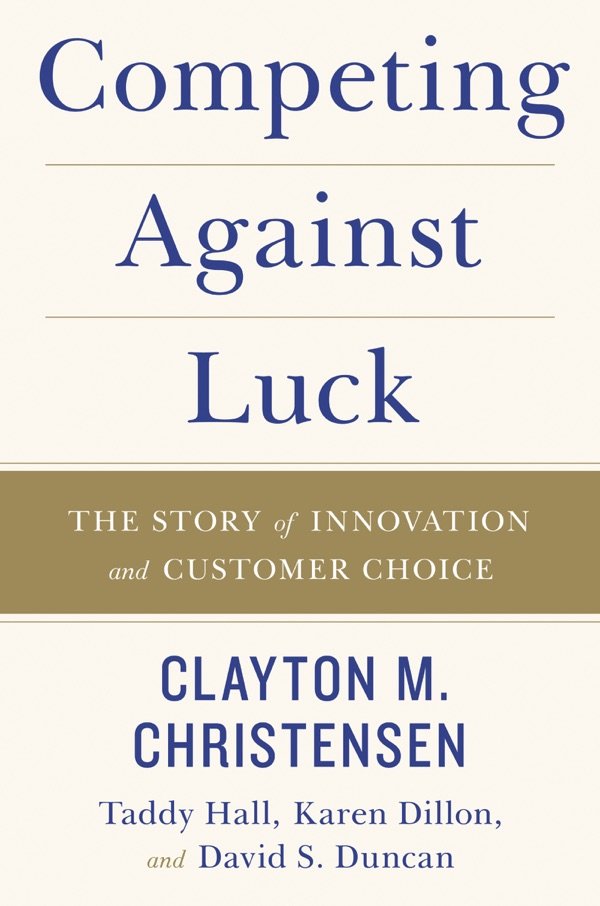
Competing Against Luck: The Story of Innovation and Customer Choice – Christensen's Jobs Theory for Startups and Business Growth
by Clayton M. Christensen
One of the fundamental mistakes that many marketers make is to collect a handful of data points from a huge sample of respondents when what they really need—and this interview illustrates—is a huge number of data points from a smaller sample size. Great innovation insights have more to do with depth than breadth. Creating the right experiences and then integrating around them to solve a job, is critical for competitive advantage. That’s because while it may be easy for competitors to copy products, it’s difficult for them to copy experiences that are well integrated into your company’s processes.
One of the fundamental mistakes that many marketers make is to collect a handful of data points from a huge sample of respondents when what they really need—and this interview illustrates—is a huge number of data points from a smaller sample size. Great innovation insights have more to do with depth than breadth.
Creating the right experiences and then integrating around them to solve a job, is critical for competitive advantage. That’s because while it may be easy for competitors to copy products, it’s difficult for them to copy experiences that are well integrated into your company’s processes.
The foundation of our thinking is the Theory of Jobs to Be Done, which focuses on deeply understanding your customers’ struggle for progress and then creating the right solution and attendant set of experiences to ensure you solve your customers’ jobs well, every time.
If a company doesn’t understand why I might choose to “hire” its product in certain circumstances—and why I might choose something else in others—its data3 about me or people like me4 is unlikely to help it create any new innovations for me.
The circumstance is fundamental to defining the job (and finding a solution for it), because the nature of the progress desired will always be strongly influenced by the circumstance.
"One of the fundamental mistakes that many marketers make is to collect a handful of data points from a huge sample of respondents when what they really need—and this interview illustrates—is a huge number of data points from a smaller sample size. Great innovation insights have more to do with depth than breadth."
"Creating the right experiences and then integrating around them to solve a job, is critical for competitive advantage. That’s because while it may be easy for competitors to copy products, it’s difficult for them to copy experiences that are well integrated into your company’s processes."
"The foundation of our thinking is the Theory of Jobs to Be Done, which focuses on deeply understanding your customers’ struggle for progress and then creating the right solution and attendant set of experiences to ensure you solve your customers’ jobs well, every time."
"If a company doesn’t understand why I might choose to “hire” its product in certain circumstances—and why I might choose something else in others—its data3 about me or people like me4 is unlikely to help it create any new innovations for me."
"The circumstance is fundamental to defining the job (and finding a solution for it), because the nature of the progress desired will always be strongly influenced by the circumstance."
"They were conceived, developed, and launched into the market with a clear understanding of how these products would help consumers make the progress they were struggling to achieve."
"For innovators, understanding the job is to understand what consumers care most about in that moment of trying to make progress."
- →One of the fundamental mistakes that many marketers make is to collect a handful of data points from a huge sample of respondents when what they really need—and this interview illustrates—is a huge number of data points from a smaller sample size. Great innovation insights have more to do with depth than breadth.
- →Creating the right experiences and then integrating around them to solve a job, is critical for competitive advantage. That’s because while it may be easy for competitors to copy products, it’s difficult for them to copy experiences that are well integrated into your company’s processes.
- →If a company doesn’t understand why I might choose to “hire” its product in certain circumstances—and why I might choose something else in others—its data3 about me or people like me4 is unlikely to help it create any new innovations for me.
- →The circumstance is fundamental to defining the job (and finding a solution for it), because the nature of the progress desired will always be strongly influenced by the circumstance.
Looking for something similar?
Describe your situation. The search finds the right book from the entire library.