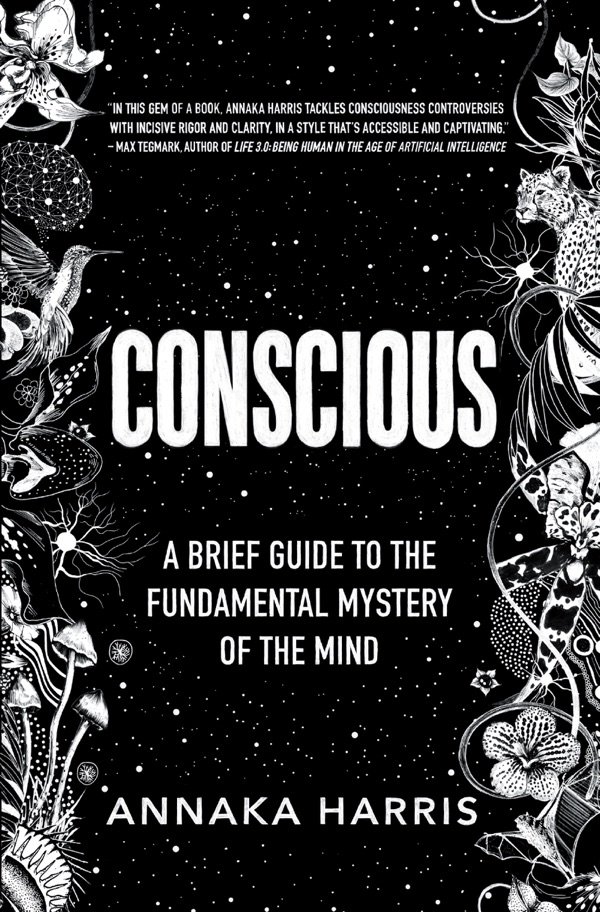
Conscious: A Brief Guide to the Fundamental Mystery of the Mind
by Annaka Harris
Even though we are talking about modifying a conscious experience, consciousness itself isn’t necessarily controlling the system; all we know is that consciousness is experiencing the system. It is no contradiction to say that consciousness is essential to ethical concerns, yet irrelevant when it comes to will. It seems clear that we can’t decide what to think or feel, any more than we can decide what to see or hear. A highly complicated convergence of factors and past events—including our genes, our personal life history, our immediate environment, and the state of our brain—is responsible for each next thought.
Even though we are talking about modifying a conscious experience, consciousness itself isn’t necessarily controlling the system; all we know is that consciousness is experiencing the system. It is no contradiction to say that consciousness is essential to ethical concerns, yet irrelevant when it comes to will.
It seems clear that we can’t decide what to think or feel, any more than we can decide what to see or hear. A highly complicated convergence of factors and past events—including our genes, our personal life history, our immediate environment, and the state of our brain—is responsible for each next thought.
Seth refers to our experiences of ourselves in the world as a kind of “controlled hallucination.” He describes the brain as a “prediction engine” and explains that “what we perceive is its best guess of what’s out there in the world.” In a sense, he says, “we predict ourselves into existence.”
The delight I experienced came from temporarily silencing a false intuition and glimpsing a deeper truth: being on the earth doesn’t separate us from the rest of the universe; indeed, we are and have always been in outer space.
The problem is that both conscious and nonconscious states seem to be compatible with any behavior, even those associated with emotion, so a behavior itself doesn’t necessarily signal the presence of consciousness.
"Even though we are talking about modifying a conscious experience, consciousness itself isn’t necessarily controlling the system; all we know is that consciousness is experiencing the system. It is no contradiction to say that consciousness is essential to ethical concerns, yet irrelevant when it comes to will."
"It seems clear that we can’t decide what to think or feel, any more than we can decide what to see or hear. A highly complicated convergence of factors and past events—including our genes, our personal life history, our immediate environment, and the state of our brain—is responsible for each next thought."
"Seth refers to our experiences of ourselves in the world as a kind of “controlled hallucination.” He describes the brain as a “prediction engine” and explains that “what we perceive is its best guess of what’s out there in the world.” In a sense, he says, “we predict ourselves into existence.”"
"The delight I experienced came from temporarily silencing a false intuition and glimpsing a deeper truth: being on the earth doesn’t separate us from the rest of the universe; indeed, we are and have always been in outer space."
"The problem is that both conscious and nonconscious states seem to be compatible with any behavior, even those associated with emotion, so a behavior itself doesn’t necessarily signal the presence of consciousness."
"An intuition is simply the powerful sense that something is true without our having an awareness or an understanding of the reasons behind this feeling—it may or may not represent something true about the world."
"We now have reason to believe that with access to certain activity inside your brain, another person can know what you’re going to do before you do."
- →The delight I experienced came from temporarily silencing a false intuition and glimpsing a deeper truth: being on the earth doesn’t separate us from the rest of the universe; indeed, we are and have always been in outer space.
- →We now have reason to believe that with access to certain activity inside your brain, another person can know what you’re going to do before you do.
Looking for something similar?
Describe your situation. The search finds the right book from the entire library.