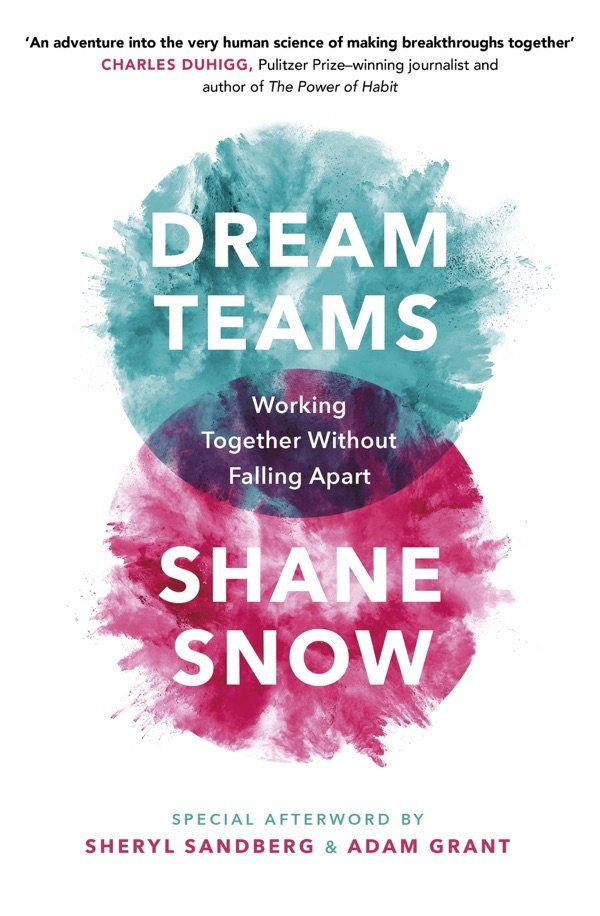
Dream Teams: Working Together Without Falling Apart
by Shane Snow
We shout only 74 percent as loud in a group of six as we do alone, even when we think we’re shouting our loudest. Businesses that rank high in “innovation”—the ones that grow quickly and produce game-changing products and services—tend to encourage the airing and clashing of diverse viewpoints. Not just having differences, but speaking up.
We shout only 74 percent as loud in a group of six as we do alone, even when we think we’re shouting our loudest.
Businesses that rank high in “innovation”—the ones that grow quickly and produce game-changing products and services—tend to encourage the airing and clashing of diverse viewpoints. Not just having differences, but speaking up.
So far in Dream Teams, we’ve seen that extraordinary collaborations are powered by differences, and that breakthrough progress is the product of cognitive friction. But as we talked about in the last chapter, groups often fail to reach their potential because friction tends to make people nervous.
People get cognitive entrenchment the longer they work on the same things in the same ways—and especially when those ways work. Research shows us that the longer people work together, the more similar their work styles tend to become. We may start out different, but the more time we spend together, the more we start speaking, behaving, and even dressing similarly.
“Because of cognitive entrenchment, experts may be restricted in their ability to identify optimal solutions to problems, to adapt to novel situations, and to generate radically creative ideas within their domain.”
"We shout only 74 percent as loud in a group of six as we do alone, even when we think we’re shouting our loudest."
"Businesses that rank high in “innovation”—the ones that grow quickly and produce game-changing products and services—tend to encourage the airing and clashing of diverse viewpoints. Not just having differences, but speaking up."
"So far in Dream Teams, we’ve seen that extraordinary collaborations are powered by differences, and that breakthrough progress is the product of cognitive friction. But as we talked about in the last chapter, groups often fail to reach their potential because friction tends to make people nervous."
"People get cognitive entrenchment the longer they work on the same things in the same ways—and especially when those ways work. Research shows us that the longer people work together, the more similar their work styles tend to become. We may start out different, but the more time we spend together, the more we start speaking, behaving, and even dressing similarly."
"“Because of cognitive entrenchment, experts may be restricted in their ability to identify optimal solutions to problems, to adapt to novel situations, and to generate radically creative ideas within their domain.”"
"Millar’s tactic—bringing in extreme people to focus groups instead of average ones—is a clever way to get cognitive diversity. If we return to Problem Mountain, a dominatrix or Special Forces soldier is someone who looks at the problem of blisters like this:"
"“Curiosity in a way [is] where some situation presents itself to you and it just doesn’t make any sense,”"
- →We shout only 74 percent as loud in a group of six as we do alone, even when we think we’re shouting our loudest.
- →So far in Dream Teams, we’ve seen that extraordinary collaborations are powered by differences, and that breakthrough progress is the product of cognitive friction. But as we talked about in the last chapter, groups often fail to reach their potential because friction tends to make people nervous.
- →“Because of cognitive entrenchment, experts may be restricted in their ability to identify optimal solutions to problems, to adapt to novel situations, and to generate radically creative ideas within their domain.”
- →Millar’s tactic—bringing in extreme people to focus groups instead of average ones—is a clever way to get cognitive diversity. If we return to Problem Mountain, a dominatrix or Special Forces soldier is someone who looks at the problem of blisters like this:
Looking for something similar?
Describe your situation. The search finds the right book from the entire library.