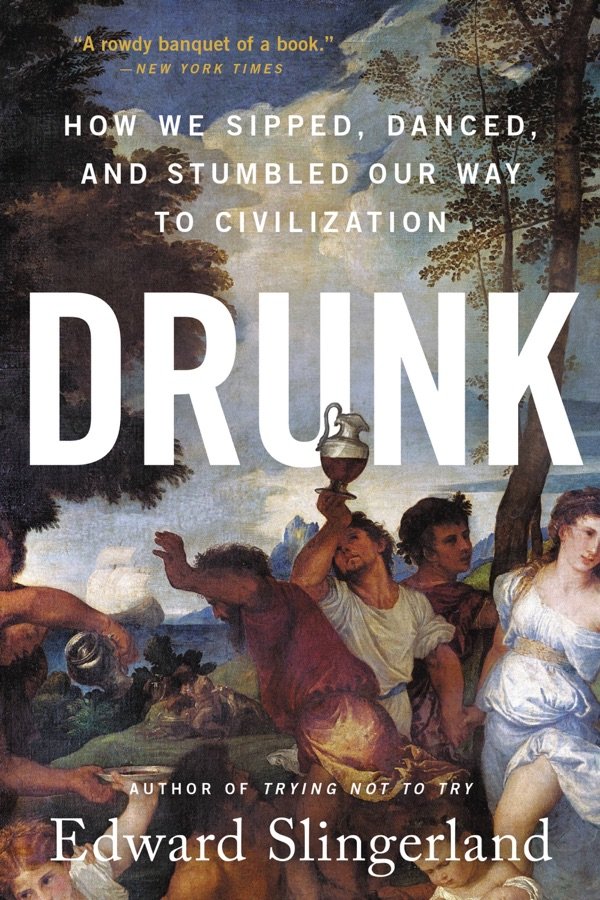
Drunk: How We Sipped, Danced, and Stumbled Our Way to Civilization
by Edward Slingerland
This book argues that, far from being an evolutionary mistake, chemical intoxication helps solve a number of distinctively human challenges: enhancing creativity, alleviating stress, building trust, and pulling off the miracle of getting fiercely tribal primates to cooperate with strangers. The desire to get drunk, along with the individual and social benefits provided by drunkenness, played a crucial role in sparking the rise of the first large-scale societies. We could not have civilization without intoxication. In fact, archaeologists have begun to suggest that various forms of alcohol were not merely a by-product of the invention of agriculture, but actually a motivation for it—that the first farmers were driven by a desire for beer, not bread.
In fact, archaeologists have begun to suggest that various forms of alcohol were not merely a by-product of the invention of agriculture, but actually a motivation for it—that the first farmers were driven by a desire for beer, not bread.
As innocuous as a mild social high might seem, it is already undermining the capacity that arguably makes us human: our ability to consciously govern our own behavior, stay focused on task, and maintain a clear sense of self.
My central argument is that getting drunk, high, or otherwise cognitively altered must have, over evolutionary time, helped individuals to survive and flourish, and cultures to endure and expand.
It should puzzle us more than it does that one of the greatest foci of human ingenuity and concentrated effort over the past millennia has been the problem of how to get drunk.
Humans are powerful in groups precisely because we are weak as individuals, pathetically eager to connect with one another, and utterly dependent on the group for survival.
"This book argues that, far from being an evolutionary mistake, chemical intoxication helps solve a number of distinctively human challenges: enhancing creativity, alleviating stress, building trust, and pulling off the miracle of getting fiercely tribal primates to cooperate with strangers. The desire to get drunk, along with the individual and social benefits provided by drunkenness, played a crucial role in sparking the rise of the first large-scale societies. We could not have civilization without intoxication."
"In fact, archaeologists have begun to suggest that various forms of alcohol were not merely a by-product of the invention of agriculture, but actually a motivation for it—that the first farmers were driven by a desire for beer, not bread."
"As innocuous as a mild social high might seem, it is already undermining the capacity that arguably makes us human: our ability to consciously govern our own behavior, stay focused on task, and maintain a clear sense of self."
"My central argument is that getting drunk, high, or otherwise cognitively altered must have, over evolutionary time, helped individuals to survive and flourish, and cultures to endure and expand."
"It should puzzle us more than it does that one of the greatest foci of human ingenuity and concentrated effort over the past millennia has been the problem of how to get drunk."
"Humans are powerful in groups precisely because we are weak as individuals, pathetically eager to connect with one another, and utterly dependent on the group for survival."
"This is why it’s not a bad idea to drink when you have sushi: Washing down the raw fish with sake might help kill any nasty bugs that came along for the ride."
- →Humans are powerful in groups precisely because we are weak as individuals, pathetically eager to connect with one another, and utterly dependent on the group for survival.
Looking for something similar?
Describe your situation. The search finds the right book from the entire library.