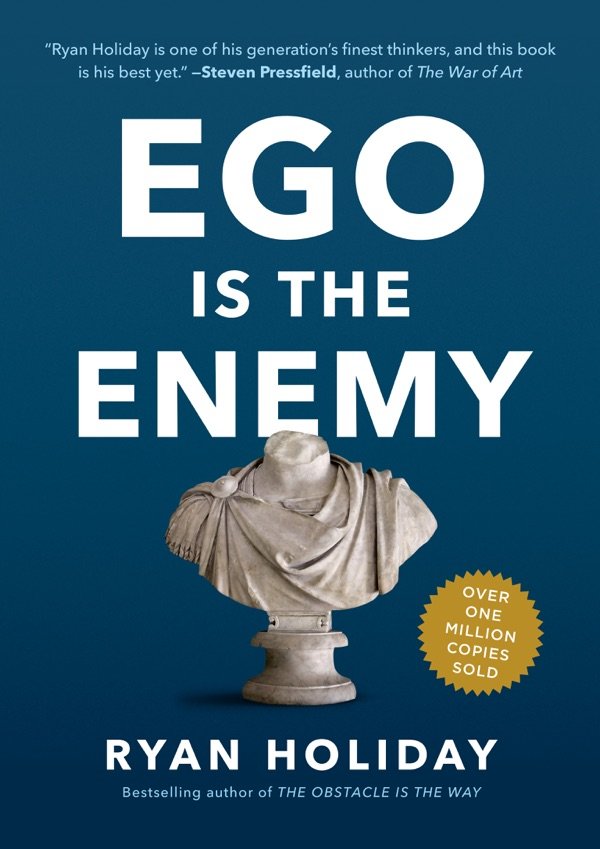
Ego Is the Enemy
by Ryan Holiday
Living clearly and presently takes courage. Don’t live in the haze of the abstract, live with the tangible and real, even if—especially if—it’s uncomfortable. Be part of what’s going on around you. Feast on it, adjust for it. There’s no one to perform for. There is just work to be done and lessons to be learned, in all that is around us. Just one thing keeps ego around—comfort. Pursuing great work—whether it is in sports or art or business—is often terrifying. Ego soothes that fear. It’s a salve to that insecurity. Replacing the rational and aware parts of our psyche with bluster and self-absorption, ego tells us what we want to hear, when we want to hear it. But it is a short-term fix with a long-term consequence.
Living clearly and presently takes courage. Don’t live in the haze of the abstract, live with the tangible and real, even if—especially if—it’s uncomfortable. Be part of what’s going on around you. Feast on it, adjust for it. There’s no one to perform for. There is just work to be done and lessons to be learned, in all that is around us.
Just one thing keeps ego around—comfort. Pursuing great work—whether it is in sports or art or business—is often terrifying. Ego soothes that fear. It’s a salve to that insecurity. Replacing the rational and aware parts of our psyche with bluster and self-absorption, ego tells us what we want to hear, when we want to hear it. But it is a short-term fix with a long-term consequence.
The only relationship between work and chatter is that one kills the other.
Ego needs honors in order to be validated. Confidence, on the other hand, is able to wait and focus on the task at hand regardless of external recognition.
This is characteristic of how great people think. It’s not that they find failure in every success. They just hold themselves to a standard that exceeds what society might consider to be objective success. Because of that, they don’t much care what other people think; they care whether they meet their own standards. And these standards are much, much higher than everyone else’s.
"Living clearly and presently takes courage. Don’t live in the haze of the abstract, live with the tangible and real, even if—especially if—it’s uncomfortable. Be part of what’s going on around you. Feast on it, adjust for it. There’s no one to perform for. There is just work to be done and lessons to be learned, in all that is around us."
"Just one thing keeps ego around—comfort. Pursuing great work—whether it is in sports or art or business—is often terrifying. Ego soothes that fear. It’s a salve to that insecurity. Replacing the rational and aware parts of our psyche with bluster and self-absorption, ego tells us what we want to hear, when we want to hear it. But it is a short-term fix with a long-term consequence."
"Be lesser, do more. Imagine if for every person you met, you thought of some way to help them, something you could do for them? And you looked at it in a way that entirely benefited them and not you. The cumulative effect this would have over time would be profound: You’d learn a great deal by solving diverse problems. You’d develop a reputation for being indispensable. You’d have countless new relationships. You’d have an enormous bank of favors to call upon down the road."
"The only relationship between work and chatter is that one kills the other."
"Ego needs honors in order to be validated. Confidence, on the other hand, is able to wait and focus on the task at hand regardless of external recognition."
"This is not a harmless conceit. The physicist John Wheeler, who helped develop the hydrogen bomb, once observed that “as our island of knowledge grows, so does the shore of our ignorance.” In other words, each victory and advancement that made Khan smarter also bumped him against new situations he’d never encountered before. It takes a special kind of humility to grasp that you know less, even as you know and grasp more and more. It’s remembering Socrates’ wisdom lay in the fact that he knew that he knew next to nothing."
"This is characteristic of how great people think. It’s not that they find failure in every success. They just hold themselves to a standard that exceeds what society might consider to be objective success. Because of that, they don’t much care what other people think; they care whether they meet their own standards. And these standards are much, much higher than everyone else’s."
- →Ego needs honors in order to be validated. Confidence, on the other hand, is able to wait and focus on the task at hand regardless of external recognition.
- →Passion typically masks a weakness. Its breathlessness and impetuousness and franticness are poor substitutes for discipline, for mastery, for strength and purpose and perseverance. You need to be able to spot this in others and in yourself, because while the origins of passion may be earnest and good, its effects are comical and then monstrous.
- →According to Greene, there are two types of time in our lives: dead time, when people are passive and waiting, and alive time, when people are learning and acting and utilizing every second. Every moment of failure, every moment or situation that we did not deliberately choose or control, presents this choice: Alive time.
- →Pride blunts the very instrument we need to own in order to succeed: our mind. Our ability to learn, to adapt, to be flexible, to build relationships, all of this is dulled by pride.
Looking for something similar?
Describe your situation. The search finds the right book from the entire library.