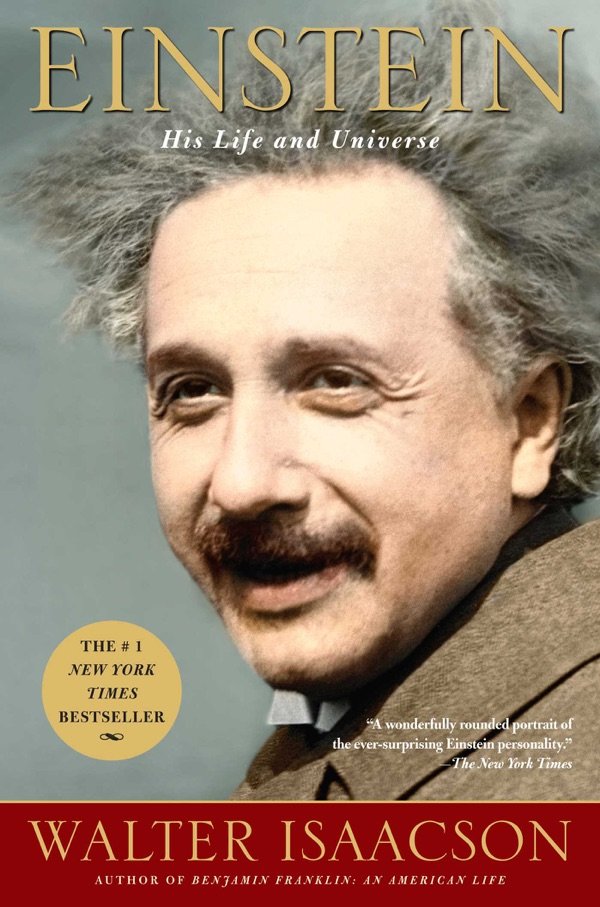
Einstein: His Life and Universe
by Walter Isaacson
There was a simple set of formulas that defined Einstein’s outlook. Creativity required being willing not to conform. That required nurturing free minds and free spirits, which in turn required “a spirit of tolerance.” And the underpinning of tolerance was humility—the belief that no one had the right to impose ideas and beliefs on others. Music continued to beguile Einstein. It was not so much an escape as it was a connection: to the harmony underlying the universe, to the creative genius of the great composers, and to other people who felt comfortable bonding with more than just words. He was awed, both in music and in physics, by the beauty of harmonies.
There was a simple set of formulas that defined Einstein’s outlook. Creativity required being willing not to conform. That required nurturing free minds and free spirits, which in turn required “a spirit of tolerance.” And the underpinning of tolerance was humility—the belief that no one had the right to impose ideas and beliefs on others.
Music continued to beguile Einstein. It was not so much an escape as it was a connection: to the harmony underlying the universe, to the creative genius of the great composers, and to other people who felt comfortable bonding with more than just words. He was awed, both in music and in physics, by the beauty of harmonies.
He was a loner with an intimate bond to humanity, a rebel who was suffused with reverence. And thus it was that an imaginative, impertinent patent clerk became the mind reader of the creator of the cosmos, the locksmith of the mysteries of the atom and the universe.
The explanation that Einstein himself most often gave for his mental accomplishments was his curiosity. As he put it near the end of his life, “I have no special talents, I am only passionately curious.”
A society’s competitive advantage will come not from how well its schools teach the multiplication and periodic tables, but from how well they stimulate imagination and creativity.
"There was a simple set of formulas that defined Einstein’s outlook. Creativity required being willing not to conform. That required nurturing free minds and free spirits, which in turn required “a spirit of tolerance.” And the underpinning of tolerance was humility—the belief that no one had the right to impose ideas and beliefs on others."
"Music continued to beguile Einstein. It was not so much an escape as it was a connection: to the harmony underlying the universe, to the creative genius of the great composers, and to other people who felt comfortable bonding with more than just words. He was awed, both in music and in physics, by the beauty of harmonies."
"He was a loner with an intimate bond to humanity, a rebel who was suffused with reverence. And thus it was that an imaginative, impertinent patent clerk became the mind reader of the creator of the cosmos, the locksmith of the mysteries of the atom and the universe."
"The explanation that Einstein himself most often gave for his mental accomplishments was his curiosity. As he put it near the end of his life, “I have no special talents, I am only passionately curious.”"
"A society’s competitive advantage will come not from how well its schools teach the multiplication and periodic tables, but from how well they stimulate imagination and creativity."
"“A new idea comes suddenly and in a rather intuitive way,” Einstein once said. “But,” he hastened to add, “intuition is nothing but the outcome of earlier intellectual experience.”"
"His success came from questioning conventional wisdom, challenging authority, and marveling at mysteries that struck others as mundane."
Looking for something similar?
Describe your situation. The search finds the right book from the entire library.