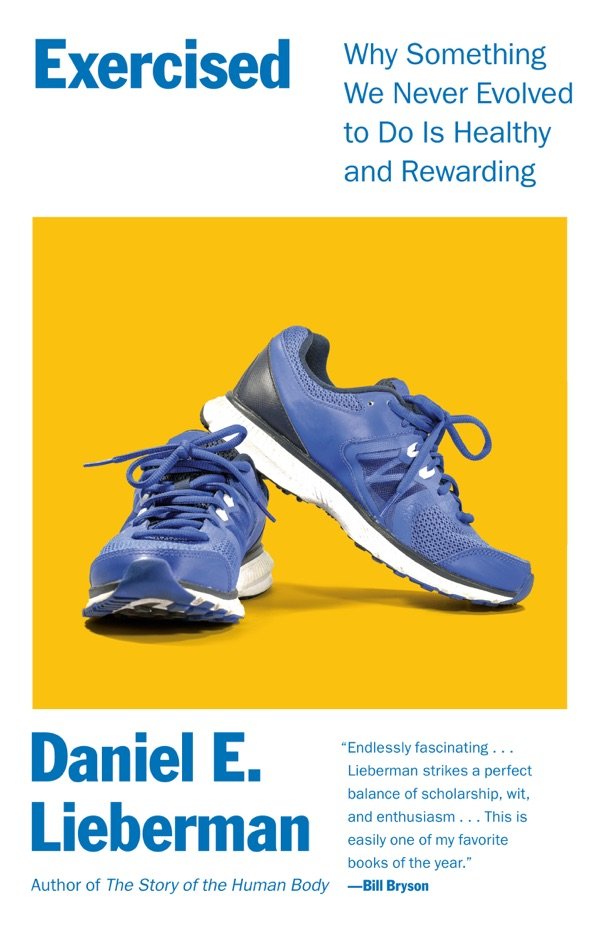
Exercised: Why Something We Never Evolved to Do Is Healthy and Rewarding
by Daniel E. Lieberman
When my colleague Dr. Aaron Baggish attached accelerometers (tiny devices, like Fitbits, that measure steps per day) to more than twenty Tarahumara men, he discovered they walked on average ten miles a day. In other words, the training that enables them to run back-to-back marathons is the physical work that is part and parcel of their everyday life. The problem, of course, is that physical activity helps slow aging and promotes fitness and health. So those of us who no longer engage in physical labor to survive must now weirdly choose to engage in unnecessary physical activity for the sake of health and fitness. In other words, exercise.
When my colleague Dr. Aaron Baggish attached accelerometers (tiny devices, like Fitbits, that measure steps per day) to more than twenty Tarahumara men, he discovered they walked on average ten miles a day. In other words, the training that enables them to run back-to-back marathons is the physical work that is part and parcel of their everyday life.
The problem, of course, is that physical activity helps slow aging and promotes fitness and health. So those of us who no longer engage in physical labor to survive must now weirdly choose to engage in unnecessary physical activity for the sake of health and fitness. In other words, exercise.
If you weigh 180 pounds, your DEE is probably about twenty-seven hundred calories a day. Because we already learned your RMR is about seventeen hundred calories a day, that means nearly two-thirds (63 percent) of the energy you expend each day is spent just on your resting metabolism.
According to a 2018 survey of millions of Americans, about half of adults and nearly three-quarters of teenagers report they don’t reach the base level of 150 minutes of physical activity per week, and less than one-third report they exercise in their leisure time.
The key lesson to digest from the starving men’s dramatically lower resting metabolic rates is that human resting metabolisms are flexible. Most critically, resting metabolism is what the body has opted to spend on maintenance, not what it needs to spend.
"When my colleague Dr. Aaron Baggish attached accelerometers (tiny devices, like Fitbits, that measure steps per day) to more than twenty Tarahumara men, he discovered they walked on average ten miles a day. In other words, the training that enables them to run back-to-back marathons is the physical work that is part and parcel of their everyday life."
"The problem, of course, is that physical activity helps slow aging and promotes fitness and health. So those of us who no longer engage in physical labor to survive must now weirdly choose to engage in unnecessary physical activity for the sake of health and fitness. In other words, exercise."
"If you weigh 180 pounds, your DEE is probably about twenty-seven hundred calories a day. Because we already learned your RMR is about seventeen hundred calories a day, that means nearly two-thirds (63 percent) of the energy you expend each day is spent just on your resting metabolism."
"According to a 2018 survey of millions of Americans, about half of adults and nearly three-quarters of teenagers report they don’t reach the base level of 150 minutes of physical activity per week, and less than one-third report they exercise in their leisure time."
"The key lesson to digest from the starving men’s dramatically lower resting metabolic rates is that human resting metabolisms are flexible. Most critically, resting metabolism is what the body has opted to spend on maintenance, not what it needs to spend."
"The premise of this book is that evolutionary and anthropological perspectives can help us better understand the paradox of exercise—that is, why and how something we never evolved to do is so healthy."
"As I grumbled about how much money, time, and effort we had wasted getting a treadmill to Pemja, it struck me how these machines encapsulate the main theme of this book: we never evolved to exercise."
- →The problem, of course, is that physical activity helps slow aging and promotes fitness and health. So those of us who no longer engage in physical labor to survive must now weirdly choose to engage in unnecessary physical activity for the sake of health and fitness. In other words, exercise.
- →If you weigh 180 pounds, your DEE is probably about twenty-seven hundred calories a day. Because we already learned your RMR is about seventeen hundred calories a day, that means nearly two-thirds (63 percent) of the energy you expend each day is spent just on your resting metabolism.
- →The premise of this book is that evolutionary and anthropological perspectives can help us better understand the paradox of exercise—that is, why and how something we never evolved to do is so healthy.
- →As I grumbled about how much money, time, and effort we had wasted getting a treadmill to Pemja, it struck me how these machines encapsulate the main theme of this book: we never evolved to exercise.
Looking for something similar?
Describe your situation. The search finds the right book from the entire library.