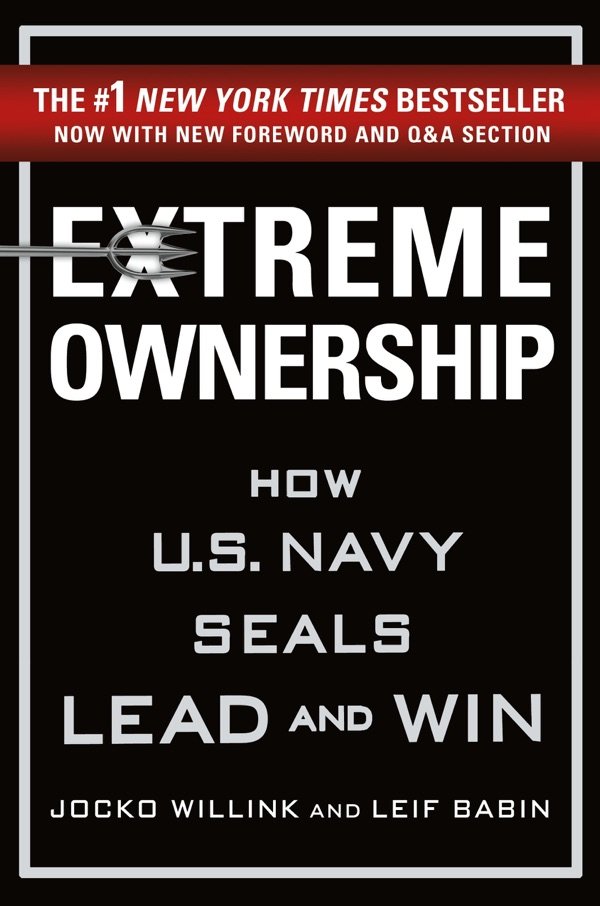
Extreme Ownership: How U.S. Navy SEALs Lead and Win
by Jocko Willink
The best-performing SEAL units had leaders who accepted responsibility for everything. Every mistake, every failure or shortfall—those leaders would own it. During the debrief after a training mission, those good SEAL leaders took ownership of failures, sought guidance on how to improve, and figured out a way to overcome challenges on the next iteration. The best leaders checked their egos, accepted blame, sought out constructive criticism, and took detailed notes for improvement. PRINCIPLE: LEADING UP THE CHAIN If your boss isn’t making a decision in a timely manner or providing necessary support for you and your team, don’t blame the boss. First, blame yourself. Examine what you can do to better convey the critical information for decisions to be made and support allocated.
PRINCIPLE: LEADING UP THE CHAIN If your boss isn’t making a decision in a timely manner or providing necessary support for you and your team, don’t blame the boss. First, blame yourself. Examine what you can do to better convey the critical information for decisions to be made and support allocated.
The greatest of these was the recognition that leadership is the most important factor on the battlefield, the single greatest reason behind the success of any team.
As a leader employing Extreme Ownership, if your team isn’t doing what you need them to do, you first have to look at yourself. Rather than blame them for not seeing the strategic picture, you must figure out a way to better communicate it to them in terms that are simple, clear, and concise, so that they understand. This is what leading down the chain of command is all about.
“The SEAL Teams and the U.S. military, much like militaries throughout history, are based around building blocks of four-to-six-man teams with a leader. We call them ‘fire teams.’ That is the ideal number for a leader to lead. Beyond that, any leader can lose control as soon as even minimal pressure is applied to the team when inevitable challenges arise.”
On the battlefield, countless problems compound in a snowball effect, every challenge complex in its own right, each demanding attention. But a leader must remain calm and make the best decisions possible. To do this, SEAL combat leaders utilize Prioritize and Execute. We verbalize this principle with this direction: “Relax, look around, make a call.”
"The best-performing SEAL units had leaders who accepted responsibility for everything. Every mistake, every failure or shortfall—those leaders would own it. During the debrief after a training mission, those good SEAL leaders took ownership of failures, sought guidance on how to improve, and figured out a way to overcome challenges on the next iteration. The best leaders checked their egos, accepted blame, sought out constructive criticism, and took detailed notes for improvement."
"PRINCIPLE: LEADING UP THE CHAIN If your boss isn’t making a decision in a timely manner or providing necessary support for you and your team, don’t blame the boss. First, blame yourself. Examine what you can do to better convey the critical information for decisions to be made and support allocated."
"To implement Prioritize and Execute in any business, team, or organization, a leader must: • evaluate the highest priority problem. • lay out in simple, clear, and concise terms the highest priority effort for your team. • develop and determine a solution, seek input from key leaders and from the team where possible. • direct the execution of that solution, focusing all efforts and resources toward this priority task. • move on to the next highest priority problem. • when priorities shift within the team, pass situational awareness both up and down the chain. • don’t let the focus on one priority cause target fixation. Maintain the ability to see other problems developing and rapidly shift as needed."
"The greatest of these was the recognition that leadership is the most important factor on the battlefield, the single greatest reason behind the success of any team."
"To implement Prioritize and Execute in any business, team, or organization, a leader must: • evaluate the highest priority problem. • lay out in simple, clear, and concise terms the highest priority effort for your team. • develop and determine a solution, seek input from key leaders and from the team where possible. • direct the execution of that solution, focusing all efforts and resources toward this priority task. • move on to the next highest priority problem. • when priorities shift within the team, pass situational awareness both up and down the chain. • don’t let the focus on one priority cause target fixation. Maintain the ability to see other problems developing and rapidly shift as needed."
"How is it possible that switching a single individual—only the leader—had completely turned around the performance of an entire group? The answer: leadership is the single greatest factor in any team’s performance. Whether a team succeeds or fails is all up to the leader. The leader’s attitude sets the tone for the entire team. The leader drives performance—or doesn’t. And this applies not just to the most senior leader of an overall team, but to the junior leaders of teams within the team."
"A leader must be calm but not robotic. It is normal—and necessary—to show emotion. The team must understand that their leader cares about them and their well-being. But, a leader must control his or her emotions. If not, how can they expect to control anything else? Leaders who lose their temper also lose respect. But, at the same time, to never show any sense of anger, sadness, or frustration would make that leader appear void of any emotion at all—a robot. People do not follow robots."
- →PRINCIPLE: LEADING UP THE CHAIN If your boss isn’t making a decision in a timely manner or providing necessary support for you and your team, don’t blame the boss. First, blame yourself. Examine what you can do to better convey the critical information for decisions to be made and support allocated.
- →Leaders should never be satisfied. They must always strive to improve, and they must build that mind-set into the team. They must face the facts through a realistic, brutally honest assessment of themselves and their team’s performance. Identifying weaknesses, good leaders seek to strengthen them and come up with a plan to overcome challenges.
- →The only meaningful measure for a leader is whether the team succeeds or fails. For all the definitions, descriptions, and characterizations of leaders, there are only two that matter: effective and ineffective. Effective leaders lead successful teams that accomplish their mission and win. Ineffective leaders do not.
- →If your boss isn’t making a decision in a timely manner or providing necessary support for you and your team, don’t blame the boss. First, blame yourself. Examine what you can do to better convey the critical information for decisions to be made and support allocated.
Looking for something similar?
Describe your situation. The search finds the right book from the entire library.