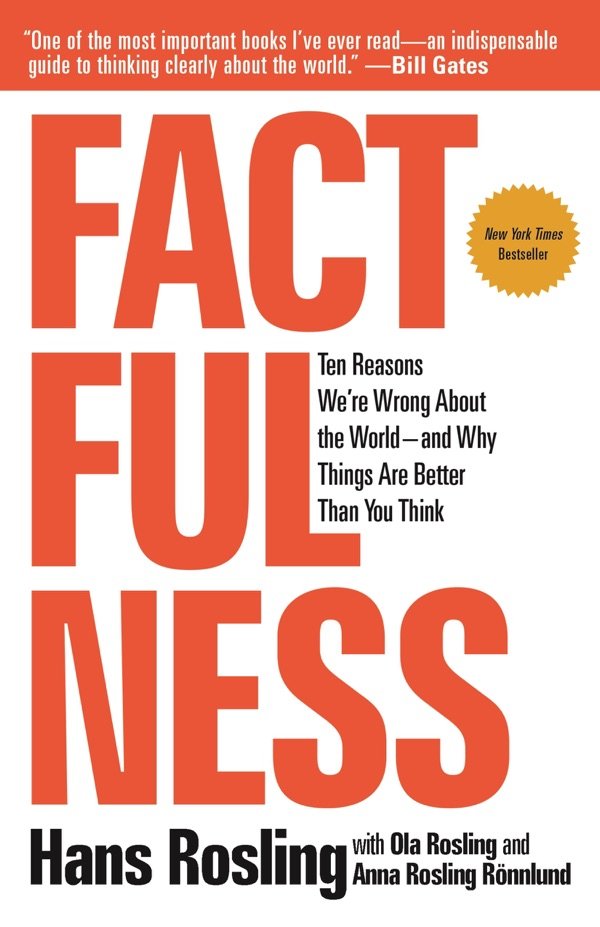
Factfulness: Ten Reasons We're Wrong About the World – and Why Things Are Better Than You Think
by Hans Rosling
Factfulness is … recognizing when a story talks about a gap, and remembering that this paints a picture of two separate groups, with a gap in between. The reality is often not polarized at all. Usually the majority is right there in the middle, where the gap is supposed to be. To control the gap instinct, look for the majority. Your most important challenge in developing a fact-based worldview is to realize that most of your firsthand experiences are from Level 4; and that your secondhand experiences are filtered through the mass media, which loves nonrepresentative extraordinary events and shuns normality.
Factfulness is … recognizing when a story talks about a gap, and remembering that this paints a picture of two separate groups, with a gap in between. The reality is often not polarized at all. Usually the majority is right there in the middle, where the gap is supposed to be. To control the gap instinct, look for the majority.
Your most important challenge in developing a fact-based worldview is to realize that most of your firsthand experiences are from Level 4; and that your secondhand experiences are filtered through the mass media, which loves nonrepresentative extraordinary events and shuns normality.
Step-by-step, year-by-year, the world is improving. Not on every single measure every single year, but as a rule. Though the world faces huge challenges, we have made tremendous progress. This is the fact-based worldview.
To control the destiny instinct, don’t confuse slow change with no change. Don’t dismiss an annual change—even an annual change of only 1 percent—because it seems too small and slow.
Yet here’s the paradox: the image of a dangerous world has never been broadcast more effectively than it is now, while the world has never been less violent and more safe.
"Factfulness is … recognizing when a story talks about a gap, and remembering that this paints a picture of two separate groups, with a gap in between. The reality is often not polarized at all. Usually the majority is right there in the middle, where the gap is supposed to be. To control the gap instinct, look for the majority."
"Your most important challenge in developing a fact-based worldview is to realize that most of your firsthand experiences are from Level 4; and that your secondhand experiences are filtered through the mass media, which loves nonrepresentative extraordinary events and shuns normality."
"Step-by-step, year-by-year, the world is improving. Not on every single measure every single year, but as a rule. Though the world faces huge challenges, we have made tremendous progress. This is the fact-based worldview."
"To control the destiny instinct, don’t confuse slow change with no change. Don’t dismiss an annual change—even an annual change of only 1 percent—because it seems too small and slow."
"Yet here’s the paradox: the image of a dangerous world has never been broadcast more effectively than it is now, while the world has never been less violent and more safe."
"This is data as you have never known it: it is data as therapy. It is understanding as a source of mental peace. Because the world is not as dramatic as it seems."
"Every group of people I ask thinks the world is more frightening, more violent, and more hopeless—in short, more dramatic—than it really is."
- →To control the destiny instinct, don’t confuse slow change with no change. Don’t dismiss an annual change—even an annual change of only 1 percent—because it seems too small and slow.
- →Yet here’s the paradox: the image of a dangerous world has never been broadcast more effectively than it is now, while the world has never been less violent and more safe.
- →This is data as you have never known it: it is data as therapy. It is understanding as a source of mental peace. Because the world is not as dramatic as it seems.
- →This is because illusions don’t happen in our eyes, they happen in our brains.
Looking for something similar?
Describe your situation. The search finds the right book from the entire library.