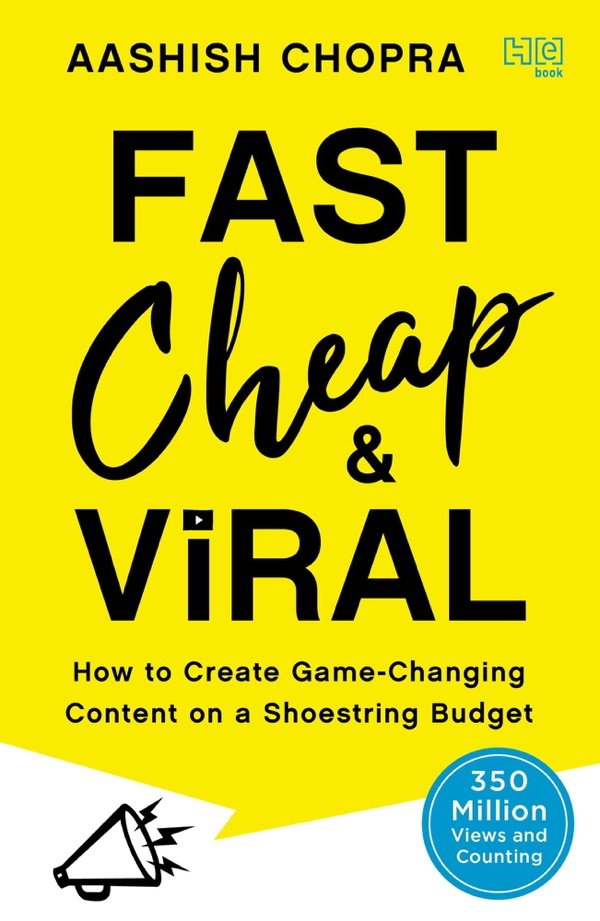
Fast, Cheap and Viral: How to Create Game-Changing Content on a Shoestring Budget
by Aashish Chopra
The head of marketing of an e-commerce brand recently asked me at an event, ‘People don’t trust us. How do we make them trust us?’ Well, why would anyone trust you, I asked. Invest in their happiness and well-being, do something for them, before there’s an expectation of users doing anything for you. The content you create must make users’ lives better and then, my friend, you have a chance at gaining their trust. ‘Operate like a movie studio, doing 10 experiments, in hopes that two will work.’
‘Operate like a movie studio, doing 10 experiments, in hopes that two will work.’
It’s about breaking down the story into three steps – C.A.R. C for context or conflict, A for action, and R for resolution You can explain any movie with this concept. There’s a character who faces conflict, or we set the character in a particular context. Then the character takes action to solve that conflict or deal with the situation. The ending is the resolution; the win at the finish.
than 100K people shared it and the Railway Minister of India wrote a poem about it! Google ‘Ixigo Ghar Wali Baat’; it’s a video about train travel in India.
Today, you cannot even expect your own team members, co-workers or employees to share your content on social media. You must earn that share.
I is for Inspirational content, U is for Useful, C is for Celebrating their life, T is for Topical content, and C is for Change the world.
"The head of marketing of an e-commerce brand recently asked me at an event, ‘People don’t trust us. How do we make them trust us?’ Well, why would anyone trust you, I asked. Invest in their happiness and well-being, do something for them, before there’s an expectation of users doing anything for you. The content you create must make users’ lives better and then, my friend, you have a chance at gaining their trust."
"‘Operate like a movie studio, doing 10 experiments, in hopes that two will work.’"
"Case in point, a video for a restaurant in Hyderabad was just about Hyderabadi dishes to try before you die. That video got 5000 shares across the city and increased footfall by 70 per cent in a week. A friend, who runs a start-up dealing with the buying and selling of cars, started creating content around the fanciest cars and bikes in the world; a wedding planner I met at an event had a light-bulb moment when he discovered he could showcase the most lavish weddings in fast-moving videos. Not just that, a founder of a plus-sized clothing brand soon learnt she could showcase the style of plus-sized celebrities; an app for young parents came up with the idea of showing how successful parents balance work and life; an accounting firm I knew of, came up with ideas for content around the biggest mergers in history and how they happened, and so on."
"Creativity can also be in curation, not necessarily creation. You could make a list of, say, 10 things which could help your users, and visualize that as a fun, entertaining video. All you would need for that is to research on Google, make a list of points, then create a list of shots you will need and stitch them together. When you do this 20 times, you get better at researching, finding new ideas and visually representing it in a video."
"The content must not be about your products or services, but about the people who would use those products or services. Not about a hotel in Goa, but challenges of people who go to Goa. Not about your automobile brand, but about people who use cars. Not about your bank, but about people who struggle with personal finance. Not about your cosmetics brand, but about people who care about beauty and wellness. Not about your restaurant, but about people who love food. You get the drift. ‘The content must not be about your products or services, but about the people who would use those products or services.’"
"It’s about breaking down the story into three steps – C.A.R. C for context or conflict, A for action, and R for resolution You can explain any movie with this concept. There’s a character who faces conflict, or we set the character in a particular context. Then the character takes action to solve that conflict or deal with the situation. The ending is the resolution; the win at the finish."
"than 100K people shared it and the Railway Minister of India wrote a poem about it! Google ‘Ixigo Ghar Wali Baat’; it’s a video about train travel in India."
Looking for something similar?
Describe your situation. The search finds the right book from the entire library.