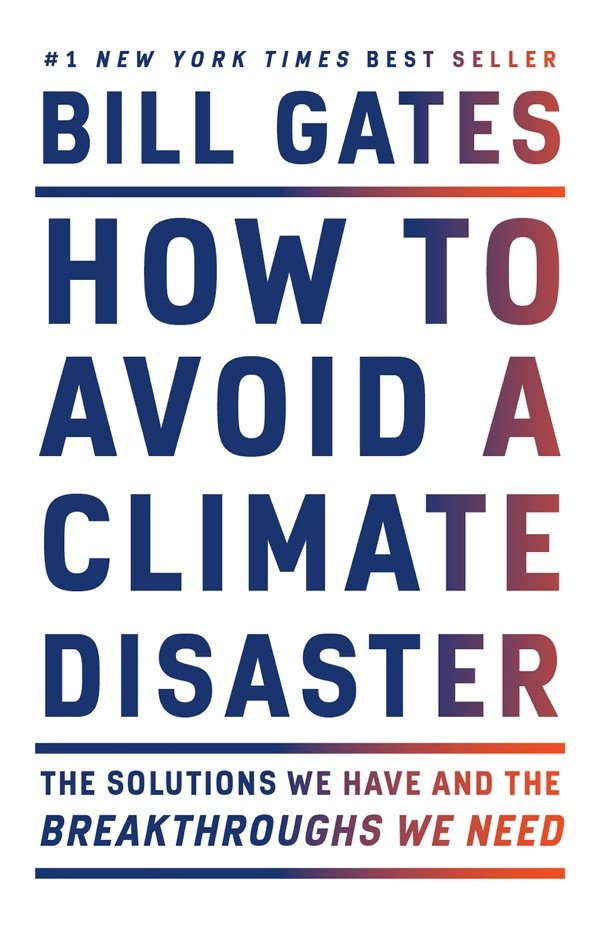
How to Avoid a Climate Disaster: The Solutions We Have and the Breakthroughs We Need
by Bill Gates
Nearly nine million acre of old-growth forest were destroyed in 2018 alone, and whenas in likely–we hit 2 degrees Celsius of warming, most of the coral reefs in the world will die off. On the other hand, restoring ecosystems has a huge payoff. Water utilities in the world's largest cities could save $890 million a year by restoring forests and watersheds. Many countries are already leading the way: In Niger, one local reforestation effort led by farmers has boosted crop yields, increased tree cover, and cut the amount of time women spend gathering firewood from three hours a day to 30 minutes. China has identified about a quarter of its landmass as critical natural assets where it'll make a priority of promoting conservation and preserving the ecosystem. Mexico is protecting a third of its river basins to preserve the water supply for 45 million people. I spend a lot of time with people who oversee the foreign aid budgets in rich-world countries. Even some very well-intentioned ones have told me, "We used to fund vaccines. Now we need to make our aid budget climate-sensitive"-by which they mean helping Africa lower its greenhouse gas emissions. I tell them, “Please don't take away vaccine money pue ind into electric cars. Africa is responsible for only about 2 percent of all global emissions. What you really should be funding there is adaptation. The best way we can help the poor adapt to climate change is to make sure they're healthy enough to survive it. And to thrive despite it."
To sum up: We need to accomplish something gigantic we have never done before, much faster than we have ever done anything similar. To do it, we need lots of breakthroughs in science and engineering. [...] But don't despair. We can do this. There are lots of ideas out there for how to do it, some of them more promising than others. In the next chapter, I'll explain how I try to tell them apart.
we can still make homes and offices more efficient at a low cost. They can be designed with what developers call a supertight envelope (not much air leaking in or out), good insulation, triple-glazed windows, and efficient doors. I'm also intrigued by windows that use so-called smart glass, which automatically turns darker when the room needs to be cooler and lighter when it needs to be warmer.
-lowering the Green Premiums that the world pays is not charity. Countries like the United States shouldn't see investing in clean energy R&D as just a favor to the rest of the world. They should also see it as an opportunity to make scientific breakthroughs that will give birth to new industries composed of major new companies, creating jobs and reducing emissions at the same time.
Most experts agree that as we electrify other carbonintensive processes like making steel and running cars, the world's electricity supply will need to double or even triple by 2050. And that doesn't even account for population growth, or the fact that people will get richer and use more electricity. So the world will need much more than three times the electricity we generate now.
The bigger the vehicle you want to move, and the farther you want to drive it without recharging, the harder itll be to use electricity as your power source-becomes a law. [...] In other words, a fossil-fuel-powered jetliner can fly more than three times as fast, for six times as long, and carry reach pund nearly 150 times as many people as the best electric plane on the market.
"Nearly nine million acre of old-growth forest were destroyed in 2018 alone, and whenas in likely–we hit 2 degrees Celsius of warming, most of the coral reefs in the world will die off. On the other hand, restoring ecosystems has a huge payoff. Water utilities in the world's largest cities could save $890 million a year by restoring forests and watersheds. Many countries are already leading the way: In Niger, one local reforestation effort led by farmers has boosted crop yields, increased tree cover, and cut the amount of time women spend gathering firewood from three hours a day to 30 minutes. China has identified about a quarter of its landmass as critical natural assets where it'll make a priority of promoting conservation and preserving the ecosystem. Mexico is protecting a third of its river basins to preserve the water supply for 45 million people."
"I spend a lot of time with people who oversee the foreign aid budgets in rich-world countries. Even some very well-intentioned ones have told me, "We used to fund vaccines. Now we need to make our aid budget climate-sensitive"-by which they mean helping Africa lower its greenhouse gas emissions. I tell them, “Please don't take away vaccine money pue ind into electric cars. Africa is responsible for only about 2 percent of all global emissions. What you really should be funding there is adaptation. The best way we can help the poor adapt to climate change is to make sure they're healthy enough to survive it. And to thrive despite it.""
"What does climate-proofing a city look like? For one thing, city planners need the latest data on climate risks and projections from computer models that predict the impact of climate change, (Today, many city leaders in the developing world don't have even basic maps to indicate which areas of town are most prone to floods.) Armed with the latest information, they can make better decisions about how to plan for neighborhoods and industrial centers, build or expand seawalls, protect themselves from the storms that are getting more violent, shore up storm-water drainage systems, and raise wharves so they stay above rising tides."
"TerraPower's reactor could run on many different types of fuel, including the waste from other nuclear facilities. The reactor would produce far less waste than today's plants, would be fully automated-eliminating the possibility of human error-and could be built underground, protecting it from attack. Finally, the design would be inherently safe, using some ingenious features to control the nuclear reaction; for example, the radioactive fuel is contained in pins that expand if they get too hot, which slows the nuclear reaction down and prevents overheating. Accidents would literally be prevented by the laws of physics."
"In particular, Green Premiums are a fantastic lens for making decisions. They help us put our time, attention, and money to their best use. Looking at all the different premiums, we can decide which zero-carbon solutions we should deploy now and where we should pursue breakthroughs because the clean alternatives aren't cheap enough. Which zero-carbon options should we be deploying now? Answer: the ones with a low Green Premium, or no premium at all. Where do we need to focus our research and development spending, our early investors, and our best inventors? Answer: wherever we decide Green Premiums are too high."
"To sum up, the path to zero emissions in manufacturing looks like this: 1. Electrify every process possible. This is going to take a lot of innovation. 2. Get that electricity from a power grid that's been decarbonized. This also will take a lot of innovation. 3. Use carbon capture to absorb the remaining emissions. And so will this. 4. Use materials more efficiently. Same. Get used to this theme. You'll see it often in the coming chapters. Next up is agriculture, which features one of the great unsung heroes of the 20th century as well as farms full of burping cows."
"In the United States, for example, using this process to make the nitrogen-based fertilizer urea would raise its cost by more than 20 percent. But that's the emissions from making fertilizer. We don't have just any way to capture the greenhouse gases that come from applying it. There's no equivalent of carbon capture for nitrous oxide. That means I can't calculate a complete Green Premium for zero-carbon fertilizer-which itself is actually useful information, because it tells us that we need significant innovation in this area."
- →We need to produce much more food than we do today, but if we keep producing it with the same methods we use now, it will be a disaster for the climate. Assuming we don't make any improvements in the amount of food we get per acre of pasture or cropland, growing enough to feed 10 billion people will drive up food-related emissions by two-thirds.
- →So if you want a measuring stick for which countries are making progress on climate change and which ones aren't, don't simply look for the ones that are reducing their emissions. Look for the ones that are setting themselves up to get to zero. Their emissions might not be changing much now, but they deserve credit for getting on the right path.
- →It's great that America's Green Premium could be so low. Europe is similarly well situated; one study by a European trade association suggested that decarbonizing its power grid by 90 to 95 percent would cause average rates to go up about 20 percent. (This study used a different methodology from the way I figured America's Green Premium.)
- →Use electricity to run all the vehicles we can, and get cheap alternative fuels for the rest. [...] As for cost, electric passenger cars will soon be no more expensive to own than gas-powered ones, which is great; but alternative fuels are still quite expensive, which isn't We need innovation to bring those prices down.
Looking for something similar?
Describe your situation. The search finds the right book from the entire library.