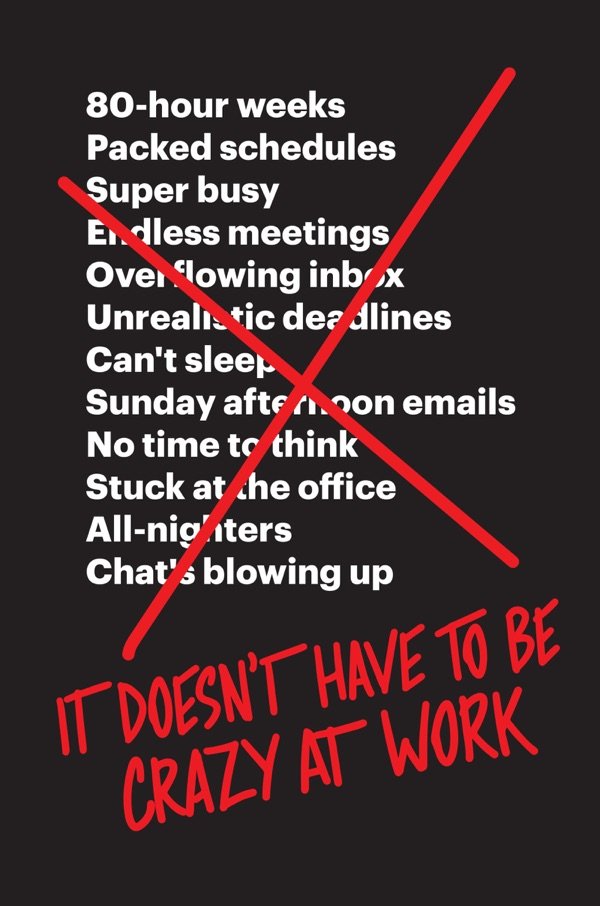
It Doesn't Have to Be Crazy at Work
by Jason Fried
But when you think of the company as a product, you ask different questions: Do people who work here know how to use the company? Is it simple? Complex? Is it obvious how it works? What’s fast about it? What’s slow about it? Are there bugs? What’s broken that we can fix quickly and what’s going to take a long time? Because let’s face it: Goals are fake. Nearly all of them are artificial targets set for the sake of setting targets. These made-up numbers then function as a source of unnecessary stress until they’re either achieved or abandoned. And when that happens, you’re supposed to pick new ones and start stressing again. Nothing ever stops at the quarterly win. There are four quarters to a year. Forty to a decade. Every one of them has to produce, exceed, and beat EXPECTATIONS.
But when you think of the company as a product, you ask different questions: Do people who work here know how to use the company? Is it simple? Complex? Is it obvious how it works? What’s fast about it? What’s slow about it? Are there bugs? What’s broken that we can fix quickly and what’s going to take a long time?
In the long run, work is not more important than sleep.
In fact, junk the whole metaphor of talent wars altogether. Stop thinking of talent as something to be plundered and start thinking of it as something to be grown and nurtured, the seeds for which are readily available all over the globe for companies willing to do the work.
Knowing what you’ll say no to is better than knowing what you’ll say yes to.
But why worry? Do your best, believe in the work you’ve done, and ship it. Then you’ll find out for sure. Maybe it’ll be spot-on. Maybe it’ll suck. Maybe it’ll be somewhere in between. But if you want to know, you have to put it on the market. The real market. It’s the only place you’ll find the truth.
"But when you think of the company as a product, you ask different questions: Do people who work here know how to use the company? Is it simple? Complex? Is it obvious how it works? What’s fast about it? What’s slow about it? Are there bugs? What’s broken that we can fix quickly and what’s going to take a long time?"
"Because let’s face it: Goals are fake. Nearly all of them are artificial targets set for the sake of setting targets. These made-up numbers then function as a source of unnecessary stress until they’re either achieved or abandoned. And when that happens, you’re supposed to pick new ones and start stressing again. Nothing ever stops at the quarterly win. There are four quarters to a year. Forty to a decade. Every one of them has to produce, exceed, and beat EXPECTATIONS."
"The idea that you’ll instantly move needles because you’ve never tried to move them until now is, well, delusional. Sometimes you get lucky and things are as easy as you had imagined, but that’s rarely the case. Most conversion work, most business-development work, most sales work is a grind —a lot of effort for a little movement. You pile those little movements into a big one eventually, but that fruit is way up at the top of the tree."
"In the long run, work is not more important than sleep."
"In fact, junk the whole metaphor of talent wars altogether. Stop thinking of talent as something to be plundered and start thinking of it as something to be grown and nurtured, the seeds for which are readily available all over the globe for companies willing to do the work."
"Knowing what you’ll say no to is better than knowing what you’ll say yes to."
"But why worry? Do your best, believe in the work you’ve done, and ship it. Then you’ll find out for sure. Maybe it’ll be spot-on. Maybe it’ll suck. Maybe it’ll be somewhere in between. But if you want to know, you have to put it on the market. The real market. It’s the only place you’ll find the truth."
- →But when you think of the company as a product, you ask different questions: Do people who work here know how to use the company? Is it simple? Complex? Is it obvious how it works? What’s fast about it? What’s slow about it? Are there bugs? What’s broken that we can fix quickly and what’s going to take a long time?
- →In fact, junk the whole metaphor of talent wars altogether. Stop thinking of talent as something to be plundered and start thinking of it as something to be grown and nurtured, the seeds for which are readily available all over the globe for companies willing to do the work.
- →But why worry? Do your best, believe in the work you’ve done, and ship it. Then you’ll find out for sure. Maybe it’ll be spot-on. Maybe it’ll suck. Maybe it’ll be somewhere in between. But if you want to know, you have to put it on the market. The real market. It’s the only place you’ll find the truth.
- →Jean-Louis Gassée, who used to run Apple France, describes this situation as the choice between two tokens. When you deal with people who have trouble, you can either choose to take the token that says “It’s no big deal” or the token that says “It’s the end of the world.” Whichever token you pick, they’ll take the other.
Looking for something similar?
Describe your situation. The search finds the right book from the entire library.