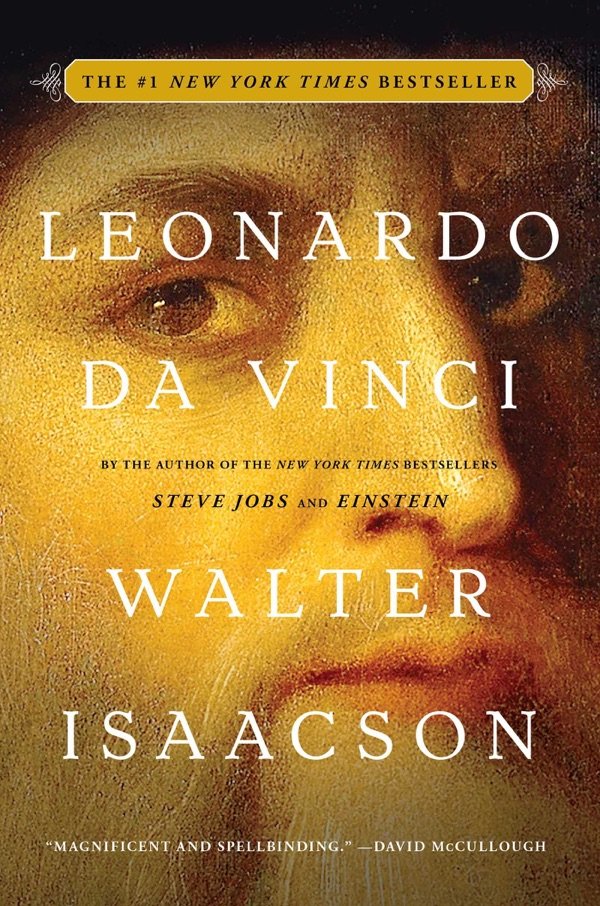
Leonardo da Vinci
by Walter Isaacson
he became the first person in history to describe fully the human dental elements, including a depiction of the roots that is almost perfect.9 “The six upper molars have three roots each, of which two roots are on the outer side of the jaw and one on the inner,” he wrote, evidence that he had cut through the wall of a sinus to determine the position of the roots. If there were not so much else to remember him for, Leonardo could have been celebrated as a pioneer of dentistry. His appetite for soaking up information from books was voracious and wide-ranging. In addition, he liked to pick people’s brains. He was constantly peppering acquaintances with the type of questions we should all learn to pose more often. “Ask Benedetto Portinari how they walk on ice in Flanders,” reads one memorable and vivid entry on a to-do list.
His appetite for soaking up information from books was voracious and wide-ranging. In addition, he liked to pick people’s brains. He was constantly peppering acquaintances with the type of questions we should all learn to pose more often. “Ask Benedetto Portinari how they walk on ice in Flanders,” reads one memorable and vivid entry on a to-do list.
The glory of being an artist, he realized, was that reality should inform but not constrain. “If the painter wishes to see beauties that would enrapture him, he is master of their production,” he wrote. “If he seeks valleys, if he wants to disclose great expanses of countryside from the summits of mountains, and if he subsequently wishes to see the horizon of the sea, he is lord of all of them.”
I embarked on this book because Leonardo da Vinci is the ultimate example of the main theme of my previous biographies: how the ability to make connections across disciplines—arts and sciences, humanities and technology—is a key to innovation, imagination, and genius.
There was another reason, one even more fundamental, that Leonardo did not complete the painting: he preferred the conception to the execution. As his father and others knew when they drew up the strict contract for his commission, Leonardo at twenty-nine was more easily distracted by the future than he was focused on the present. He was a genius undisciplined by diligence.
Vision without execution is hallucination. But I also came to believe that his ability to blur the line between reality and fantasy, just like his sfumato techniques for blurring the lines of a painting, was a key to his creativity. Skill without imagination is barren. Leonardo knew how to marry observation and imagination, which made him history’s consummate innovator.
"he became the first person in history to describe fully the human dental elements, including a depiction of the roots that is almost perfect.9 “The six upper molars have three roots each, of which two roots are on the outer side of the jaw and one on the inner,” he wrote, evidence that he had cut through the wall of a sinus to determine the position of the roots. If there were not so much else to remember him for, Leonardo could have been celebrated as a pioneer of dentistry."
"His appetite for soaking up information from books was voracious and wide-ranging. In addition, he liked to pick people’s brains. He was constantly peppering acquaintances with the type of questions we should all learn to pose more often. “Ask Benedetto Portinari how they walk on ice in Flanders,” reads one memorable and vivid entry on a to-do list."
"The glory of being an artist, he realized, was that reality should inform but not constrain. “If the painter wishes to see beauties that would enrapture him, he is master of their production,” he wrote. “If he seeks valleys, if he wants to disclose great expanses of countryside from the summits of mountains, and if he subsequently wishes to see the horizon of the sea, he is lord of all of them.”"
"I embarked on this book because Leonardo da Vinci is the ultimate example of the main theme of my previous biographies: how the ability to make connections across disciplines—arts and sciences, humanities and technology—is a key to innovation, imagination, and genius."
"Leonardo had almost no schooling and could barely read Latin or do long division. His genius was of the type we can understand, even take lessons from. It was based on skills we can aspire to improve in ourselves, such as curiosity and intense observation. He had an imagination so excitable that it flirted with the edges of fantasy, which is also something we can try to preserve in ourselves and indulge in our children."
"His notebooks have been rightly called “the most astonishing testament to the powers of human observation and imagination ever set down on paper.”3 The more than 7,200 pages now extant probably represent about one-quarter of what Leonardo actually wrote,4 but that is a higher percentage after five hundred years than the percentage of Steve Jobs’s emails and digital documents from the 1990s that he and I were able to retrieve. Leonardo’s notebooks are nothing less than an astonishing windfall that provides the documentary record of applied creativity."
"Ideas are often generated in physical gathering places where people with diverse interests encounter one another serendipitously. That is why Steve Jobs liked his buildings to have a central atrium and why the young Benjamin Franklin founded a club where the most interesting people of Philadelphia would gather every Friday. At the court of Ludovico Sforza, Leonardo found friends who could spark new ideas by rubbing together their diverse passions."
- →I embarked on this book because Leonardo da Vinci is the ultimate example of the main theme of my previous biographies: how the ability to make connections across disciplines—arts and sciences, humanities and technology—is a key to innovation, imagination, and genius.
- →He was a perfectionist faced with challenges other artists would have disregarded but that he could not. So he put down his brushes. That behavior meant he would never again receive a public commission. But it is also what allowed him to go down in history as an obsessed genius rather than merely a reliable master painter.
- →Leonardo was romantically and sexually attracted to men and, unlike Michelangelo, seemed to be just fine with that. He made no effort either to hide or proclaim it, but it probably contributed to his sense of being unconventional, someone who wasn’t geared to be part of a family procession of notaries.
- →By exalting the interplay between art and science, Leonardo wove an argument that was integral to understanding his genius: that true creativity involves the ability to combine observation with imagination, thereby blurring the border between reality and fantasy. A great painter depicts both, he said.
Looking for something similar?
Describe your situation. The search finds the right book from the entire library.