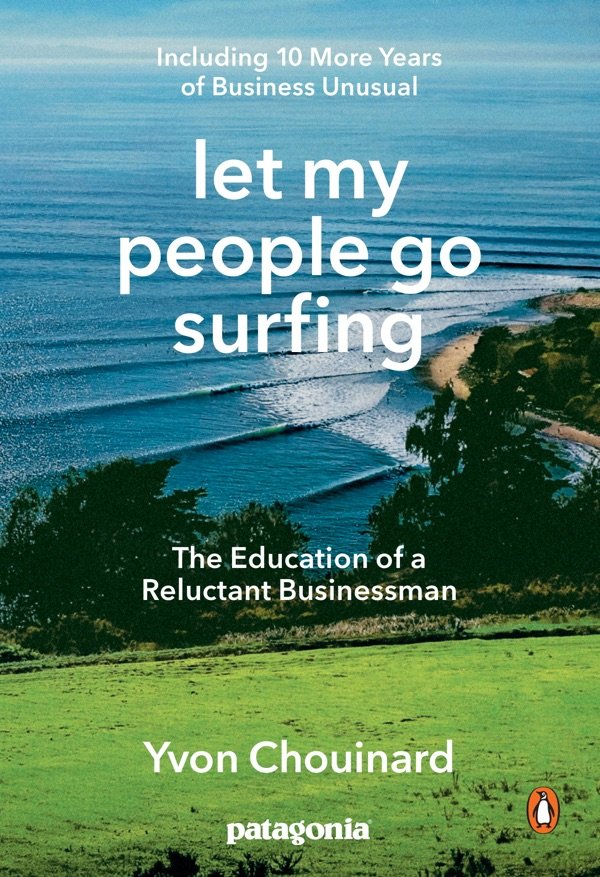
Let My People Go Surfing: The Education of a Reluctant Businessman
by Yvon Chouinard
A chief in an American Indian tribe was not elected because he was the richest or had a strong political machine; he was chosen chief because of his oratory skills, which were invaluable for building consensus within the tribe. When I think of stewardship or sustainability, I think back to when I was a GI in Korea, where I saw farmers pouring night soil on rice paddies that had been in continuous use for over three thousand years. Each generation of farmers assumed responsibility for leaving the land in better condition than when they took possession of it. Contrast this approach with that of modern agribusiness, in the Midwest, which wastes a bushel of topsoil to grow one bushel of corn and pumps out groundwater at a rate 25 percent faster than it’s being replenished.
A chief in an American Indian tribe was not elected because he was the richest or had a strong political machine; he was chosen chief because of his oratory skills, which were invaluable for building consensus within the tribe.
A master in the art of living draws no sharp distinction between his work and his play; his labor and his leisure; his mind and his body; his education and his recreation. He hardly knows which is which. He simply pursues his vision of excellence through whatever he is doing, and leaves others to determine whether he is working or playing. To himself, he always appears to be doing both.
The most responsible way for a consumer and a good citizen to buy clothes is to buy used clothing. Beyond that, avoid buying clothes you have to dry-clean or iron. Wash in cold water. Line dry when possible. Wear your shirt more than one day before you wash it. Consider faster-drying alternatives to 100 percent cotton for your travel clothes.
That suffering taught us that taking extraordinary steps to set up the manufacturing correctly the first time is much cheaper than taking extraordinary steps down the line. If you’re committed to being the best, you’re going to have to take those extra steps at some point in production anyway. It might as well be at the start.
We make certain assumptions about our customers, not just that they are intelligent. We assume that they don’t shop as entertainment, that they’re not out to “buy a life,” that they want to deepen and simplify, not junk up, their lives, and that they are fed up with or indifferent to being targets for aggressive advertising.
"A chief in an American Indian tribe was not elected because he was the richest or had a strong political machine; he was chosen chief because of his oratory skills, which were invaluable for building consensus within the tribe."
"When I think of stewardship or sustainability, I think back to when I was a GI in Korea, where I saw farmers pouring night soil on rice paddies that had been in continuous use for over three thousand years. Each generation of farmers assumed responsibility for leaving the land in better condition than when they took possession of it. Contrast this approach with that of modern agribusiness, in the Midwest, which wastes a bushel of topsoil to grow one bushel of corn and pumps out groundwater at a rate 25 percent faster than it’s being replenished."
"A master in the art of living draws no sharp distinction between his work and his play; his labor and his leisure; his mind and his body; his education and his recreation. He hardly knows which is which. He simply pursues his vision of excellence through whatever he is doing, and leaves others to determine whether he is working or playing. To himself, he always appears to be doing both."
"The most responsible way for a consumer and a good citizen to buy clothes is to buy used clothing. Beyond that, avoid buying clothes you have to dry-clean or iron. Wash in cold water. Line dry when possible. Wear your shirt more than one day before you wash it. Consider faster-drying alternatives to 100 percent cotton for your travel clothes."
"That suffering taught us that taking extraordinary steps to set up the manufacturing correctly the first time is much cheaper than taking extraordinary steps down the line. If you’re committed to being the best, you’re going to have to take those extra steps at some point in production anyway. It might as well be at the start."
"We make certain assumptions about our customers, not just that they are intelligent. We assume that they don’t shop as entertainment, that they’re not out to “buy a life,” that they want to deepen and simplify, not junk up, their lives, and that they are fed up with or indifferent to being targets for aggressive advertising."
"Over the years we have come upon a balance we find just about ideal: 55 percent product content and 45 percent devoted to message—essays, stories, and image photos. Whenever we have edged that content toward increased product presentation, we have actually experienced a decrease in sales."
- →A chief in an American Indian tribe was not elected because he was the richest or had a strong political machine; he was chosen chief because of his oratory skills, which were invaluable for building consensus within the tribe.
- →Over the years we have come upon a balance we find just about ideal: 55 percent product content and 45 percent devoted to message—essays, stories, and image photos. Whenever we have edged that content toward increased product presentation, we have actually experienced a decrease in sales.
- →That begins with an attitude of embracing change rather than resisting it. Not just changing without reflection and weighing the relative merits of the new ideas, but nonetheless assuming that if we only look hard enough, there may be a better way to do things.
- →Uncurious people do not lead examined lives; they cannot see causes that lie deeper than the surface. They believe in blind faith, and the most frightening thing about blind faith is that it in turn leads to an inability, even an unwillingness, to accept facts.
Looking for something similar?
Describe your situation. The search finds the right book from the entire library.