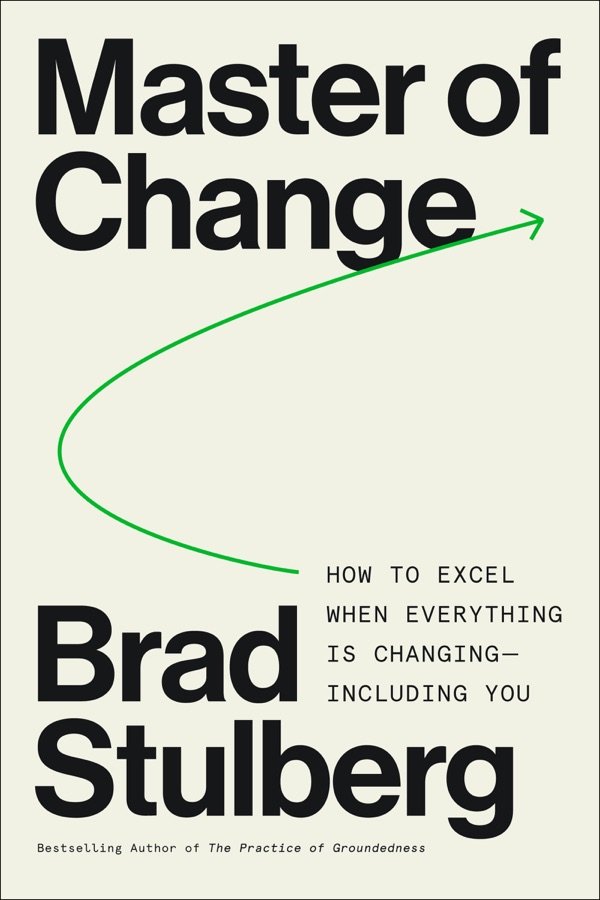
Master of Change: How to Excel When Everything Is Changing, Including You; Embracing Life’s Instability with Rugged Flexibility―a Practical Model for Resilience
by Brad Stulberg
Cultivate a Fluid Sense of Self Like water, a fluid sense of self can go into and fill any one space; but it can also flow out of that space when necessary, changing shape without changing form. A fluid sense of self is non-dual; it is: not differentiated or integrated, but differentiated and integrated not independent or interdependent, but independent and interdependent not separate or connected, but separate and connected not conventional or ultimate, but conventional and ultimate The more we can conceptualize our identities non-dually, holding all of these contradictions at once, the better off we’ll be and do. By conceiving of ourselves in a fluid manner, change, be it internal or external, becomes less threatening; our identities become more rugged and flexible and thus better able to endure and persist over the long haul, including throughout countless cycles of order, disorder, and reorder. Rugged and Flexible Mindset What Is Health? by Peter Sterling How to Change by Katy Milkman Life is in the Transitions by Bruce Feiler Falling Upward by Richard Rohr The Structure of Scientific Revolutions by Thomas S. Kuhn Full Catastrophe Living by Jon Kabat-Zinn Radical Acceptance by Tara Brach Tao Te Ching by Lao Tzu (Stephen Mitchell translation) Epictetus: Discourses and Selected Writings (Penguin Classics version) Meditations by Marcus Aurelius The Pali Canon: In the Buddha’s Words by Bhikkhu Bodhi Death by Todd May Almost Everything by Anne Lamott Antifragile by Nassim Nicholas Taleb A Guide to the Good Life by William B. Irvine What Matters Most by James Hollis The Hero with a Thousand Faces by Joseph Campbell Lost & Found by Kathryn Schulz Man’s Search for Meaning by Viktor Frankl Grit by Angela Duckworth
“rugged flexibility”—minimizes distress, restlessness, and angst while promoting deep happiness and lasting fulfillment. It also leads to better and more sustainable performance on the activities and pursuits about which we care most. In this way, rugged flexibility is foundational to sustainable excellence: doing good and feeling good in a way that supports our long-term goals.
if we deliberately respond to uncertain situations, we feel good, and we become more likely to deliberately respond again. Remember, this is so important because the RAGE pathway is automatically turned off when the SEEKING pathway is turned on. Once we get into a productive groove, our brains are less likely to be hijacked by hot and potentially destructive emotions.
Rugged and Flexible Actions Dopamine Nation by Anna Lembke A Significant Life by Todd May Dancing with Life by Phillip Moffitt The Shallows by Nicholas Carr Do Hard Things by Steve Magness Surviving Survival by Laurence Gonzales The Hidden Spring by Mark Solms Subtract by Leidy Klotz Stumbling on Happiness by Daniel Gilbert No Cure for Being Human by Kate Bowler
“If we try to control a situation or our lives,13 we have to work hard at doing something to get the results we want,” writes the neuroscientist Judson Brewer. “In contrast, if we can relax into an attitude that is more like a dance with [life], simply being with it as the situation unfolds, no striving or struggling necessary, we [can] get out of our own way.”
Non-dual thinking recognizes that the world is complex, that much is nuanced, and that truth is often found in paradox: not this or that, but this and that. Non-dual thinking is an important, albeit spectacularly underused, concept in many facets of life, including our subject matter here. As such, it will come up repeatedly throughout this book.
"Cultivate a Fluid Sense of Self Like water, a fluid sense of self can go into and fill any one space; but it can also flow out of that space when necessary, changing shape without changing form. A fluid sense of self is non-dual; it is: not differentiated or integrated, but differentiated and integrated not independent or interdependent, but independent and interdependent not separate or connected, but separate and connected not conventional or ultimate, but conventional and ultimate The more we can conceptualize our identities non-dually, holding all of these contradictions at once, the better off we’ll be and do. By conceiving of ourselves in a fluid manner, change, be it internal or external, becomes less threatening; our identities become more rugged and flexible and thus better able to endure and persist over the long haul, including throughout countless cycles of order, disorder, and reorder."
"Rugged and Flexible Mindset What Is Health? by Peter Sterling How to Change by Katy Milkman Life is in the Transitions by Bruce Feiler Falling Upward by Richard Rohr The Structure of Scientific Revolutions by Thomas S. Kuhn Full Catastrophe Living by Jon Kabat-Zinn Radical Acceptance by Tara Brach Tao Te Ching by Lao Tzu (Stephen Mitchell translation) Epictetus: Discourses and Selected Writings (Penguin Classics version) Meditations by Marcus Aurelius The Pali Canon: In the Buddha’s Words by Bhikkhu Bodhi Death by Todd May Almost Everything by Anne Lamott Antifragile by Nassim Nicholas Taleb A Guide to the Good Life by William B. Irvine What Matters Most by James Hollis The Hero with a Thousand Faces by Joseph Campbell Lost & Found by Kathryn Schulz Man’s Search for Meaning by Viktor Frankl Grit by Angela Duckworth"
"When he hit his age-related rough patch between 2013 and 2016, Federer made a number of significant changes. He trained and competed less so he could focus more on rest and recovery between big events. He played at the net frequently, which shortened the duration of points so he wouldn’t have to run the baseline for hours on end against competitors who were much younger. He learned a one-handed backhand with massive topspin that conserved energy and gave his rival, Rafael Nadal, all sorts of trouble. And he embraced new technology, leaving behind the racket he had played with for most of his career, the one that had made him perhaps the greatest male tennis player of all time, in favor of a new racket with enhanced design technology that all the younger players were already using."
"Once you accept something as an immutable reality in the present moment, you give yourself permission to stop wishing it away or trying to manipulate it on your terms. This allows you to direct all of your energy toward acceptance and moving forward. The key is that you’ve got to truly accept your reality: not think about accepting it, not talk about accepting it, not wish you could accept it, but actually accept it. Your mind all too easily detects when you are lying to yourself."
"Even (and perhaps especially) if we don’t know where the path ahead is going, we’d be wise to adopt an attitude of simply doing the next right (i.e., values-driven) thing. This gives us the best chance of getting where we ought to go. Developing rugged flexibility is anything but passive. Taking thoughtful and deliberate actions is what being in conversation with change is all about—and it is the topic we’ll examine in the next, and final, part of this book."
"Research shows that, on average,1 people experience thirty-six disorder events in the course of their adulthood—or about one every eighteen months. This does not include aging, the ever-present, ongoing disorder event that many of us futilely resist and deny. We tend to think that change and disorder are the exceptions when, in reality, they are the rules. Look closely and you’ll see that everything is always changing, including us. Life is flux."
"Rugged and Flexible Identity To Have or To Be? by Erich Fromm Devotions by Mary Oliver The Art of Living by Thich Nhat Hanh Going to Pieces Without Falling Apart by Mark Epstein The Trauma of Everyday Life by Mark Epstein The Cancer Journals by Audre Lorde The Wisdom of Insecurity by Alan Watts A Liberated Mind by Steven C. Hayes The Extended Mind by Annie Murphy Paul Clash! by Hazel Rose Markus and Alana Conner Range by David Epstein"
- →central part of the reason our species evolved to live in groups is because it is near impossible to get by otherwise. Pain and suffering are never easy, but they are a bit less hard when they are held together.
- →A big part of the reason that our culture is so unhealthy and at such dis-ease—physically, emotionally, intellectually, socially, and spiritually—is because we lack the requisite skills to navigate change.
- →Only once we open to the flow of life and arrive at a genuine acceptance of change can things start to fall into place, empowering us to proceed pragmatically and productively on our respective paths.
- →Here is what I was hoping for or thought would happen. Here is what is actually happening. Since I live not only in my own head but also in reality, I need to focus on the latter.
Looking for something similar?
Describe your situation. The search finds the right book from the entire library.