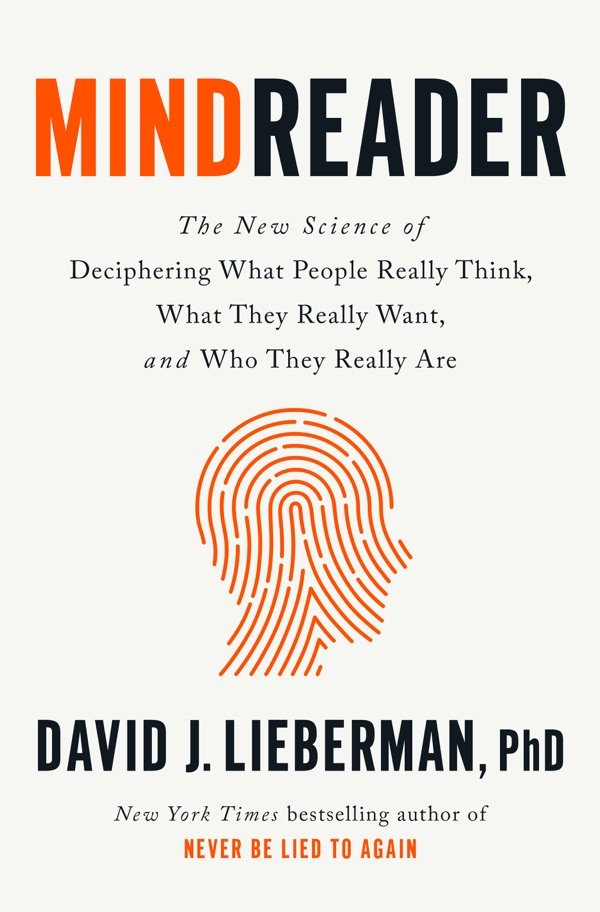
Mindreader: The New Science of Deciphering What People Really Think, What They Really Want, and Who They Really Are
by David J. Lieberman
The use of a euphemism informs us that the individual wants to dilute or deflect directness and may be (a) attempting to minimize their request or their deeds, (b) concerned that their message will be ill received, (c) uncomfortable with the topic itself, or (d) any combination thereof. Someone making a deceitful statement often focuses heavily on irrelevant details to mimic the natural depth and richness found in a truthful statement. He peppers the conversation with minutiae to distract you from the truth, as if he’s throwing sand in your face.
The use of a euphemism informs us that the individual wants to dilute or deflect directness and may be (a) attempting to minimize their request or their deeds, (b) concerned that their message will be ill received, (c) uncomfortable with the topic itself, or (d) any combination thereof.
Someone making a deceitful statement often focuses heavily on irrelevant details to mimic the natural depth and richness found in a truthful statement. He peppers the conversation with minutiae to distract you from the truth, as if he’s throwing sand in your face.
Logically, anger offers no real satisfaction or psychological comfort. It is our ego’s defense mechanism to feeling vulnerable, yet we spiral out of control and become emotionally weaker with each intense anger-driven thought or action.
The personal pronouns (e.g., I, me, mine, and my) indicate that a person is committed to and confident about his statement. Omitting personal pronouns from the action may signal someone’s reluctance to accept ownership of his words.
The concept of symbolic representation, illustrated by these scenarios, states that we can discern how someone feels about another person by observing how they treat objects associated with that person.
"The use of a euphemism informs us that the individual wants to dilute or deflect directness and may be (a) attempting to minimize their request or their deeds, (b) concerned that their message will be ill received, (c) uncomfortable with the topic itself, or (d) any combination thereof."
"Someone making a deceitful statement often focuses heavily on irrelevant details to mimic the natural depth and richness found in a truthful statement. He peppers the conversation with minutiae to distract you from the truth, as if he’s throwing sand in your face."
"Logically, anger offers no real satisfaction or psychological comfort. It is our ego’s defense mechanism to feeling vulnerable, yet we spiral out of control and become emotionally weaker with each intense anger-driven thought or action."
"The personal pronouns (e.g., I, me, mine, and my) indicate that a person is committed to and confident about his statement. Omitting personal pronouns from the action may signal someone’s reluctance to accept ownership of his words."
"The concept of symbolic representation, illustrated by these scenarios, states that we can discern how someone feels about another person by observing how they treat objects associated with that person."
"People who bluff habitually overcompensate, in either direction, and you can uncover a bluff instantly by noticing how someone tries to appear."
"The guilty person wants the subject changed and the conversation to end; the innocent person always wants a further exchange of information."
- →The use of a euphemism informs us that the individual wants to dilute or deflect directness and may be (a) attempting to minimize their request or their deeds, (b) concerned that their message will be ill received, (c) uncomfortable with the topic itself, or (d) any combination thereof.
- →The guilty person wants the subject changed and the conversation to end; the innocent person always wants a further exchange of information.
- →Another unwritten rule of power is that the less you have to say or do to gain cooperation, the more control you have.
Looking for something similar?
Describe your situation. The search finds the right book from the entire library.