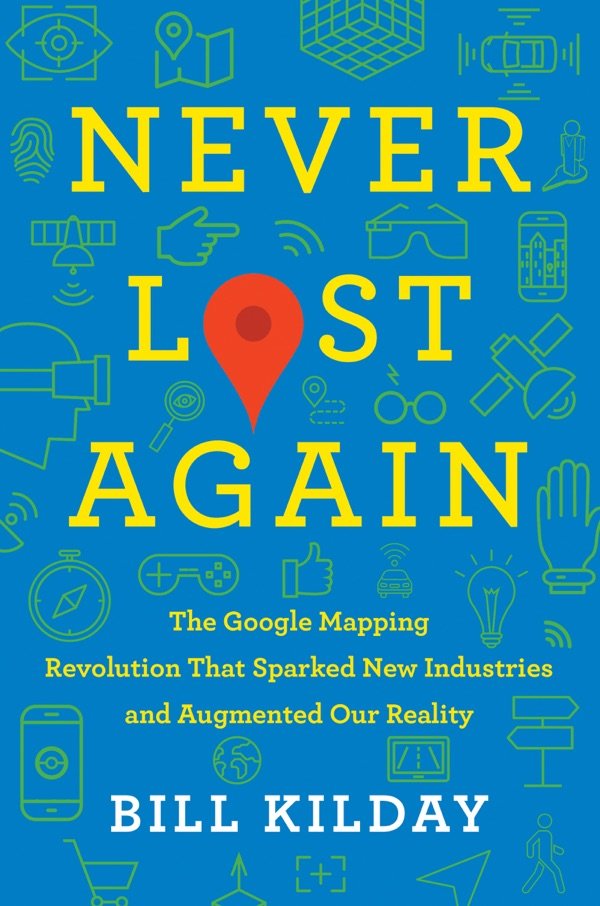
Never Lost Again: The Google Mapping Revolution That Sparked New Industries and Augmented Our Reality – The Essential Application's Creation Story from Keyhole
by Bill Kilday
In the fall of 2004, Google combined those two teams with a small group of existing Google employees in Building 41 in the Googleplex in Mountain View, California, gave them zero direction, unlimited resources, and presented the teams with a secret problem: Twenty-five percent of all queries being typed into the simple white Google search box were looking for a map. These unexpected uses of Google Earth also included countless new discoveries: new species of animals, new islands, a new barrier reef, a miniaturized military training ground in China, migrating cow deer in the Czech Republic (that naturally aligned themselves according to the Earth’s magnetic poles), and a variety of others.
In the fall of 2004, Google combined those two teams with a small group of existing Google employees in Building 41 in the Googleplex in Mountain View, California, gave them zero direction, unlimited resources, and presented the teams with a secret problem: Twenty-five percent of all queries being typed into the simple white Google search box were looking for a map.
These unexpected uses of Google Earth also included countless new discoveries: new species of animals, new islands, a new barrier reef, a miniaturized military training ground in China, migrating cow deer in the Czech Republic (that naturally aligned themselves according to the Earth’s magnetic poles), and a variety of others.
Brett, Lars, Chikai, and team were creating the fastest, most beautiful base map, but what was most important was the data. The places of interest, or POIs, being plotted on the map. Egnor and Harmon’s work was going to ensure that Google’s POIs—our geographic information—were the most comprehensive and most current.
The following year, the event was broadened to include more than just Google Geo products, and it was called Google Developer Day. In 2008, the concept was expanded further to include its own unique brand, Google I/O, which is the company’s largest annual developer relations and product launch event.
With Larry Page’s support, and Rebecca Moore and Jenifer Austin Foulkes’s stewardship, a new mapping project was born. Created in 2011, Google Ocean is an initiative to map the ocean floor, allowing Google Earth users to dive below sea level to explore underwater.
"In the fall of 2004, Google combined those two teams with a small group of existing Google employees in Building 41 in the Googleplex in Mountain View, California, gave them zero direction, unlimited resources, and presented the teams with a secret problem: Twenty-five percent of all queries being typed into the simple white Google search box were looking for a map."
"These unexpected uses of Google Earth also included countless new discoveries: new species of animals, new islands, a new barrier reef, a miniaturized military training ground in China, migrating cow deer in the Czech Republic (that naturally aligned themselves according to the Earth’s magnetic poles), and a variety of others."
"Brett, Lars, Chikai, and team were creating the fastest, most beautiful base map, but what was most important was the data. The places of interest, or POIs, being plotted on the map. Egnor and Harmon’s work was going to ensure that Google’s POIs—our geographic information—were the most comprehensive and most current."
"The following year, the event was broadened to include more than just Google Geo products, and it was called Google Developer Day. In 2008, the concept was expanded further to include its own unique brand, Google I/O, which is the company’s largest annual developer relations and product launch event."
"With Larry Page’s support, and Rebecca Moore and Jenifer Austin Foulkes’s stewardship, a new mapping project was born. Created in 2011, Google Ocean is an initiative to map the ocean floor, allowing Google Earth users to dive below sea level to explore underwater."
"Six years later, Google’s mapping products—run by several key members of the former Keyhole team—had one billion monthly active users and became the number one consumer mapping service worldwide. From zero users to a billion users monthly. In six years."
"My position was based on a rule from visual artist and author Wendy Richmond, a rule that I have always considered a foundational marketing truth. It goes like this: “If you want to teach someone something new, start with something they already know.”"
- →My position was based on a rule from visual artist and author Wendy Richmond, a rule that I have always considered a foundational marketing truth. It goes like this: “If you want to teach someone something new, start with something they already know.”
Looking for something similar?
Describe your situation. The search finds the right book from the entire library.