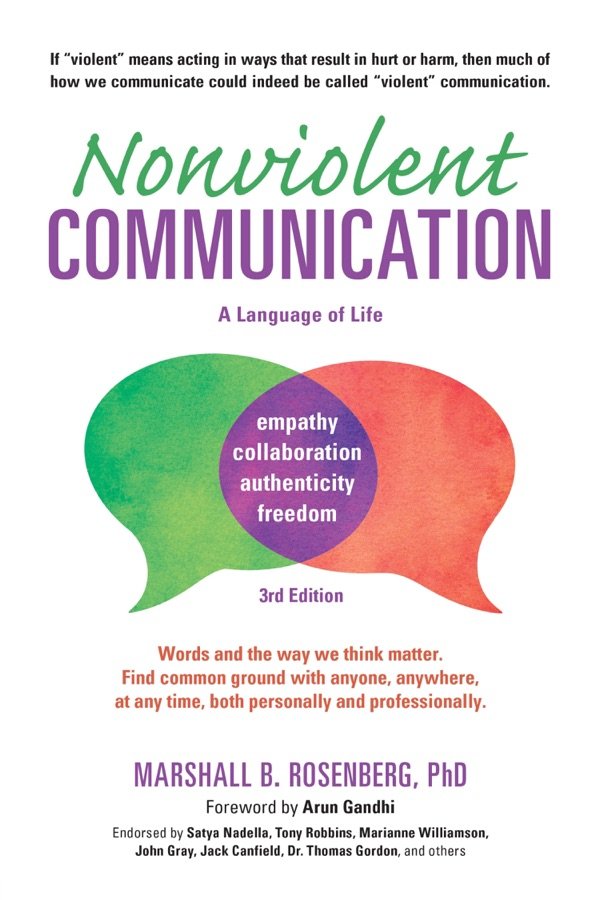
Nonviolent Communication: A Language of Life
by Marshall B. Rosenberg
First, we observe what is actually happening in a situation: what are we observing others saying or doing that is either enriching or not enriching our life? The trick is to be able to articulate this observation without introducing any judgment or evaluation—to simply say what people are doing that we either like or don’t like. Next, we state how we feel when we observe this action: are we hurt, scared, joyful, amused, irritated? And thirdly, we say what needs of ours are connected to the feelings we have identified. Our attention is focused on classifying, analyzing, and determining levels of wrongness rather than on what we and others need and are not getting.
Our attention is focused on classifying, analyzing, and determining levels of wrongness rather than on what we and others need and are not getting.
NVC Process The concrete actions we observe that affect our well-being How we feel in relation to what we observe The needs, values, desires, etc.
We know a speaker has received adequate empathy when (1) we sense a release of tension, or (2) the flow of words comes to a halt.
We are led to express ourselves with honesty and clarity, while simultaneously paying others a respectful and empathic attention.
The Indian philosopher J. Krishnamurti once remarked that observing without evaluating is the highest form of human intelligence.
"First, we observe what is actually happening in a situation: what are we observing others saying or doing that is either enriching or not enriching our life? The trick is to be able to articulate this observation without introducing any judgment or evaluation—to simply say what people are doing that we either like or don’t like. Next, we state how we feel when we observe this action: are we hurt, scared, joyful, amused, irritated? And thirdly, we say what needs of ours are connected to the feelings we have identified."
"Our attention is focused on classifying, analyzing, and determining levels of wrongness rather than on what we and others need and are not getting."
"NVC Process The concrete actions we observe that affect our well-being How we feel in relation to what we observe The needs, values, desires, etc."
"We know a speaker has received adequate empathy when (1) we sense a release of tension, or (2) the flow of words comes to a halt."
"We are led to express ourselves with honesty and clarity, while simultaneously paying others a respectful and empathic attention."
"The Indian philosopher J. Krishnamurti once remarked that observing without evaluating is the highest form of human intelligence."
"Steps to expressing anger: 1. Identify our judgmental thoughts. Connect with our needs. Express our feelings and unmet needs."
- →What others do may be the stimulus of our feelings, but not the cause.
Looking for something similar?
Describe your situation. The search finds the right book from the entire library.