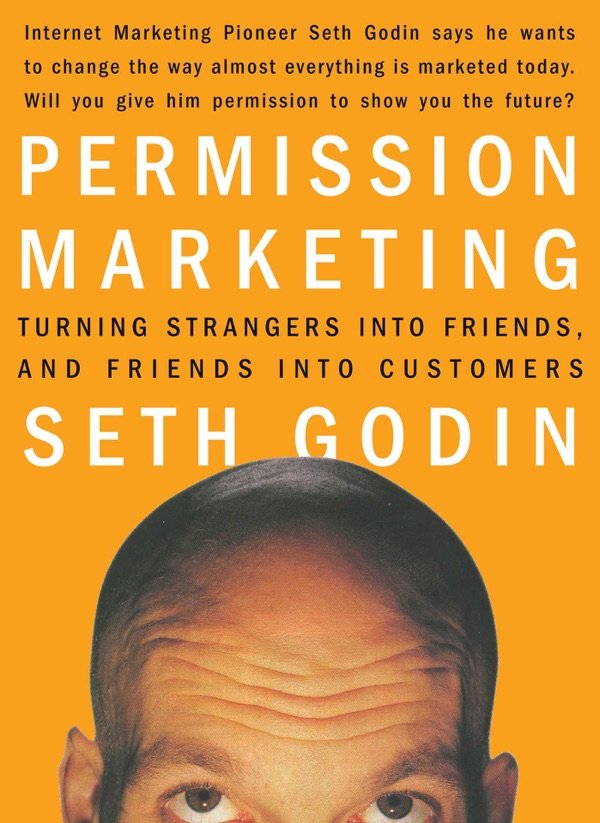
Permission Marketing: Turning Strangers into Friends and Friends into Customers
by Seth Godin
Five Steps to Dating Your Customer Offer the prospect an incentive to volunteer. Using the attention offered by the prospect, offer a curriculum over time, teaching the consumer about your product or service. Reinforce the incentive to guarantee that the prospect maintains the permission. Offer additional incentives to get even more permission from the consumer. Over time, leverage the permission to change consumer behavior toward profits. The one-to-one marketer works to change his focus from finding as many new customers as he can to extracting the maximum value from each customer. The Permission Marketer works to change his focus from finding as many prospects as he can to converting the largest number of prospects into customers. Then he leverages the permission on an ongoing basis.
The one-to-one marketer works to change his focus from finding as many new customers as he can to extracting the maximum value from each customer. The Permission Marketer works to change his focus from finding as many prospects as he can to converting the largest number of prospects into customers. Then he leverages the permission on an ongoing basis.
Nicholas Negroponte at the MIT Media Lab uses a great analogy to make a similar point: When you double the length of a fish, its weight goes up by a factor of four. The same thing is true for advertising. When you increase your frequency by 100 percent, you usually increase your effectiveness by 400 percent.
By focusing media on getting permission instead of making the ultimate sale, marketers are able to get far more out of their expenditures. The response rate to a free sample or an affinity program or a birthday club might be five or ten times the response rate of an ad asking for a sale.
Before a marketer can build trust, it must breed familiarity. But there’s no familiarity without awareness. And awareness—the science of letting people know you exist and getting them to understand your message—can’t happen effectively in today’s environment without advertising.
There is one critical resource, though, that is in chronically short supply. Bill Gates has just as much as you do. And even Warren Buffet can’t buy more. That scarce resource is time. And in light of today’s information glut, that means there’s a vast shortage of attention.
"Five Steps to Dating Your Customer Offer the prospect an incentive to volunteer. Using the attention offered by the prospect, offer a curriculum over time, teaching the consumer about your product or service. Reinforce the incentive to guarantee that the prospect maintains the permission. Offer additional incentives to get even more permission from the consumer. Over time, leverage the permission to change consumer behavior toward profits."
"The one-to-one marketer works to change his focus from finding as many new customers as he can to extracting the maximum value from each customer. The Permission Marketer works to change his focus from finding as many prospects as he can to converting the largest number of prospects into customers. Then he leverages the permission on an ongoing basis."
"Nicholas Negroponte at the MIT Media Lab uses a great analogy to make a similar point: When you double the length of a fish, its weight goes up by a factor of four. The same thing is true for advertising. When you increase your frequency by 100 percent, you usually increase your effectiveness by 400 percent."
"By focusing media on getting permission instead of making the ultimate sale, marketers are able to get far more out of their expenditures. The response rate to a free sample or an affinity program or a birthday club might be five or ten times the response rate of an ad asking for a sale."
"Before a marketer can build trust, it must breed familiarity. But there’s no familiarity without awareness. And awareness—the science of letting people know you exist and getting them to understand your message—can’t happen effectively in today’s environment without advertising."
"There is one critical resource, though, that is in chronically short supply. Bill Gates has just as much as you do. And even Warren Buffet can’t buy more. That scarce resource is time. And in light of today’s information glut, that means there’s a vast shortage of attention."
"For ninety years marketers have relied on one form of advertising almost exclusively. I call it Interruption Marketing. Interruption, because the key to each and every ad is to interrupt what the viewers are doing in order to get them to think about something else."
- →Before a marketer can build trust, it must breed familiarity. But there’s no familiarity without awareness. And awareness—the science of letting people know you exist and getting them to understand your message—can’t happen effectively in today’s environment without advertising.
- →For ninety years marketers have relied on one form of advertising almost exclusively. I call it Interruption Marketing. Interruption, because the key to each and every ad is to interrupt what the viewers are doing in order to get them to think about something else.
- →In summary, the successful Permission Marketer first offers an obvious benefit to the right audience. Second, because it is so allied with the services being offered, the congruence makes it far easier to escalate the customer up the permission ladder.
- →Marketing guru Jay Levinson figures you have to run an ad twenty-seven times against one individual before it has its desired impact. Because only one out of nine ads is seen, and you’ve got to see it at least three times before it sinks in.
Looking for something similar?
Describe your situation. The search finds the right book from the entire library.