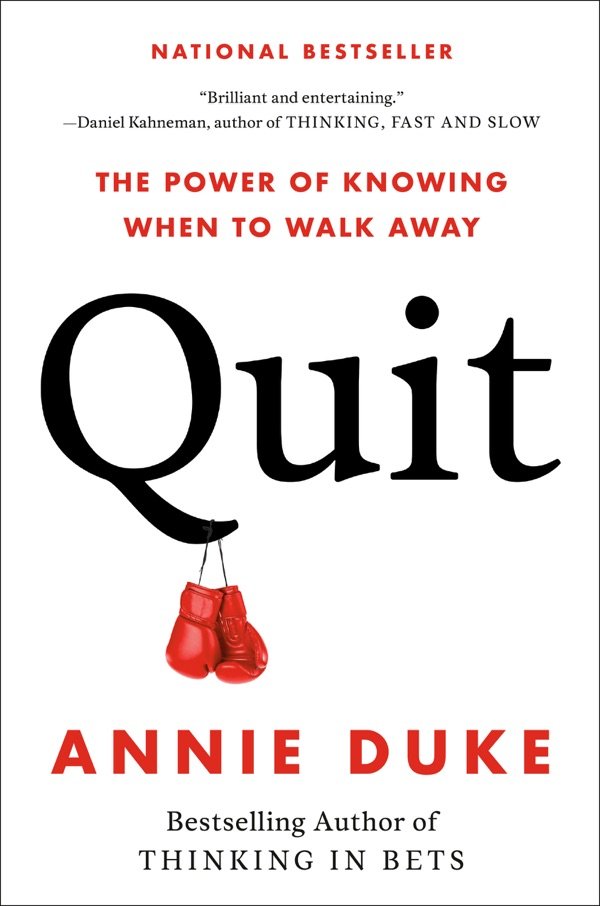
Quit: The Power of Knowing When to Walk Away
by Annie Duke
Chapter 1 Summary We tend to celebrate people who respond to adversity by soldiering on. The quitters, in comparison, are invisible. If we don’t notice the decision-making of the quitters, it’s hard to learn from them. Quitting a course of action is sometimes the best way to win in the long run, whether you’re cutting your losses at the poker table or getting to climb another day. Quit and grit are two sides of the exact same decision. Decision-making in the real world requires action without complete information. Quitting is the tool that allows us to react to new information that is revealed after we make a decision. Sticking with a course of action is the only way to find out for sure how it will turn out. Quitting requires being okay with not knowing what might have been. Having the option to quit helps you to explore more, learn more, and ultimately find the right things to stick with. To avoid becoming entrapped, set benchmarks, in the form of states and dates, in advance. Find out the average time it takes a newly minted PhD to secure a tenure-track position and circle that date on the calendar as a quitting deadline. If, for example, that’s four years from the time you get your PhD, then if you haven’t secured a tenure-track position (the state) within four years (the date), you ought to quit. If your goal is to be an Olympic sprinter, figure out how fast the best runners in the world were running the 100-meter dash at fifteen years old, or eighteen years old, or as college sprinters. You can mark those milestones along the way and if you are hitting them, keep going (as long as the pursuit still brings you happiness), and if you miss them, quit and pursue a new goal.
The next time that you find yourself saying, “I’m just not ready to decide yet,” what you should actually say is “For now I think that the status quo is still the best choice.” Maybe you need more information to know whether to switch. But what shouldn’t stop you from quitting (or getting that information) is that it’s too scary to switch because loss aversion is too intense.
If there’s one thing that you’ve learned from this book, it’s that just knowing about the problem, doing a thought experiment of taking somebody else’s perspective and trying to see it from the outside, looking in on yourself, is something you cannot do. That’s why Daniel Kahneman thinks he needs a quitting coach, and why we all ought to see that need.
This behavior, expertly exercising the option to quit, baffles us. In trying to make sense of the world, we will impute all sorts of things. The quitters are cowards, or crazy, or flighty. This is the human tendency when we don’t understand things. We try to make sense of them. Often, our sense-making is unkind to the quitter.
Sunk costs snowball, like a katamari. The resources you have already spent make it less likely you will quit, which makes it more likely you will accumulate additional sunk costs, which makes it again less likely you will quit, and so on. The growing debris of your prior commitment makes it increasingly harder to walk away.
Because people were much happier when they quit what they considered a close decision, that shows that people are generally quitting too late. That’s exactly what was happening with Sarah Olstyn Martinez. She thought it was a close call, but once I put it in terms of expected value, she realized it wasn’t close at all.
"Chapter 1 Summary We tend to celebrate people who respond to adversity by soldiering on. The quitters, in comparison, are invisible. If we don’t notice the decision-making of the quitters, it’s hard to learn from them. Quitting a course of action is sometimes the best way to win in the long run, whether you’re cutting your losses at the poker table or getting to climb another day. Quit and grit are two sides of the exact same decision. Decision-making in the real world requires action without complete information. Quitting is the tool that allows us to react to new information that is revealed after we make a decision. Sticking with a course of action is the only way to find out for sure how it will turn out. Quitting requires being okay with not knowing what might have been. Having the option to quit helps you to explore more, learn more, and ultimately find the right things to stick with."
"To avoid becoming entrapped, set benchmarks, in the form of states and dates, in advance. Find out the average time it takes a newly minted PhD to secure a tenure-track position and circle that date on the calendar as a quitting deadline. If, for example, that’s four years from the time you get your PhD, then if you haven’t secured a tenure-track position (the state) within four years (the date), you ought to quit. If your goal is to be an Olympic sprinter, figure out how fast the best runners in the world were running the 100-meter dash at fifteen years old, or eighteen years old, or as college sprinters. You can mark those milestones along the way and if you are hitting them, keep going (as long as the pursuit still brings you happiness), and if you miss them, quit and pursue a new goal."
"Milkman and Beshears wanted to find out what happened to analysts who made earnings estimates that were way out of the consensus when those estimates later turned out to be far off actual earnings. Would the analysts stubbornly stick to their original forecast, or would they revise the projections based on the new information? Not surprisingly to a reader of this book, there was a lot of stubbornly sticking. The analysts escalated their commitment to their extreme position, despite the information that actual results were not bearing out the forecast."
"“Monkeys and pedestals” has become part of the language of the organization. When X-ers give project presentations, you’ll see #MONKEYFIRST and icons of monkeys. That’s their way of identifying the hard thing they have to do for the project to be worth pursuing. The lesson here is, when you’re starting your business, the first thing you tackle shouldn’t be designing the perfect business card or investing in the most beautiful logo or coming up with the coolest name."
"That’s the way that we need to think too. When we find something that’s working for us, whether it’s a job, a career, a product that we’re developing, a business strategy, or even a favorite restaurant that we love going to, continuing to explore what other options might be available is a good strategy in a world as uncertain as the one that we live in. Never stop exploring. That’s the topic that we turn our attention to in the last section of this book."
"The next time that you find yourself saying, “I’m just not ready to decide yet,” what you should actually say is “For now I think that the status quo is still the best choice.” Maybe you need more information to know whether to switch. But what shouldn’t stop you from quitting (or getting that information) is that it’s too scary to switch because loss aversion is too intense."
"If there’s one thing that you’ve learned from this book, it’s that just knowing about the problem, doing a thought experiment of taking somebody else’s perspective and trying to see it from the outside, looking in on yourself, is something you cannot do. That’s why Daniel Kahneman thinks he needs a quitting coach, and why we all ought to see that need."
- →This behavior, expertly exercising the option to quit, baffles us. In trying to make sense of the world, we will impute all sorts of things. The quitters are cowards, or crazy, or flighty. This is the human tendency when we don’t understand things. We try to make sense of them. Often, our sense-making is unkind to the quitter.
- →Because people were much happier when they quit what they considered a close decision, that shows that people are generally quitting too late. That’s exactly what was happening with Sarah Olstyn Martinez. She thought it was a close call, but once I put it in terms of expected value, she realized it wasn’t close at all.
- →There is a well-known heuristic in management consulting that the right time to fire someone is the first time it crosses your mind. This heuristic is meant to get businesses to the decision sooner, because most managers are reluctant to terminate personnel, hanging on to them too long.
- →There is a well-known heuristic in management consulting that the right time to fire someone is the first time it crosses your mind. This heuristic is meant to get businesses to the decision sooner, because most managers are reluctant to terminate personnel, hanging on to them too long.
Looking for something similar?
Describe your situation. The search finds the right book from the entire library.