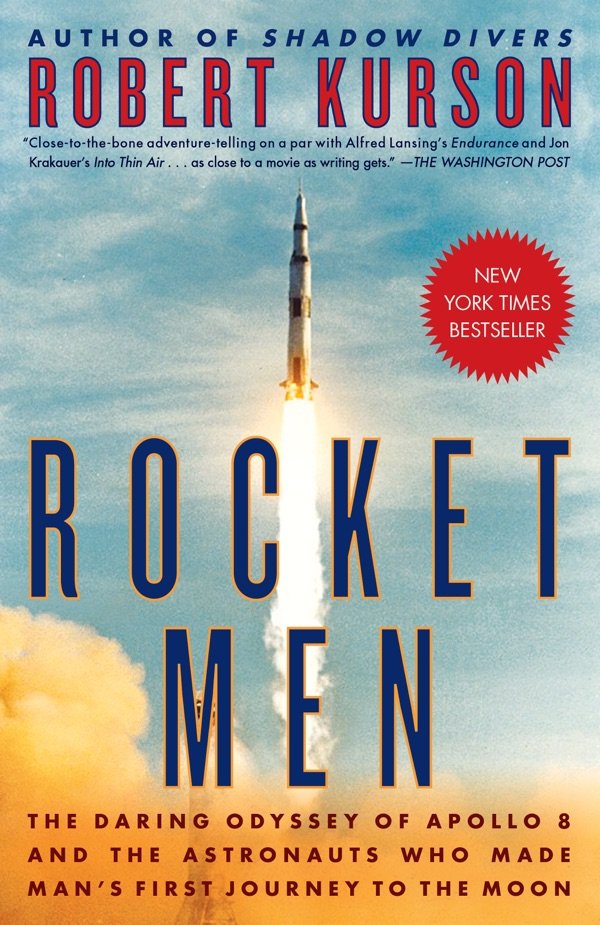
Rocket Men: The Daring Odyssey of Apollo 8 and the Astronauts Who Made Man's First Journey to the Moon
by Robert Kurson
In September 1958, Eisenhower signed into law the National Defense Education Act, which provided billions of dollars for the education of young Americans in science and related subjects. And in October, he opened a space agency, the National Aeronautics and Space Administration, known as NASA, which took on the eight thousand workers and $100 million budget of its predecessor agency, the National Advisory Committee for Aeronautics (NACA). Many of its employees were young scientists, engineers, and visionaries. NASA made four more manned trips to the Moon after Apollo 13, all of which successfully landed crews on the surface. Collectively, the astronauts on the Apollo missions returned almost 842 pounds of lunar soil and rock, samples that continue to form the bedrock upon which our understanding of the solar system’s origins is based. In all, twelve Americans walked on the Moon between 1969 and 1972. And that was it. Since Apollo 17, humankind has never returned.
The Moon’s gravitational pull on Earth is equally important; without it, Earth would wobble on its axis and lose its moderate climate. Summer temperatures could exceed 200 degrees Fahrenheit. Much of Earth could sink beneath water. Spinning faster without the Moon’s grip, Earth days might last just eight hours, winds would reach hurricane strengths, and life would be difficult, if not impossible.
Earthrise was the most beautiful sight Borman had ever seen, the only color visible in all the cosmos. The planet just hung there, a jewel on black velvet, and it struck him that everything he loved—Susan, the boys, his parents, his friends, his country—was on that tiny sphere, a brilliant blue and white interruption in a never-ending darkness, the only place he or anyone else had to call home.
“I believe that this nation should commit itself to achieving the goal, before this decade is out, of landing a man on the Moon and returning him safely to the Earth. No single space project in this period will be more impressive to mankind, or more important for the long-range exploration of space; and none will be so difficult or expensive to accomplish.”
But the worst experience came at Cornell University, where astronomy professor Carl Sagan invited Borman and Susan to his home for a roundtable with students. The Bormans accepted, then were treated to an evening of attacks on America and its conduct in Vietnam, all of it encouraged by Sagan, whom Borman would never forgive for the treatment.
In a year that was shaping up to be among the most fractious in the nation’s history, in which its citizens were rippling with anger and its institutions were no longer trusted, something sublime had occurred in this office. Shaking hands, Kraft and Borman had the same thought: This was a great afternoon. This was America at her best.
"In September 1958, Eisenhower signed into law the National Defense Education Act, which provided billions of dollars for the education of young Americans in science and related subjects. And in October, he opened a space agency, the National Aeronautics and Space Administration, known as NASA, which took on the eight thousand workers and $100 million budget of its predecessor agency, the National Advisory Committee for Aeronautics (NACA). Many of its employees were young scientists, engineers, and visionaries."
"NASA made four more manned trips to the Moon after Apollo 13, all of which successfully landed crews on the surface. Collectively, the astronauts on the Apollo missions returned almost 842 pounds of lunar soil and rock, samples that continue to form the bedrock upon which our understanding of the solar system’s origins is based. In all, twelve Americans walked on the Moon between 1969 and 1972. And that was it. Since Apollo 17, humankind has never returned."
"More than once the astronauts perished because someone didn’t fix problems correctly or in time. In those cases, the crew and controllers held a short briefing afterward, discussed how they’d failed and what could be improved, then tried again. Over and over, scenarios were run, often for full days at a time, the more catastrophic the better, until repetition began to groove instinct into all the participants, and dying helped the men learn to survive."
"One minute into the flight, Apollo 8 reached the speed of sound—767 miles per hour—and an altitude of about 24,000 feet. At that point, the roar and crackle generated by the interaction between engine exhaust and air could not move fast enough to catch up to the spacecraft, and the cabin grew quiet, the hum of its instrument panel the only noise Borman could detect. To him, it now sounded as if he was flying an unpowered glider."
"The Moon’s gravitational pull on Earth is equally important; without it, Earth would wobble on its axis and lose its moderate climate. Summer temperatures could exceed 200 degrees Fahrenheit. Much of Earth could sink beneath water. Spinning faster without the Moon’s grip, Earth days might last just eight hours, winds would reach hurricane strengths, and life would be difficult, if not impossible."
"Earthrise was the most beautiful sight Borman had ever seen, the only color visible in all the cosmos. The planet just hung there, a jewel on black velvet, and it struck him that everything he loved—Susan, the boys, his parents, his friends, his country—was on that tiny sphere, a brilliant blue and white interruption in a never-ending darkness, the only place he or anyone else had to call home."
"“I believe that this nation should commit itself to achieving the goal, before this decade is out, of landing a man on the Moon and returning him safely to the Earth. No single space project in this period will be more impressive to mankind, or more important for the long-range exploration of space; and none will be so difficult or expensive to accomplish.”"
- →But the worst experience came at Cornell University, where astronomy professor Carl Sagan invited Borman and Susan to his home for a roundtable with students. The Bormans accepted, then were treated to an evening of attacks on America and its conduct in Vietnam, all of it encouraged by Sagan, whom Borman would never forgive for the treatment.
- →By early August 1968, things looked dire for the American space program. The Saturn V rocket was in no shape to fly with a crew aboard. The Soviets looked ready to send men around the Moon by year’s end. And now, because of issues with the lunar module, Kennedy’s end-of-decade deadline for a lunar landing was slipping away.
- →“We just got word from the CIA that the Russians are planning a lunar fly-by before the end of the year. We want to change Apollo 8 from an Earth orbital to a lunar orbital flight. A lot has to come together. And Apollo 7 has to be perfect. But if it happens, Frank, do you want to go to the Moon?”
- →The flight was now just ten seconds old, but Anders already felt like a rat in the jaws of a giant, angry terrier, helpless to do anything but hang on and breathe while the five massive F-1 engines constantly swiveled their thrust to keep the 363-foot rocket from toppling over.
Looking for something similar?
Describe your situation. The search finds the right book from the entire library.