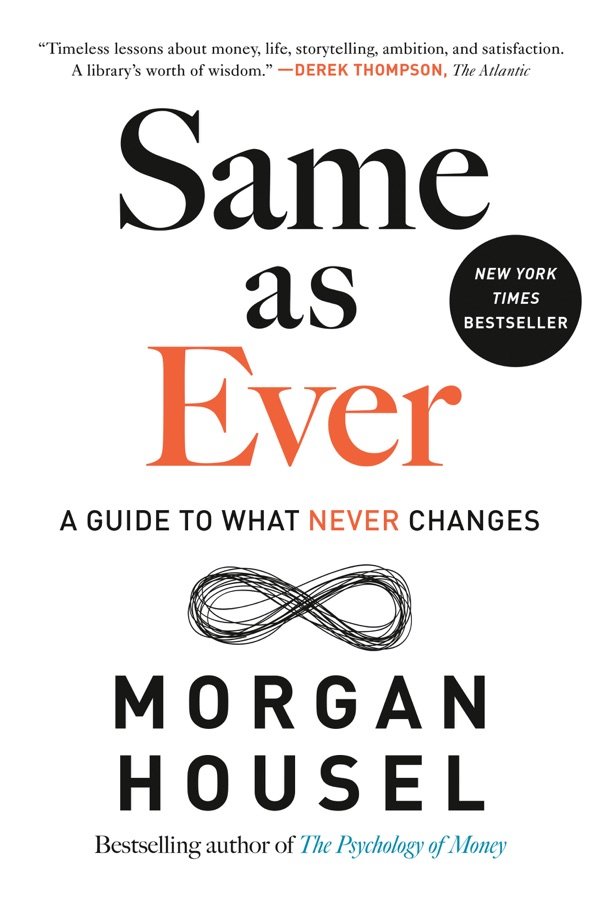
Same as Ever: A Guide to What Never Changes
by Morgan Housel
The decline of local news has all kinds of implications. One that doesn’t get much attention is that the wider the news becomes the more likely it is to be pessimistic. Two things make that so: • Bad news gets more attention than good news because pessimism is seductive and feels more urgent than optimism. • The odds of a bad news story—a fraud, a corruption, a disaster—occurring in your local town at any given moment is low. When you expand your attention nationally, the odds increase. When they expand globally, the odds of something terrible happening in any given moment are 100 percent. But usually a better question is, “What have you experienced that I haven’t that makes you believe what you do? And would I think about the world like you do if I experienced what you have?” It’s the question that contains the most answers about why people don’t agree with one another. But it’s such a hard question to ask. It’s uncomfortable to think that what you haven’t experienced might change what you believe, because it’s admitting your own ignorance. It’s much easier to assume that those who disagree with you aren’t thinking as hard as you are.
I read newspapers and books every day. I cannot recall one damn thing I read in a newspaper from, say, 2011. But I can tell you in detail about a few great books I read in 2011 and how they changed the way I think. I’ll remember them forever. I’ll keep reading newspapers. But if I read more books I’d probably develop better filters and frameworks that would help me make better sense of the news.
decade ago I made a goal to read more history and fewer forecasts. It was one of the most enlightening changes of my life. And the irony is that the more history I read, the more comfortable I became with the future. When you focus on what never changes, you stop trying to predict uncertain events and spend more time understanding timeless behavior. Hopefully this book nudged you down that path.
In any normal person’s life, miracles should occur at the rate of roughly one per month: The proof of the law is simple. During the time that we are awake and actively engaged in living our lives, roughly for eight hours each day, we see and hear things happening at a rate of one per second. So the total number of events that happen to us is about 30,000 per day, or about a million per month.
“The tendency for evolution to create larger species is counterbalanced by the tendency of extinction to kill off larger species.” Body size in biology is like leverage in investing: It accentuates the gains but amplifies the losses. It works well for a while and then backfires spectacularly at the point where the benefits are nice but the losses are lethal.
base predictions on how people behave rather than on specific events. Predicting what the world will look like fifty years from now is impossible. But predicting that people will still respond to greed, fear, opportunity, exploitation, risk, uncertainty, tribal affiliations, and social persuasion in the same way is a bet I’d take.
"The decline of local news has all kinds of implications. One that doesn’t get much attention is that the wider the news becomes the more likely it is to be pessimistic. Two things make that so: • Bad news gets more attention than good news because pessimism is seductive and feels more urgent than optimism. • The odds of a bad news story—a fraud, a corruption, a disaster—occurring in your local town at any given moment is low. When you expand your attention nationally, the odds increase. When they expand globally, the odds of something terrible happening in any given moment are 100 percent."
"But usually a better question is, “What have you experienced that I haven’t that makes you believe what you do? And would I think about the world like you do if I experienced what you have?” It’s the question that contains the most answers about why people don’t agree with one another. But it’s such a hard question to ask. It’s uncomfortable to think that what you haven’t experienced might change what you believe, because it’s admitting your own ignorance. It’s much easier to assume that those who disagree with you aren’t thinking as hard as you are."
"The magazine asked if he and show cocreator Larry David could have avoided burnout and kept the show going if they used a consulting company like McKinsey to create a more efficient writing process. Seinfeld asked if McKinsey is funny. No, the magazine said. “Then I don’t need them,” he said. “If you’re efficient, you’re doing it the wrong way. The right way is the hard way. The show was successful because I micromanaged it—every word, every line, every take, every edit, every casting.” If you’re efficient, you’re doing it the wrong way."
"Innovation is driven by incentives, which come in many forms. On one hand there’s “If I don’t figure this out I might get fired.” That will get your brain in gear. Then there’s “If I figure this out I might help people and make a lot of money.” That will produce creative sparks. Then there’s what militaries have dealt with: “If we don’t figure this out right now we’re all going to die and Adolf Hitler might take over the world.”"
"There’s a theory in evolutionary biology called Fisher’s Fundamental Theorem of Natural Selection. It’s the idea that variance equals strength, because the more diverse a population is, the more chances it has to come up with new traits that can be selected for. No one can know what traits will be useful; that’s not how evolution works. But if you create a lot of traits, the useful one—whatever it is—will be in there somewhere."
"Permanent information is harder to notice because it’s buried in books rather than blasted in headlines. But its benefit is huge. It’s not just that permanent information never expires, letting you accumulate it. It also compounds over time, leveraging off what you’ve already learned. Expiring information tells you what happened; permanent information tells you why something happened and is likely to happen again."
"Another point about long-term thinking is how it sways the information we consume. I try to ask when I’m reading: Will I care about this a year from now? Ten years from now? Eighty years from now? It’s fine if the answer is no, even a lot of the time. But if you’re honest with yourself you may begin to steer toward the more enduring bits of information. There are two types of information: permanent and expiring."
- →When you first start to study a field, it seems like you have to memorize a zillion things. You don’t. What you need is to identify the core principles—generally three to twelve of them—that govern the field. The million things you thought you had to memorize are simply various combinations of the core principles.
- →Burns says that when writing a documentary script he will literally extend a sentence so that it lines up with a certain beat in the background music; he will cut a sentence to do the same. “Music is God,” he says. “It’s not just the icing on the cake. It’s the fudge, baked right in there.”
- →as Benedict Evans says, “The more the Internet exposes people to new points of view, the angrier people get that different views exist.” Disagreement has less to do with what people know and more to do with what they’ve experienced.
- →“What do other people like me have? What do they do? Because that’s what I should have and do as well.” And this, I think, is a window into understanding why we yearn for the 1950s, despite today being better by almost any measure.
Looking for something similar?
Describe your situation. The search finds the right book from the entire library.