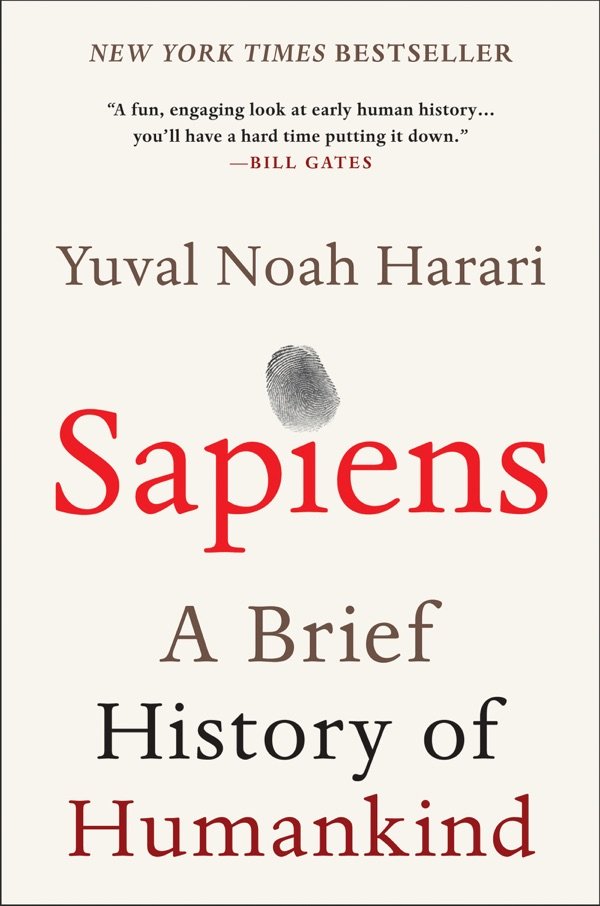
Sapiens: A Brief History of Humankind
by Yuval Noah Harari
Buddha agreed with modern biology and New Age movements that happiness is independent of external conditions. Yet his more important and far more profound insight was that true happiness is also independent of our inner feelings. Indeed, the more significance we give our feelings, the more we crave them, and the more we suffer. Buddha’s recommendation was to stop not only the pursuit of external achievements, but also the pursuit of inner feelings. Telling effective stories is not easy. The difficulty lies not in telling the story, but in convincing everyone else to believe it. Much of history revolves around this question: how does one convince millions of people to believe particular stories about gods, or nations, or limited liability companies? Yet when it succeeds, it gives Sapiens immense power, because it enables millions of strangers to cooperate and work towards common goals.
This approach is sometimes called memetics. It assumes that, just as organic evolution is based on the replication of organic information units called ‘genes’, so cultural evolution is based on the replication of cultural information units called ‘memes’.1 Successful cultures are those that excel in reproducing their memes, irrespective of the costs and benefits to their human hosts.
So why study history? Unlike physics or economics, history is not a means for making accurate predictions. We study history not to know the future but to widen our horizons, to understand that our present situation is neither natural nor inevitable, and that we consequently have many more possibilities before us than we imagine.
Don’t believe tree-huggers who claim that our ancestors lived in harmony with nature. Long before the Industrial Revolution, Homo sapiens held the record among all organisms for driving the most plant and animal species to their extinctions. We have the dubious distinction of being the deadliest species in the annals of biology.
Three important revolutions shaped the course of history: the Cognitive Revolution kick-started history about 70,000 years ago. The Agricultural Revolution sped it up about 12,000 years ago. The Scientific Revolution, which got under way only 500 years ago, may well end history and start something completely different.
The problem at the root of such calamities is that humans evolved for millions of years in small bands of a few dozen individuals. The handful of millennia separating the Agricultural Revolution from the appearance of cities, kingdoms and empires was not enough time to allow an instinct for mass cooperation to evolve.
"Buddha agreed with modern biology and New Age movements that happiness is independent of external conditions. Yet his more important and far more profound insight was that true happiness is also independent of our inner feelings. Indeed, the more significance we give our feelings, the more we crave them, and the more we suffer. Buddha’s recommendation was to stop not only the pursuit of external achievements, but also the pursuit of inner feelings."
"Telling effective stories is not easy. The difficulty lies not in telling the story, but in convincing everyone else to believe it. Much of history revolves around this question: how does one convince millions of people to believe particular stories about gods, or nations, or limited liability companies? Yet when it succeeds, it gives Sapiens immense power, because it enables millions of strangers to cooperate and work towards common goals."
"Ever since the Cognitive Revolution, Sapiens have thus been living in a dual reality. On the one hand, the objective reality of rivers, trees and lions; and on the other hand, the imagined reality of gods, nations and corporations. As time went by, the imagined reality became ever more powerful, so that today the very survival of rivers, trees and lions depends on the grace of imagined entities such as the United States and Google."
"In 1620 Francis Bacon published a scientific manifesto titled The New Instrument. In it he argued that ‘knowledge is power’. The real test of ‘knowledge’ is not whether it is true, but whether it empowers us. Scientists usually assume that no theory is 100 per cent correct. Consequently, truth is a poor test for knowledge. The real test is utility. A theory that enables us to do new things constitutes knowledge."
"UNDERSTANDING HUMAN HISTORY IN THE millennia following the Agricultural Revolution boils down to a single question: how did humans organise themselves in mass-cooperation networks, when they lacked the biological instincts necessary to sustain such networks? The short answer is that humans created imagined orders and devised scripts. These two inventions filled the gaps left by our biological inheritance."
"This approach is sometimes called memetics. It assumes that, just as organic evolution is based on the replication of organic information units called ‘genes’, so cultural evolution is based on the replication of cultural information units called ‘memes’.1 Successful cultures are those that excel in reproducing their memes, irrespective of the costs and benefits to their human hosts."
"So why study history? Unlike physics or economics, history is not a means for making accurate predictions. We study history not to know the future but to widen our horizons, to understand that our present situation is neither natural nor inevitable, and that we consequently have many more possibilities before us than we imagine."
- →Three important revolutions shaped the course of history: the Cognitive Revolution kick-started history about 70,000 years ago. The Agricultural Revolution sped it up about 12,000 years ago. The Scientific Revolution, which got under way only 500 years ago, may well end history and start something completely different.
- →The immense diversity of imagined realities that Sapiens invented, and the resulting diversity of behaviour patterns, are the main components of what we call ‘cultures’. Once cultures appeared, they never ceased to change and develop, and these unstoppable alterations are what we call ‘history’.
- →So perhaps happiness is synchronising one’s personal delusions of meaning with the prevailing collective delusions. As long as my personal narrative is in line with the narratives of the people around me, I can convince myself that my life is meaningful, and find happiness in that conviction.
- →How do you cause people to believe in an imagined order such as Christianity, democracy or capitalism? First, you never admit that the order is imagined. You always insist that the order sustaining society is an objective reality created by the great gods or by the laws of nature.
Looking for something similar?
Describe your situation. The search finds the right book from the entire library.