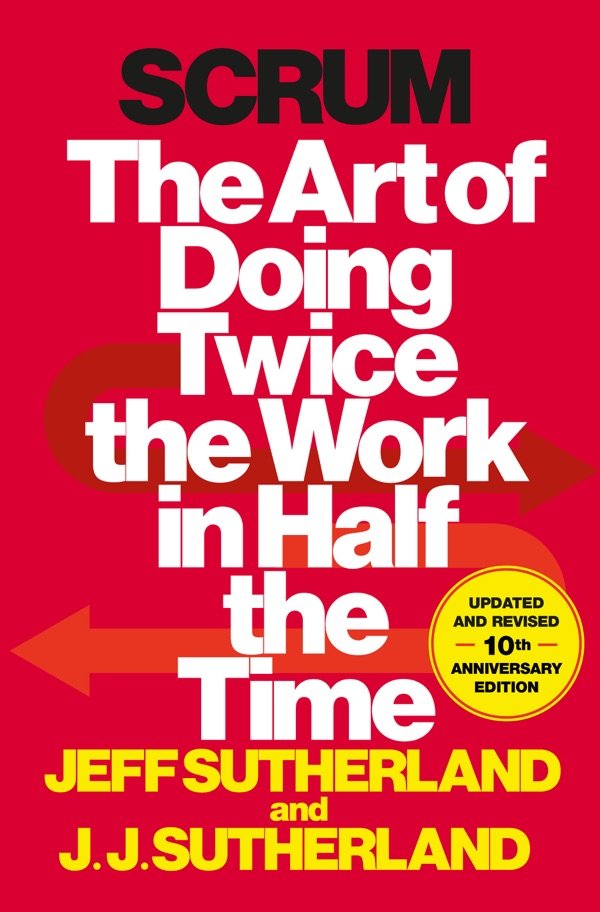
Scrum: The Art of Doing Twice the Work in Half the Time
by Jeff Sutherland
“Agile Manifesto.” It declared the following values: people over processes; products that actually work over documenting what that product is supposed to do; collaborating with customers over negotiating with them; and responding to change over following a plan. Scrum is the framework I built to put those values into practice. There is no methodology. Scrum asks those who engage in it to break from the mind-set of measuring merely hours. Hours themselves represent a cost. Instead, measure output. Who cares how many hours someone worked on something? All that matters is how fast it’s delivered and how good it is.
“Agile Manifesto.” It declared the following values: people over processes; products that actually work over documenting what that product is supposed to do; collaborating with customers over negotiating with them; and responding to change over following a plan. Scrum is the framework I built to put those values into practice. There is no methodology.
Scrum asks those who engage in it to break from the mind-set of measuring merely hours. Hours themselves represent a cost. Instead, measure output. Who cares how many hours someone worked on something? All that matters is how fast it’s delivered and how good it is.
All men dream: but not equally. Those who dream by night in the dusty recesses of their minds wake in the day to find that it was vanity: but the dreamers of the day are dangerous men, for they may act their dreams with open eyes, to make it possible.
One of the key concepts in Scrum is that the team members decide themselves how they’re going to do the work. It’s management’s responsibility to set the strategic goals, but it’s the team’s job to decide how to reach those goals.
Making people prioritize by value forces them to produce that 20 percent first. Often by the time they’re done, they realize they don’t really need the other 80 percent, or that what seemed important at the outset actually isn’t.
"“Agile Manifesto.” It declared the following values: people over processes; products that actually work over documenting what that product is supposed to do; collaborating with customers over negotiating with them; and responding to change over following a plan. Scrum is the framework I built to put those values into practice. There is no methodology."
"Scrum asks those who engage in it to break from the mind-set of measuring merely hours. Hours themselves represent a cost. Instead, measure output. Who cares how many hours someone worked on something? All that matters is how fast it’s delivered and how good it is."
"All men dream: but not equally. Those who dream by night in the dusty recesses of their minds wake in the day to find that it was vanity: but the dreamers of the day are dangerous men, for they may act their dreams with open eyes, to make it possible."
"One of the key concepts in Scrum is that the team members decide themselves how they’re going to do the work. It’s management’s responsibility to set the strategic goals, but it’s the team’s job to decide how to reach those goals."
"Making people prioritize by value forces them to produce that 20 percent first. Often by the time they’re done, they realize they don’t really need the other 80 percent, or that what seemed important at the outset actually isn’t."
"Scrum embraces uncertainty and creativity. It places a structure around the learning process, enabling teams to assess both what they’ve created and, just as important, how they created it."
"What Scrum does is bring teams together to create great things, and that requires everyone not only to see the end goal, but to deliver incrementally toward that goal."
- →All men dream: but not equally. Those who dream by night in the dusty recesses of their minds wake in the day to find that it was vanity: but the dreamers of the day are dangerous men, for they may act their dreams with open eyes, to make it possible.
- →One of the key concepts in Scrum is that the team members decide themselves how they’re going to do the work. It’s management’s responsibility to set the strategic goals, but it’s the team’s job to decide how to reach those goals.
- →Whenever there are handoffs between teams, there is the opportunity for disaster.
Looking for something similar?
Describe your situation. The search finds the right book from the entire library.