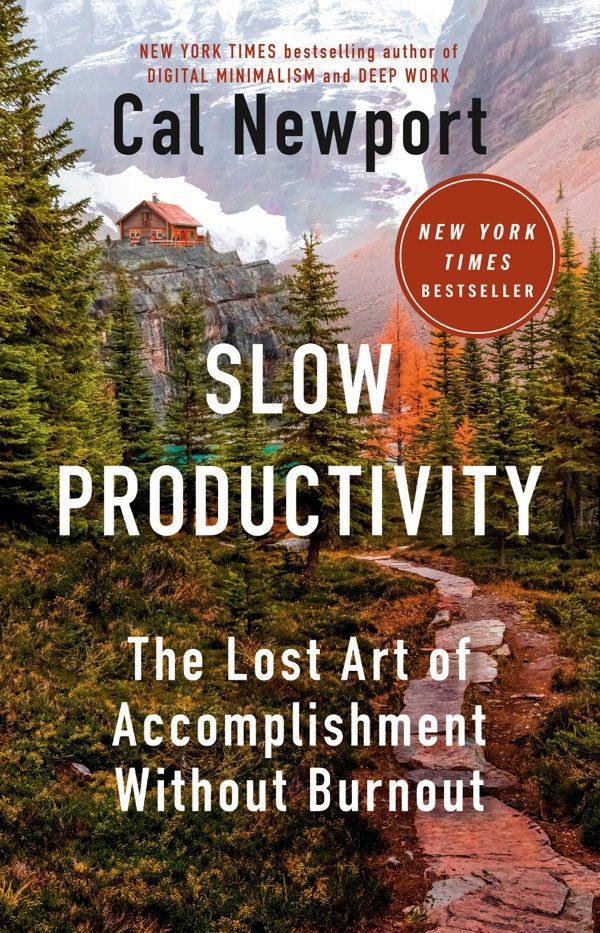
Slow Productivity: The Lost Art of Accomplishment Without Burnout
by Cal Newport
To gain this credibility, I recommend, at first, when considering a new project, you estimate how much time it will require and then go find that time and schedule it on your calendar. Block off the hours as you would for a meeting. If you’re unable to find enough blank spaces in your schedule in the near future to easily fit the work, then you don’t have enough time for it. Either decline the project, or cancel something else to make room. The power of this approach is that you’re dealing with the reality of your time, not a gut feeling about how busy you are at the moment. You I mention this well-worn tale of Jack Kerouac’s inspired writing binge because it neatly captures an obvious objection to the second principle of slow productivity: sometimes a natural pace is too slow. Important work, this objection argues, requires sustained high-intensity, perhaps even obsessive, attention. To stretch out timelines and vary effort levels might be fine for making average efforts more tolerable, but it’s not compatible with great work.
Doing fewer things and working at a natural pace are both absolutely necessary components of this philosophy, but if those earlier principles are implemented on their own, without an accompanying obsession with quality, they might serve only to fray your relationship to work over time—casting your professional efforts as an imposition that you must tame.
She’d arrive at six thirty in the morning, with a Bible, a yellow pad, and a bottle of sherry. No writing desk was necessary; she’d instead work lying across the bed, once explaining to George Plimpton, in an interview, how this habit led one of her elbows to become “absolutely encrusted” with calluses.
Moonves tried to save his network by pushing his employees to work more. What ended up mattering, however, was instead the obsessive efforts of an eccentric creative talent who spent over three years nurturing a vision, coming at it again and again in an attempt to create something special.fn1
There’s a calibrated steadiness to working on just one major initiative a day. Real progress accrues, while anxiety is subdued. This pace might seem slow in the moment, but zooming out to consider the results that eventually accrue over many months reveals the narrowness of this concern.
Give yourself enough time to produce something great, but not unlimited time. Focus on creating something good enough to catch the attention of those whose taste you care about, but relieve yourself of the need to forge a masterpiece. Progress is what matters. Not perfection.
"To gain this credibility, I recommend, at first, when considering a new project, you estimate how much time it will require and then go find that time and schedule it on your calendar. Block off the hours as you would for a meeting. If you’re unable to find enough blank spaces in your schedule in the near future to easily fit the work, then you don’t have enough time for it. Either decline the project, or cancel something else to make room. The power of this approach is that you’re dealing with the reality of your time, not a gut feeling about how busy you are at the moment. You"
"I mention this well-worn tale of Jack Kerouac’s inspired writing binge because it neatly captures an obvious objection to the second principle of slow productivity: sometimes a natural pace is too slow. Important work, this objection argues, requires sustained high-intensity, perhaps even obsessive, attention. To stretch out timelines and vary effort levels might be fine for making average efforts more tolerable, but it’s not compatible with great work."
"As the twentieth century progressed, this visible-activity heuristic became the dominant way we began thinking about productivity in knowledge work. It’s why we gather in office buildings using the same forty-hour workweeks originally developed for limiting the physical fatigue of factory labor, and why we feel guilty about ignoring our inboxes, or experience internalized pressure to volunteer or “perform busyness” when we see the boss is nearby."
"According to Jobs’s biographer, Walter Isaacson, Jobs began asking top managers a simple question: “Which ones do I tell my friends to buy?”15 When they couldn’t provide a clear answer, he made the decision to simplify their product line down to only four computers: a desktop and laptop for business users and a desktop and laptop for casual users. There would be no confusion about which Apple machine was right for you."
"Doing fewer things and working at a natural pace are both absolutely necessary components of this philosophy, but if those earlier principles are implemented on their own, without an accompanying obsession with quality, they might serve only to fray your relationship to work over time—casting your professional efforts as an imposition that you must tame."
"She’d arrive at six thirty in the morning, with a Bible, a yellow pad, and a bottle of sherry. No writing desk was necessary; she’d instead work lying across the bed, once explaining to George Plimpton, in an interview, how this habit led one of her elbows to become “absolutely encrusted” with calluses."
"Moonves tried to save his network by pushing his employees to work more. What ended up mattering, however, was instead the obsessive efforts of an eccentric creative talent who spent over three years nurturing a vision, coming at it again and again in an attempt to create something special.fn1"
- →Give yourself enough time to produce something great, but not unlimited time. Focus on creating something good enough to catch the attention of those whose taste you care about, but relieve yourself of the need to forge a masterpiece. Progress is what matters. Not perfection.
- →PRINCIPLE #1: DO FEWER THINGS Strive to reduce your obligations to the point where you can easily imagine accomplishing them with time to spare. Leverage this reduced load to more fully embrace and advance the small number of projects that matter most.
- →SLOW PRODUCTIVITY A philosophy for organizing knowledge work efforts in a sustainable and meaningful manner, based on the following three principles: 1. Do fewer things. 2. Work at a natural pace. 3. Obsess over quality.
- →A philosophy for organizing knowledge work efforts in a sustainable and meaningful manner, based on the following three principles: 1. Do fewer things. 2. Work at a natural pace. 3. Obsess over quality.
Looking for something similar?
Describe your situation. The search finds the right book from the entire library.