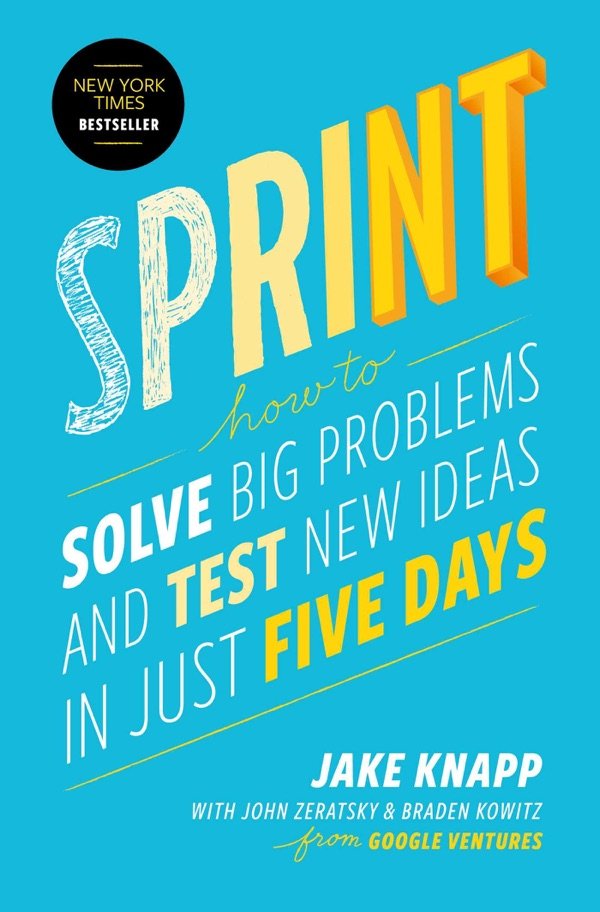
Sprint: How to Solve Big Problems and Test New Ideas in Just Five Days
by Jake Knapp
This distinction between feedback and reaction is crucial. You want to create a prototype that evokes honest reactions from your customers. You want it to be as real as possible, while sticking to your one-day timeline. As our partner Daniel Burka says, the ideal prototype should be “Goldilocks quality.” If the quality is too low, people won’t believe the prototype is a real product. If the quality is too high, you’ll be working all night and you won’t finish. You need Goldilocks quality. Not too high, not too low, but just right. To build the perfect sprint team, first you’re going to need a Danny Ocean: someone with authority to make decisions. That person is the Decider, a role so important we went ahead and capitalized it. The Decider is the official decision-maker for the project.
To build the perfect sprint team, first you’re going to need a Danny Ocean: someone with authority to make decisions. That person is the Decider, a role so important we went ahead and capitalized it. The Decider is the official decision-maker for the project.
An important part of this exercise is rephrasing assumptions and obstacles into questions.
Monday’s structured discussions create a path for the sprint week. In the morning, you’ll start at the end and agree to a long-term goal. Next, you’ll make a map of the challenge. In the afternoon, you’ll ask the experts at your company to share what they know. Finally, you’ll pick a target: an ambitious but manageable piece of the problem that you can solve in one week.
On Monday, you’ll map out the problem and pick an important place to focus. On Tuesday, you’ll sketch competing solutions on paper. On Wednesday, you’ll make difficult decisions and turn your ideas into a testable hypothesis. On Thursday, you’ll hammer out a realistic prototype. And on Friday, you’ll test it with real live humans.
Get that surface right, and you can work backward to figure out the underlying systems or technology. Focusing on the surface allows you to move fast and answer big questions before you commit to execution, which is why any challenge, no matter how large, can benefit from a sprint.
"This distinction between feedback and reaction is crucial. You want to create a prototype that evokes honest reactions from your customers. You want it to be as real as possible, while sticking to your one-day timeline. As our partner Daniel Burka says, the ideal prototype should be “Goldilocks quality.” If the quality is too low, people won’t believe the prototype is a real product. If the quality is too high, you’ll be working all night and you won’t finish. You need Goldilocks quality. Not too high, not too low, but just right."
"To build the perfect sprint team, first you’re going to need a Danny Ocean: someone with authority to make decisions. That person is the Decider, a role so important we went ahead and capitalized it. The Decider is the official decision-maker for the project."
"An important part of this exercise is rephrasing assumptions and obstacles into questions."
"Monday’s structured discussions create a path for the sprint week. In the morning, you’ll start at the end and agree to a long-term goal. Next, you’ll make a map of the challenge. In the afternoon, you’ll ask the experts at your company to share what they know. Finally, you’ll pick a target: an ambitious but manageable piece of the problem that you can solve in one week."
"On Monday, you’ll map out the problem and pick an important place to focus. On Tuesday, you’ll sketch competing solutions on paper. On Wednesday, you’ll make difficult decisions and turn your ideas into a testable hypothesis. On Thursday, you’ll hammer out a realistic prototype. And on Friday, you’ll test it with real live humans."
"Get that surface right, and you can work backward to figure out the underlying systems or technology. Focusing on the surface allows you to move fast and answer big questions before you commit to execution, which is why any challenge, no matter how large, can benefit from a sprint."
"But turning these potential problems into questions makes them easier to track—and easier to answer with sketches, prototypes, and tests. It also creates a subtle shift from uncertainty (which is uncomfortable) to curiosity (which is exciting)."
- →To build the perfect sprint team, first you’re going to need a Danny Ocean: someone with authority to make decisions. That person is the Decider, a role so important we went ahead and capitalized it. The Decider is the official decision-maker for the project.
- →“Why are we doing this project? Where do we want to be six months, a year, or even five years from now?”
Looking for something similar?
Describe your situation. The search finds the right book from the entire library.