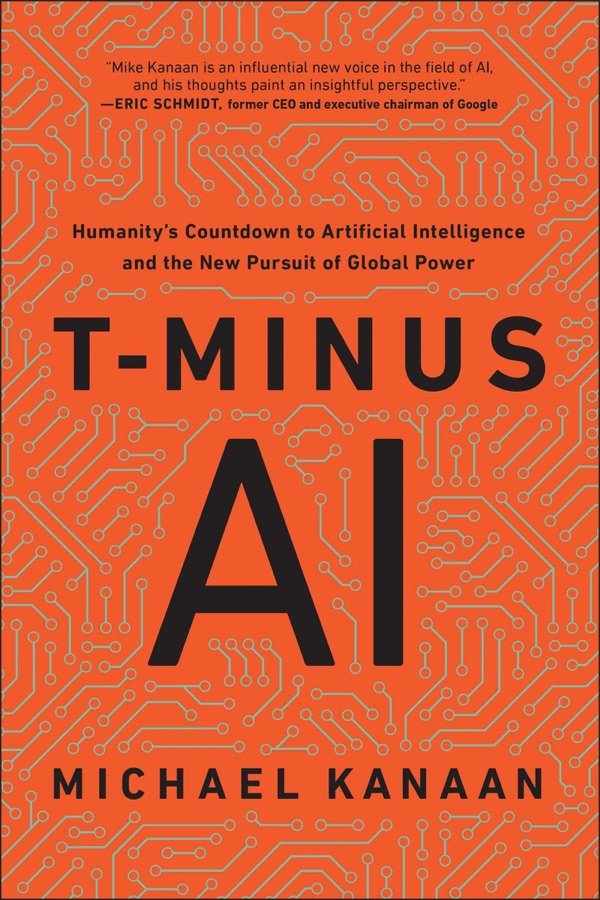
T-Minus AI: Humanity's Countdown to Artificial Intelligence and the New Pursuit of Global Power
by Michael Kanaan
While China is receiving increasing international condemnation for its repression of the Uighurs, the atrocities have apparently continued unabated. In late 2019 and early 2020, the world learned that the Chinese government had systematically destroyed dozens of Uighur cemeteries in and around Xinjiang in an effort to eradicate their ethnic identity.5 The world is now also learning that Xi's government is beginning to use advanced facial recognition technologies to identify and track Uighurs not only in Xinjiang, but throughout other parts of the country as well. It is, to put it bluntly but accurately, the implementation of AI for government-funded, state-purposed racial profiling.6 Uighurs, who descend from a different genetic lineage than the Han majority of Chinese, tend to have more Central Asian and Mediterranean facial features, a different skin tone, and a generally different physical build. Facial recognition software integrated into China's national surveillance cameras is now reportedly being used for "minority identification" purposes, specifically to spot and identify people of Uighur heritage. Through deep-learning algorithms that can identify patterns of facial features, databases are apparently being built by police forces and other agencies in various parts of the country to keep and analyze records of the whereabouts and activities of the Uighurs. in nanoseconds, we can't watch each of the instantaneous interconnections and interactions occurring in the hidden layers. But bat doesn't mean there's some mystical or inherently unreliable process out within them. It only means that we see the end result of the playing esessment, not the interim steps, just as we do in the case of our own minds. If a neural net could describe “how" or “why" it came to the conclusion it did, the description wouldn't be much different from what we would say about our own assessments of information streaming into Qur own brains. We would probably say something like, "Well, I thought about it and just concluded what I did-based, I imagine, on all of my prior experiences and the information that was newly available to me." Similarly, a machine learning system would say that it assessed the information, made its calculations, and predicted that its output was accurate, or most probable. In both cases, although we might have no idea of the precise measurements occurring deep at the evaluative levels, at the end of the process we feel confident that we’ve made sense of the data, and that we can likewise feel confident of whatever we’ve concluded.
Our job is now to convince the public in particular that using AI to achieve these aims is a necessary and desirable part of our society, but we cannot afford to do so unless we know how it will best be used and when. But in the end, the future demands we make moral decisions as we begin to build a world that is truly safe and sustainable, one where humans and AI can truly coexist together.
Al is a disruptive technology with widespread influence that may cause: transformation of employment structures; impact on legal and social theories; violations of personal privacy; challenges in international relations and norms; and other problems. It will have far-reaching effects on the management of government, economic security, and social stability, as well as global governance.
it most poignantly: "What surprised me the most was that AlphaGo showed us that moves humans may have thought are creative were actually conventional."Fan Hui, the European champion who had been the first to lose to AlphaGo, also reflected, "Maybe AlphaGo can just show humans something we never discovered. Maybe it's beautiful."
"While China is receiving increasing international condemnation for its repression of the Uighurs, the atrocities have apparently continued unabated. In late 2019 and early 2020, the world learned that the Chinese government had systematically destroyed dozens of Uighur cemeteries in and around Xinjiang in an effort to eradicate their ethnic identity.5 The world is now also learning that Xi's government is beginning to use advanced facial recognition technologies to identify and track Uighurs not only in Xinjiang, but throughout other parts of the country as well. It is, to put it bluntly but accurately, the implementation of AI for government-funded, state-purposed racial profiling.6 Uighurs, who descend from a different genetic lineage than the Han majority of Chinese, tend to have more Central Asian and Mediterranean facial features, a different skin tone, and a generally different physical build. Facial recognition software integrated into China's national surveillance cameras is now reportedly being used for "minority identification" purposes, specifically to spot and identify people of Uighur heritage. Through deep-learning algorithms that can identify patterns of facial features, databases are apparently being built by police forces and other agencies in various parts of the country to keep and analyze records of the whereabouts and activities of the Uighurs."
"in nanoseconds, we can't watch each of the instantaneous interconnections and interactions occurring in the hidden layers. But bat doesn't mean there's some mystical or inherently unreliable process out within them. It only means that we see the end result of the playing esessment, not the interim steps, just as we do in the case of our own minds. If a neural net could describe “how" or “why" it came to the conclusion it did, the description wouldn't be much different from what we would say about our own assessments of information streaming into Qur own brains. We would probably say something like, "Well, I thought about it and just concluded what I did-based, I imagine, on all of my prior experiences and the information that was newly available to me." Similarly, a machine learning system would say that it assessed the information, made its calculations, and predicted that its output was accurate, or most probable. In both cases, although we might have no idea of the precise measurements occurring deep at the evaluative levels, at the end of the process we feel confident that we’ve made sense of the data, and that we can likewise feel confident of whatever we’ve concluded."
"Twentieth-century German American philosopher Hannah Arendt said it well: "A people that no longer can believe anything cannot make up its mind. It is deprived not only of its capacity to act but also of its capacity to think and to judge. And with such a people you can do what you please."23 That axionm holds true in both domestic and foreign policy, and the creation and distribution of disinformation has been a Russian political methodology predating the Soviets. Under Putin, digital disinformation has become a vital component of Russian foreign policy strategies. To Russian cyber operatives, fake news stories implanted within foreign social media and news platforms are considered doctrinally appropriate political and military measures. They regularly use AI-enabled algorithms to create and manipulate information to spread provocative and intentionally misleading political reports, social slogans, fake news stories, and contrived or mislabeled photos and videos."
"Security has always been a question and an area of significant concern when it comes to cloud computing. People are understandably curious about how their data can remain safe when traveling back and forth over the internet. In reality, though, cloud-based systems are generally far more secure than conventional, localized ones. There's an economy of scale and expertise that applies and that makes providers of cloudbased services much more capable of effective security measures than smaller, independent users. Large, sophisticated providers like Amazon, Microsoft, and Google are far more capable of providing qualified IT personnel, cutting-edge security programs, and carefully constructed and secure facilities than individual citizens or most companies could ever hope to acquire or properly manage themselves. As a result, security is actually a compelling reason to use cloud-based systems rather than avoid them."
"Since 2015, China has been developing a "social credit "powered by AI that is expected to be a unified, fully operational umbrella covering all 1.4 billion of its people by 2022. The system is meant to collect all forms of digital data in order to calculate the “social trustworthiness" of individual citizens, and then reward or punish them irher allowing or restricting various opportunities and entitlements based on their scores. The formal and publicly stated aim of the system s to “allow the trustworthy to roam everywhere under heaven while making it hard for the discredited to take a single step." An additional party slogan for the system is "Once discredited, limited everywhere.“ The analogies to George Orwell's novel 1984, and its themes of government overreach and Big Brother's regimentation of social behavior are hard to deny."
"Militarily, China doesn't approach the size, power, or of the US and its allies, which lead by a wide margin on the ground in the air, and at sea. But China views AI technology as its opportunity to leapfrog certain phases of weapons development to bridge the gap between it and the US. In October 2018, the deputy director of the General Office of China's Central Military Commission confirmed the Chinese military's vision for AI when he characterized China's overall goal as an effort to "narrow the gap between the Chinese military and global advanced powers" by taking advantage of the "ongoing military revolution... centered on information technology and intelligent technology.""
"Turing called his machine the Bombe after the earlier, manually operated Polish Bomba. Turing's was an extravagantly complicated machine for the tìme, built of more than 12 miles of electrical wiring and more than 97,000 mechanical parts. The Bombe's significance for modern computing is that it was the first machine to capably sort through tremendous amounts of variable information to find a solution that a human couldn't possibly accomplish on his or her own. That same basic purpose is essentially what today's computers do. And although modern computers are infinitely more refined than the Bombe, they are, at the core of their function, arguably no different."
- →it most poignantly: "What surprised me the most was that AlphaGo showed us that moves humans may have thought are creative were actually conventional."Fan Hui, the European champion who had been the first to lose to AlphaGo, also reflected, "Maybe AlphaGo can just show humans something we never discovered. Maybe it's beautiful."
Looking for something similar?
Describe your situation. The search finds the right book from the entire library.