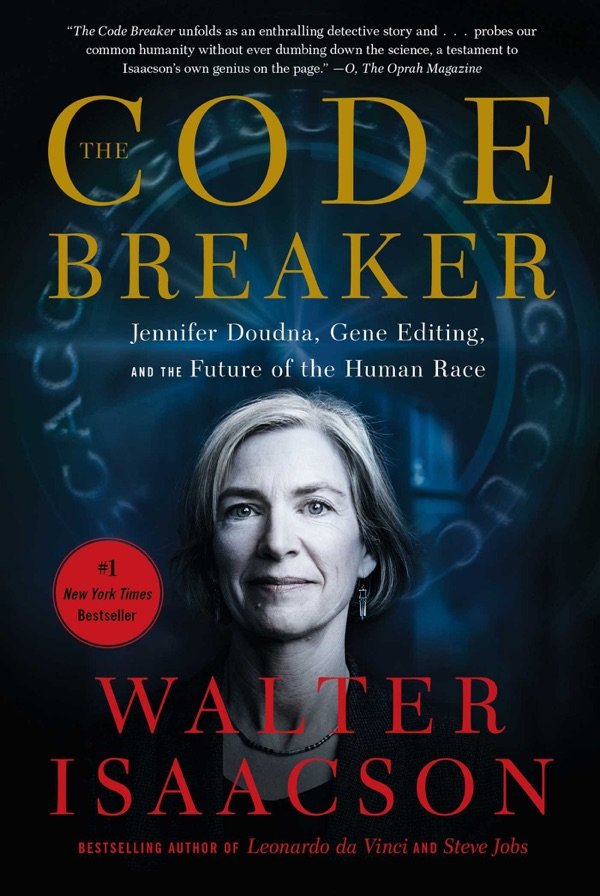
The Code Breaker: Jennifer Doudna, Gene Editing, and the Future of the Human Race
by Walter Isaacson
Enzymes are a type of protein. Their main function is to act as a catalyst that sparks chemical reactions in the cells of living organisms, from bacteria to humans. There are more than five thousand biochemical reactions that are catalyzed by enzymes. These include breaking down starches and proteins in the digestive system, causing muscles to contract, sending signals between cells, regulating metabolism, and (most important for this discussion) cutting and splicing DNA and RNA. RNA interference operates by deploying an enzyme known as “Dicer.” Dicer snips a long piece of RNA into short fragments. These little fragments can then embark on a search-and-destroy mission: they seek out a messenger RNA molecule that has matching letters, then they use a scissors-like enzyme to chop it up. The genetic information carried by that messenger RNA is thus silenced.
RNA interference operates by deploying an enzyme known as “Dicer.” Dicer snips a long piece of RNA into short fragments. These little fragments can then embark on a search-and-destroy mission: they seek out a messenger RNA molecule that has matching letters, then they use a scissors-like enzyme to chop it up. The genetic information carried by that messenger RNA is thus silenced.
It turns out that tracrRNA performs two important tasks. First, it facilitates the making of the crRNA, the sequence that carries the memory of a virus that previously attacked the bacteria. Then it serves as a handle to latch on to the invading virus so that the crRNA can target the right spot for the Cas9 enzyme to chop.
The gene-editing tool that Doudna and others developed in 2012 is based on a virus-fighting trick used by bacteria, which have been battling viruses for more than a billion years. In their DNA, bacteria develop clustered repeated sequences, known as CRISPRs, that can remember and then destroy viruses that attack them.
The invention of CRISPR and the plague of COVID will hasten our transition to the third great revolution of modern times. These revolutions arose from the discovery, beginning just over a century ago, of the three fundamental kernels of our existence: the atom, the bit, and the gene.
The easiest of these viruses to study are the ones that attack bacteria, and they were dubbed (remember the term, for it will reappear when we discuss the discovery of CRISPR) “phages,” which was short for “bacteriophages,” meaning bacteria-eaters.
"Enzymes are a type of protein. Their main function is to act as a catalyst that sparks chemical reactions in the cells of living organisms, from bacteria to humans. There are more than five thousand biochemical reactions that are catalyzed by enzymes. These include breaking down starches and proteins in the digestive system, causing muscles to contract, sending signals between cells, regulating metabolism, and (most important for this discussion) cutting and splicing DNA and RNA."
"RNA interference operates by deploying an enzyme known as “Dicer.” Dicer snips a long piece of RNA into short fragments. These little fragments can then embark on a search-and-destroy mission: they seek out a messenger RNA molecule that has matching letters, then they use a scissors-like enzyme to chop it up. The genetic information carried by that messenger RNA is thus silenced."
"It turns out that tracrRNA performs two important tasks. First, it facilitates the making of the crRNA, the sequence that carries the memory of a virus that previously attacked the bacteria. Then it serves as a handle to latch on to the invading virus so that the crRNA can target the right spot for the Cas9 enzyme to chop."
"The gene-editing tool that Doudna and others developed in 2012 is based on a virus-fighting trick used by bacteria, which have been battling viruses for more than a billion years. In their DNA, bacteria develop clustered repeated sequences, known as CRISPRs, that can remember and then destroy viruses that attack them."
"The invention of CRISPR and the plague of COVID will hasten our transition to the third great revolution of modern times. These revolutions arose from the discovery, beginning just over a century ago, of the three fundamental kernels of our existence: the atom, the bit, and the gene."
"The easiest of these viruses to study are the ones that attack bacteria, and they were dubbed (remember the term, for it will reappear when we discuss the discovery of CRISPR) “phages,” which was short for “bacteriophages,” meaning bacteria-eaters."
"Her work also illustrates, as Leonardo da Vinci’s did, that the key to innovation is connecting a curiosity about basic science to the practical work of devising tools that can be applied to our lives—moving discoveries from lab bench to bedside."
- →Her work also illustrates, as Leonardo da Vinci’s did, that the key to innovation is connecting a curiosity about basic science to the practical work of devising tools that can be applied to our lives—moving discoveries from lab bench to bedside.
Looking for something similar?
Describe your situation. The search finds the right book from the entire library.