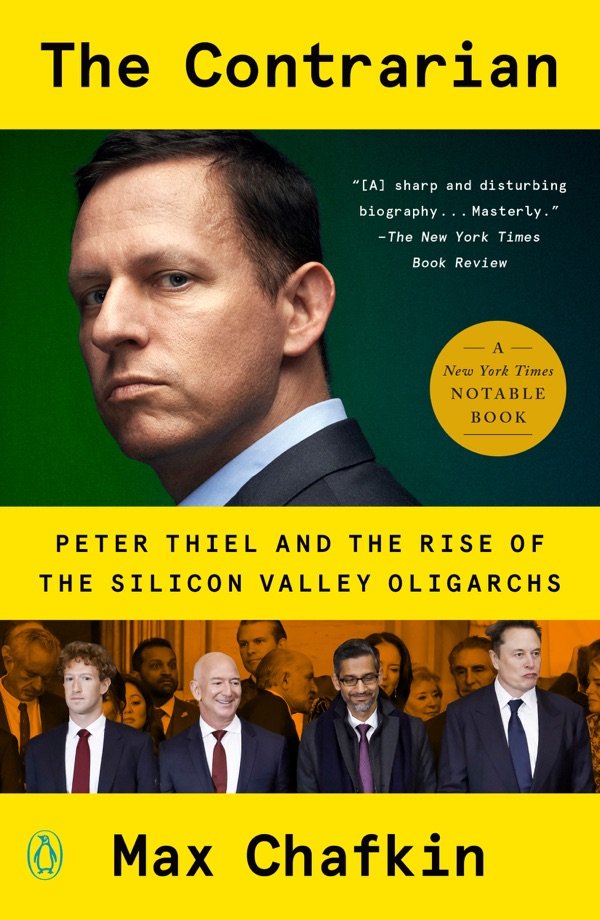
The Contrarian: Peter Thiel and the Rise of the Silicon Valley Oligarchs
by Max Chafkin
What I learned was eye-opening: Thiel, according to his friends, is brilliant—capable of visionary insights and with an uncanny ability to know exactly how to win. He has the special ability to see life like a chess game—using his friends, his business partners, and his portfolio companies as means to an end. There was a less appealing side to this, of course. The Machiavellian tendencies could make him coldly transactional, to the point, sometimes, of cruelty. This has been the consensus view on Thiel—that he is a consummate freethinker, a man constitutionally incapable of following the herd. It’s one that Thiel himself has endorsed at times. “Maybe I do always have this background program running where I’m trying to think of, ‘O.K., what’s the opposite of what you’re saying?’ and then I’ll try that,” he said shortly after the 2016 election. “It works surprisingly often.”
“Peter likes the gamesmanship of investing—like we’re all playing chess. I don’t mind that, but I’m fundamentally into doing engineering and design. I’m not an investor. I feel like using other people’s money is not cool.” A person who has talked to each man about the other put it more succinctly: “Musk thinks Peter is a sociopath, and Peter thinks Musk is a fraud and a braggart.”
Girard’s big idea—which Thiel would internalize and adopt as a guiding principle, both in investing and in life—was that people are motivated, at their core, by a desire to imitate one another. We don’t want the things we want, Girard argued, because we judge them to be good; we want them because other people want them.
Thiel’s senior quote was from The Hobbit: “The greatest adventure is what lies ahead / Today and tomorrow are yet to be said.” Years later he’d say that he’d memorized the entire passage, which continues: “The chances, the changes are all yours to make / The mold of your life is in your hands to break.”
This shift was part and parcel with Thiel’s other project: an attempt to impose a brand of extreme libertarianism that shifts power from traditional institutions toward startup companies and the billionaires who control them.
Thiel’s plan had been to use his political notoriety to establish himself as a serious macro investor—a category of fund manager that places bets on big global economic swings, which are often connected to politics.
"What I learned was eye-opening: Thiel, according to his friends, is brilliant—capable of visionary insights and with an uncanny ability to know exactly how to win. He has the special ability to see life like a chess game—using his friends, his business partners, and his portfolio companies as means to an end. There was a less appealing side to this, of course. The Machiavellian tendencies could make him coldly transactional, to the point, sometimes, of cruelty."
"This has been the consensus view on Thiel—that he is a consummate freethinker, a man constitutionally incapable of following the herd. It’s one that Thiel himself has endorsed at times. “Maybe I do always have this background program running where I’m trying to think of, ‘O.K., what’s the opposite of what you’re saying?’ and then I’ll try that,” he said shortly after the 2016 election. “It works surprisingly often.”"
"“I thought that a lot of the conventional ways people competed resulted in too many people [doing] conventional things,” he would say years later. “Then you end up in very competitive dynamics, and then even when you win it’s not quite worth it. You might get a slightly better paying job than you otherwise would, but you sort of have to sell your soul. That doesn’t sound like a very good economic or moral tradeoff.”"
"“Peter likes the gamesmanship of investing—like we’re all playing chess. I don’t mind that, but I’m fundamentally into doing engineering and design. I’m not an investor. I feel like using other people’s money is not cool.” A person who has talked to each man about the other put it more succinctly: “Musk thinks Peter is a sociopath, and Peter thinks Musk is a fraud and a braggart.”"
"Girard’s big idea—which Thiel would internalize and adopt as a guiding principle, both in investing and in life—was that people are motivated, at their core, by a desire to imitate one another. We don’t want the things we want, Girard argued, because we judge them to be good; we want them because other people want them."
"Thiel’s senior quote was from The Hobbit: “The greatest adventure is what lies ahead / Today and tomorrow are yet to be said.” Years later he’d say that he’d memorized the entire passage, which continues: “The chances, the changes are all yours to make / The mold of your life is in your hands to break.”"
"This shift was part and parcel with Thiel’s other project: an attempt to impose a brand of extreme libertarianism that shifts power from traditional institutions toward startup companies and the billionaires who control them."
- →Girard’s big idea—which Thiel would internalize and adopt as a guiding principle, both in investing and in life—was that people are motivated, at their core, by a desire to imitate one another. We don’t want the things we want, Girard argued, because we judge them to be good; we want them because other people want them.
- →Thiel’s plan had been to use his political notoriety to establish himself as a serious macro investor—a category of fund manager that places bets on big global economic swings, which are often connected to politics.
- →To start a company was no longer to help people reach their true potential; it was to flaunt norms, then change them, and, in changing them, set yourself up to get rich off the new order.
Looking for something similar?
Describe your situation. The search finds the right book from the entire library.