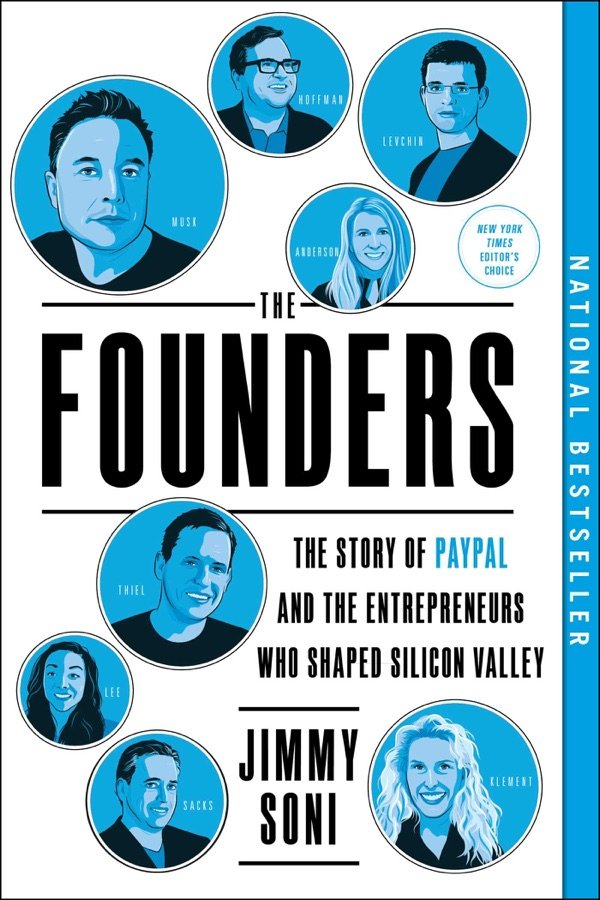
The Founders: The Story of Paypal and the Entrepreneurs Who Shaped Silicon Valley
by Jimmy Soni
To win, you need to tell a story about cogs. At Google, you’re a cog. Whereas with me, you’re an instrumental piece of this great thing that we’ll build together. Articulate the vision. Don’t even try to pay well. Meet people’s cash flow needs. Pay them so they can cover their rent and go out every once in a while. It’s not about cash. It’s about breaking through the wall of cynicism. It’s about making 1% of this new thing way more exciting than a couple hundred grand and a cubicle at Google. Musk echoed this sentiment. “If there were two paths where we had to choose one thing or the other, and one wasn’t obviously better than the other,” he explained in a 2003 public talk at Stanford, “then rather than spend a lot of time trying to figure out which one was slightly better, we would just pick one and do it. And sometimes we’d be wrong.… But oftentimes it’s better to just pick a path and do it rather than just vacillate endlessly on the choice.”
“And then engage in sort of a recursive self-improvement… keep iterating on a loop that says, ‘Am I doing something useful for other people?’ Because that’s what a company is supposed to do.” Too much precision in early plans, he believed, cut that iterative loop prematurely.
“They hired really good people, gave them a lot of trust, and so people ran at their own pace, just made sure that they checkpointed to make sure we were in sync occasionally. And then we would just keep on running. So they got the best out of some very, very smart people.”
“A good rule of thumb is that diversity of opinion is essential anytime you don’t know anything about something important. But if there’s a strong sense of what’s right already, don’t argue about it.”
“This was one of the lessons we had about PR early on,” Nosek remembered. “It was much more important for recruiting and for perception among investors than it is about actual product adoption.”
Brilliance, nonconformity, availability, and the willing suspension of disbelief—these qualities defined Confinity’s first hires and formed the foundation of its culture.
"To win, you need to tell a story about cogs. At Google, you’re a cog. Whereas with me, you’re an instrumental piece of this great thing that we’ll build together. Articulate the vision. Don’t even try to pay well. Meet people’s cash flow needs. Pay them so they can cover their rent and go out every once in a while. It’s not about cash. It’s about breaking through the wall of cynicism. It’s about making 1% of this new thing way more exciting than a couple hundred grand and a cubicle at Google."
"Musk echoed this sentiment. “If there were two paths where we had to choose one thing or the other, and one wasn’t obviously better than the other,” he explained in a 2003 public talk at Stanford, “then rather than spend a lot of time trying to figure out which one was slightly better, we would just pick one and do it. And sometimes we’d be wrong.… But oftentimes it’s better to just pick a path and do it rather than just vacillate endlessly on the choice.”"
"For Musk, the Scotiabank internship proved “how lame banks are.” Fear of the unknown had cost them billions, and in his later efforts at X.com and PayPal, he’d return to this experience as evidence that the banks could be beaten. “If they’re this bad at innovation, then any company that enters the financial space should not fear that the banks will crush them—because the banks do not innovate,” Musk concluded."
"“And then engage in sort of a recursive self-improvement… keep iterating on a loop that says, ‘Am I doing something useful for other people?’ Because that’s what a company is supposed to do.” Too much precision in early plans, he believed, cut that iterative loop prematurely."
"“They hired really good people, gave them a lot of trust, and so people ran at their own pace, just made sure that they checkpointed to make sure we were in sync occasionally. And then we would just keep on running. So they got the best out of some very, very smart people.”"
"“A good rule of thumb is that diversity of opinion is essential anytime you don’t know anything about something important. But if there’s a strong sense of what’s right already, don’t argue about it.”"
"“This was one of the lessons we had about PR early on,” Nosek remembered. “It was much more important for recruiting and for perception among investors than it is about actual product adoption.”"
- →“And then engage in sort of a recursive self-improvement… keep iterating on a loop that says, ‘Am I doing something useful for other people?’ Because that’s what a company is supposed to do.” Too much precision in early plans, he believed, cut that iterative loop prematurely.
- →“They hired really good people, gave them a lot of trust, and so people ran at their own pace, just made sure that they checkpointed to make sure we were in sync occasionally. And then we would just keep on running. So they got the best out of some very, very smart people.”
Looking for something similar?
Describe your situation. The search finds the right book from the entire library.