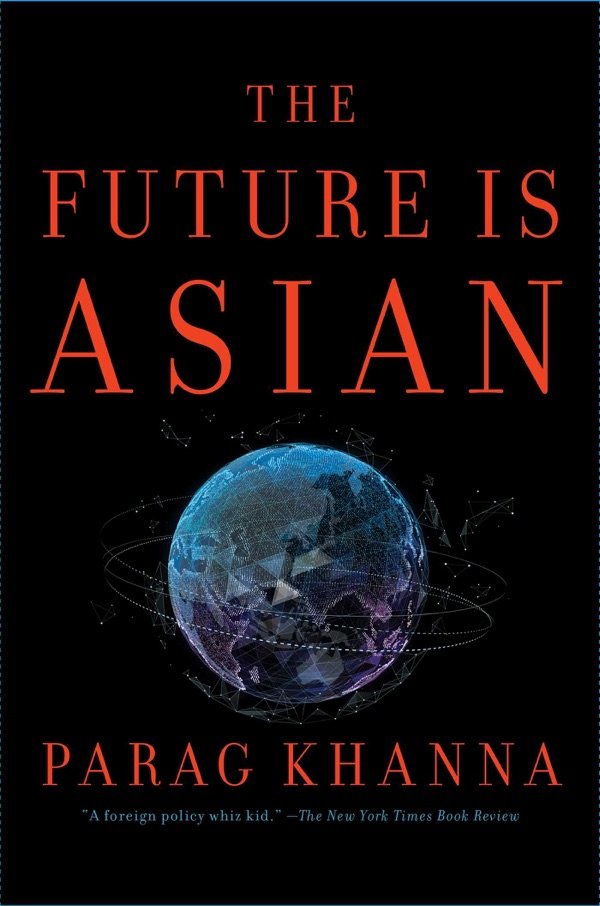
The Future Is Asian
by Parag Khanna
the age of Asianization, Asia will shape the United States more than the reverse. The Brexit debacle is instructive for Australians, who have long thought of their country as the Great Britain of Asia, the avuncular white Anglophone leader of an unruly and underdeveloped region. But that’s not how other Asians see it. Singapore’s late founding father, Lee Kuan Yew, once warned that Aussies were destined to become the “poor white trash of Asia” if they did not reform their economy, something his comments helped jolt them to do. If Australia wants to be more welcome in Asia than the United Kingdom is in Europe, it needs to swallow the hard truth that it is not the center of Asia’s solar system but merely a moon—one
the age of Asianization, Asia will shape the United States more than the reverse.
The Belt and Road Initiative is the most significant diplomatic project of the twenty-first century, the equivalent of the mid-twentieth-century founding of the United Nations and World Bank plus the Marshall Plan all rolled into one. The crucial difference: BRI was conceived in Asia and launched in Asia and will be led by Asians.
The Belt and Road Initiative is the most significant diplomatic project of the twenty-first century, the equivalent of the mid-twentieth-century founding of the United Nations and World Bank plus the Marshall Plan all rolled into one. The crucial difference: BRI was conceived in Asia and launched in Asia and will be led by Asians.
Some aspects of global Westernization will remain central to global life, especially the English language, capitalism, and the pursuit of scientific excellence and technological disruption. But over time, others will fade, such as the appeal of American-style democracy and unsustainable consumerism.
The biggest geopolitical phenomena of the past three decades have come in rapid succession: the dissolution of the Soviet Union, the consolidation of the European Union, the rise of China, the US shale energy revolution, and now the emergence of an Asian system.
"the age of Asianization, Asia will shape the United States more than the reverse."
"The Brexit debacle is instructive for Australians, who have long thought of their country as the Great Britain of Asia, the avuncular white Anglophone leader of an unruly and underdeveloped region. But that’s not how other Asians see it. Singapore’s late founding father, Lee Kuan Yew, once warned that Aussies were destined to become the “poor white trash of Asia” if they did not reform their economy, something his comments helped jolt them to do. If Australia wants to be more welcome in Asia than the United Kingdom is in Europe, it needs to swallow the hard truth that it is not the center of Asia’s solar system but merely a moon—one"
"Overall, the United States’ financial position is weakening as Asians expand local currency borrowing and regional trade rather than depend on the US dollar and US markets. At the same time, the United States’ energy and technology position is robust and growing. US oil and liquefied natural gas exports are major contributors to energy security for East Asian countries, while US military hardware and computing software are in high demand as well. US strategic influence in Asia is thus declining even as its economic dependence on Asia is growing. In"
"These examples reflect how Asians view the United States: not as a hegemon but as a service provider. US weapons, capital, oil, and technology are utilities in a global marketplace. The United States is a vendor, and Asia has become its largest customer and competitor at the same time. There was a time when the United States was the default option for the provision of security, capital, and technology, but Asian countries are increasingly providing these services for one another. The United States is more dispensable than it thinks."
"The Belt and Road Initiative is the most significant diplomatic project of the twenty-first century, the equivalent of the mid-twentieth-century founding of the United Nations and World Bank plus the Marshall Plan all rolled into one. The crucial difference: BRI was conceived in Asia and launched in Asia and will be led by Asians."
"The Belt and Road Initiative is the most significant diplomatic project of the twenty-first century, the equivalent of the mid-twentieth-century founding of the United Nations and World Bank plus the Marshall Plan all rolled into one. The crucial difference: BRI was conceived in Asia and launched in Asia and will be led by Asians."
"Some aspects of global Westernization will remain central to global life, especially the English language, capitalism, and the pursuit of scientific excellence and technological disruption. But over time, others will fade, such as the appeal of American-style democracy and unsustainable consumerism."
- →and China’s Huawei Technologies outbid European bidders to win the contract to build Iraq’s telecom infrastructure, which it rolled out in just twelve months.
Looking for something similar?
Describe your situation. The search finds the right book from the entire library.