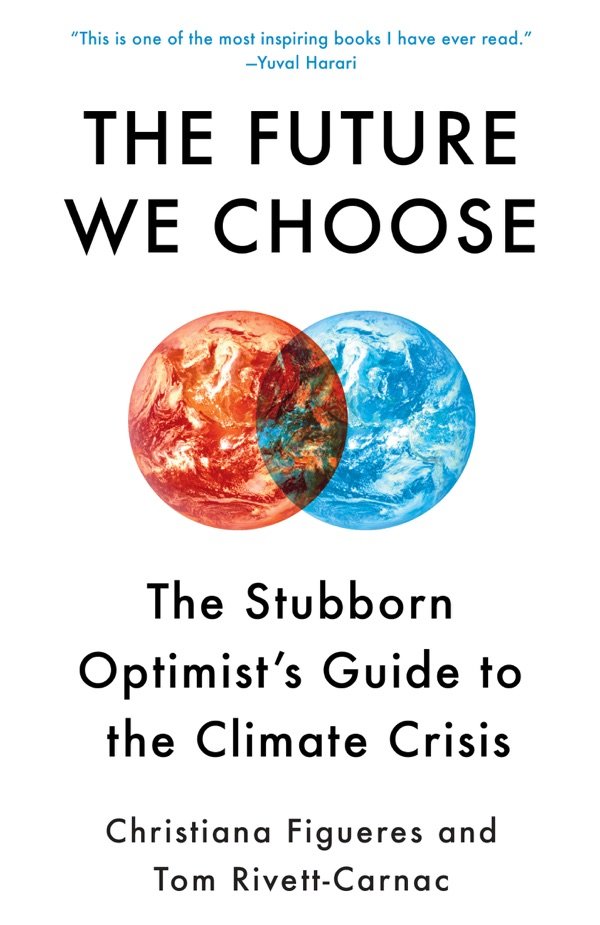
The Future We Choose: Surviving the Climate Crisis
by Christiana Figueres
By 2050 at the latest, and ideally by 2040, we must have stopped emitting more greenhouse gases into the atmosphere than Earth can naturally absorb through its ecosystems (a balance known as net-zero emissions or carbon neutrality). In order to get to this scientifically established goal, our global greenhouse gas emissions must be clearly on the decline by the early 2020s and reduced by at least 50 per cent by 2030. By 2050 at the latest, and ideally by 2040, we must have stopped emitting more greenhouse gases into the atmosphere than Earth can naturally absorb through its ecosystems (a balance known as net-zero emissions or carbon neutrality). In order to get to this scientifically established goal, our global greenhouse gas emissions must be clearly on the decline by the early 2020s and reduced by at least 50 percent by 2030.
Climate change should be of concern to all who care about health. The burning of fossil fuels releases greenhouse gas emissions that are responsible for climate change. But the burning of the very same fossil fuels (coal for industrial heat or electricity generation and diesel or gasoline for transportation) also pollutes the local ambient air with particulate matter.
Psychological research has shown that attitudes can be transformed by first identifying our thought patterns, then deliberately cultivating a more constructive approach. The practice involves becoming aware of these patterns, drawing out the unconscious assumptions, and challenging them when they don’t serve you.
And when your mind tells you that you are just one person, too small to make a difference, so why bother, you can remind yourself that tipping points are non-linear. We don’t know what is going to make the difference, but we know that in the end systems do shift and all the little actions add up to a new world.
In short, in just the last 50 years we have catapulted humanity and the planet out of the previous benevolent Holocene epoch and into the Anthropocene, a new geological period in which biogeochemical conditions are dominated not by natural processes but by the palpable impact of human activity.
Our new intentional direction must move us beyond defeatism to optimism, beyond extraction toward regeneration, beyond linear toward circular economies, beyond individual benefit toward the common good, beyond short-term thinking toward long-term thinking and acting.
"By 2050 at the latest, and ideally by 2040, we must have stopped emitting more greenhouse gases into the atmosphere than Earth can naturally absorb through its ecosystems (a balance known as net-zero emissions or carbon neutrality). In order to get to this scientifically established goal, our global greenhouse gas emissions must be clearly on the decline by the early 2020s and reduced by at least 50 per cent by 2030."
"By 2050 at the latest, and ideally by 2040, we must have stopped emitting more greenhouse gases into the atmosphere than Earth can naturally absorb through its ecosystems (a balance known as net-zero emissions or carbon neutrality). In order to get to this scientifically established goal, our global greenhouse gas emissions must be clearly on the decline by the early 2020s and reduced by at least 50 percent by 2030."
"Climate change should be of concern to all who care about health. The burning of fossil fuels releases greenhouse gas emissions that are responsible for climate change. But the burning of the very same fossil fuels (coal for industrial heat or electricity generation and diesel or gasoline for transportation) also pollutes the local ambient air with particulate matter."
"Psychological research has shown that attitudes can be transformed by first identifying our thought patterns, then deliberately cultivating a more constructive approach. The practice involves becoming aware of these patterns, drawing out the unconscious assumptions, and challenging them when they don’t serve you."
"And when your mind tells you that you are just one person, too small to make a difference, so why bother, you can remind yourself that tipping points are non-linear. We don’t know what is going to make the difference, but we know that in the end systems do shift and all the little actions add up to a new world."
"In short, in just the last 50 years we have catapulted humanity and the planet out of the previous benevolent Holocene epoch and into the Anthropocene, a new geological period in which biogeochemical conditions are dominated not by natural processes but by the palpable impact of human activity."
"Our new intentional direction must move us beyond defeatism to optimism, beyond extraction toward regeneration, beyond linear toward circular economies, beyond individual benefit toward the common good, beyond short-term thinking toward long-term thinking and acting."
- →And when your mind tells you that you are just one person, too small to make a difference, so why bother, you can remind yourself that tipping points are non-linear. We don’t know what is going to make the difference, but we know that in the end systems do shift and all the little actions add up to a new world.
- →Finally, and fundamentally, climate change should be of concern to all who care about intergenerational justice – which should be every one of us. If we fail to act as we should, future generations will be powerless to undo the inexorable consequences of our failure.
- →It does not matter if our natural tendency is to see things with optimism or with pessimism. At this point in history we have a responsibility to do what is necessary, and for most of us that will involve some deliberate reprogramming of our minds.
- →Climate deniers are shamelessly protecting the short-term financial interests of the fossil fuel industry to the detriment of the long-term interests of their own descendants.
Looking for something similar?
Describe your situation. The search finds the right book from the entire library.