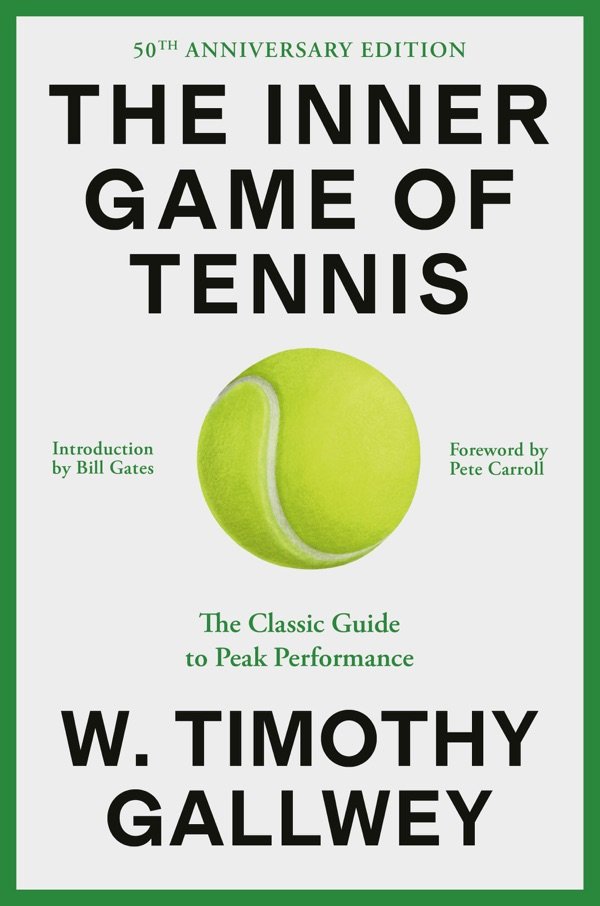
The Inner Game of Tennis: The Classic Guide to the Mental Side of Peak Performance
by W. Timothy Gallwey
Getting it together mentally in tennis involves the learning of several internal skills: 1) learning how to get the clearest possible picture of your desired outcomes; 2) learning how to trust Self 2 to perform at its best and learn from both successes and failures; and 3) learning to see “nonjudgmentally”—that is, to see what is happening rather than merely noticing how well or how badly it is happening. This overcomes “trying too hard.” All these skills are subsidiary to the master skill, without which nothing of value is ever achieved: the art of relaxed concentration. The player of the inner game comes to value the art of relaxed concentration above all other skills; he discovers a true basis for self-confidence; and he learns that the secret to winning any game lies in not trying too hard. He aims at the kind of spontaneous performance which occurs only when the mind is calm and seems at one with the body, which finds its own surprising ways to surpass its own limits again and again.
I was beginning to learn what all good pros and students of tennis must learn: that images are better than words, showing better than telling, too much instruction worse than none, and that trying often produces negative results. One question perplexed me: What’s wrong with trying? What does it mean to try too hard?
The less instruction interferes with the process of learning built into your very DNA, the more effective your progress is going to be. Said another way, the less fear and doubt are embedded in the instructional process, the easier it will be to take the natural steps of learning.
It is important not only to understand intellectually the difference between letting it happen and making it happen, but to experience the difference. To experience the difference is to know the difference. To this end, let me suggest two experiments.
Judgment results in tightness, and tightness interferes with the fluidity required for accurate and quick movement. Relaxation produces smooth strokes and results from accepting your strokes as they are, even if erratic.
In short, “getting it together” requires slowing the mind. Quieting the mind means less thinking, calculating, judging, worrying, fearing, hoping, trying, regretting, controlling, jittering, or distracting.
"Getting it together mentally in tennis involves the learning of several internal skills: 1) learning how to get the clearest possible picture of your desired outcomes; 2) learning how to trust Self 2 to perform at its best and learn from both successes and failures; and 3) learning to see “nonjudgmentally”—that is, to see what is happening rather than merely noticing how well or how badly it is happening. This overcomes “trying too hard.” All these skills are subsidiary to the master skill, without which nothing of value is ever achieved: the art of relaxed concentration."
"The player of the inner game comes to value the art of relaxed concentration above all other skills; he discovers a true basis for self-confidence; and he learns that the secret to winning any game lies in not trying too hard. He aims at the kind of spontaneous performance which occurs only when the mind is calm and seems at one with the body, which finds its own surprising ways to surpass its own limits again and again."
"Players of the Inner Game come to value the art of relaxed concentration above all other skills; they discover a true basis for self-confidence; and they learn that the secret to winning any game lies in not trying too hard. They aim at the kind of spontaneous performance which occurs only when the mind is calm and seems at one with the body, which finds its own surprising ways to surpass its own limits again and again."
"I was beginning to learn what all good pros and students of tennis must learn: that images are better than words, showing better than telling, too much instruction worse than none, and that trying often produces negative results. One question perplexed me: What’s wrong with trying? What does it mean to try too hard?"
"The less instruction interferes with the process of learning built into your very DNA, the more effective your progress is going to be. Said another way, the less fear and doubt are embedded in the instructional process, the easier it will be to take the natural steps of learning."
"It is important not only to understand intellectually the difference between letting it happen and making it happen, but to experience the difference. To experience the difference is to know the difference. To this end, let me suggest two experiments."
"Judgment results in tightness, and tightness interferes with the fluidity required for accurate and quick movement. Relaxation produces smooth strokes and results from accepting your strokes as they are, even if erratic."
- →I was beginning to learn what all good pros and students of tennis must learn: that images are better than words, showing better than telling, too much instruction worse than none, and that trying often produces negative results. One question perplexed me: What’s wrong with trying? What does it mean to try too hard?
- →The “hot streak” usually continues until they start thinking about it and try to maintain it; as soon as they attempt to exercise control, they lose it.
- →“It’s not that I don’t know what to do, it’s that I don’t do what I know!”
Looking for something similar?
Describe your situation. The search finds the right book from the entire library.