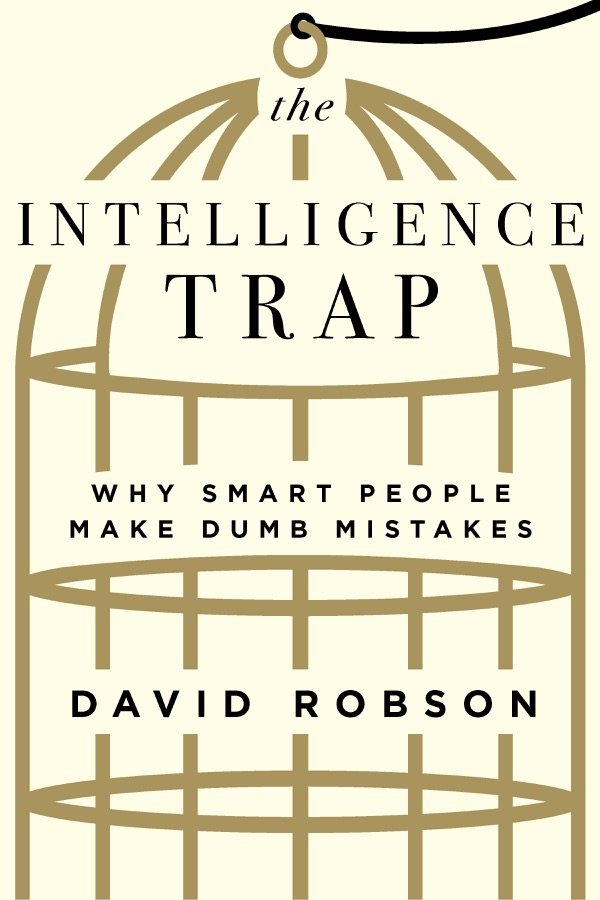
The Intelligence Trap: Why Smart People Make Dumb Mistakes
by David Robson
Intelligent and educated people are less likely to learn from their mistakes, for instance, or take advice from others. And when they do err, they are better able to build elaborate arguments to justify their reasoning, meaning that they become more and more dogmatic in their views. Worse still, they appear to have a bigger “bias blind spot,” meaning they are less able to recognize the holes in their logic. We have now seen three broad reasons why an intelligent person may act stupidly. They may lack elements of creative or practical intelligence that are essential for dealing with life’s challenges; they may suffer from “dysrationalia,” using biased intuitive judgments to make decisions; and they may use their intelligence to dismiss any evidence that contradicts their views thanks to motivated reasoning.
The upshot, according to Kahan and other scientists studying motivated reasoning, is that smart people do not apply their superior intelligence fairly, but instead use it “opportunistically” to promote their own interests and protect the beliefs that are most important to their identities. Intelligence can be a tool for propaganda rather than truth-seeking.
Besides cognitive reflection, other important characteristics that can protect us from the intelligence trap include intellectual humility, actively open-minded thinking, curiosity, refined emotional awareness, and a growth mind-set. Together, they keep our minds on track and prevent our thinking from veering off a proverbial cliff.
The idea that “I am wise because I know that I know nothing” may have become something of a cliché, but it is still rather remarkable that qualities such as your intellectual humility and capacity to understand other people’s points of view may predict your well-being better than your actual intelligence.
For this reason, some psychologists now consider that general intelligence, curiosity and conscientiousness are together the “three pillars” of academic success; if you lack any one of these qualities, you are going to suffer.
All of this would seem to chime with research showing that beliefs may first arise from emotional needs—and it is only afterward that the intellect kicks in to rationalize the feelings, however bizarre they may be.
"Intelligent and educated people are less likely to learn from their mistakes, for instance, or take advice from others. And when they do err, they are better able to build elaborate arguments to justify their reasoning, meaning that they become more and more dogmatic in their views. Worse still, they appear to have a bigger “bias blind spot,” meaning they are less able to recognize the holes in their logic."
"We have now seen three broad reasons why an intelligent person may act stupidly. They may lack elements of creative or practical intelligence that are essential for dealing with life’s challenges; they may suffer from “dysrationalia,” using biased intuitive judgments to make decisions; and they may use their intelligence to dismiss any evidence that contradicts their views thanks to motivated reasoning."
"The upshot, according to Kahan and other scientists studying motivated reasoning, is that smart people do not apply their superior intelligence fairly, but instead use it “opportunistically” to promote their own interests and protect the beliefs that are most important to their identities. Intelligence can be a tool for propaganda rather than truth-seeking."
"Besides cognitive reflection, other important characteristics that can protect us from the intelligence trap include intellectual humility, actively open-minded thinking, curiosity, refined emotional awareness, and a growth mind-set. Together, they keep our minds on track and prevent our thinking from veering off a proverbial cliff."
"The idea that “I am wise because I know that I know nothing” may have become something of a cliché, but it is still rather remarkable that qualities such as your intellectual humility and capacity to understand other people’s points of view may predict your well-being better than your actual intelligence."
"For this reason, some psychologists now consider that general intelligence, curiosity and conscientiousness are together the “three pillars” of academic success; if you lack any one of these qualities, you are going to suffer."
"All of this would seem to chime with research showing that beliefs may first arise from emotional needs—and it is only afterward that the intellect kicks in to rationalize the feelings, however bizarre they may be."
- →The idea that “I am wise because I know that I know nothing” may have become something of a cliché, but it is still rather remarkable that qualities such as your intellectual humility and capacity to understand other people’s points of view may predict your well-being better than your actual intelligence.
Looking for something similar?
Describe your situation. The search finds the right book from the entire library.