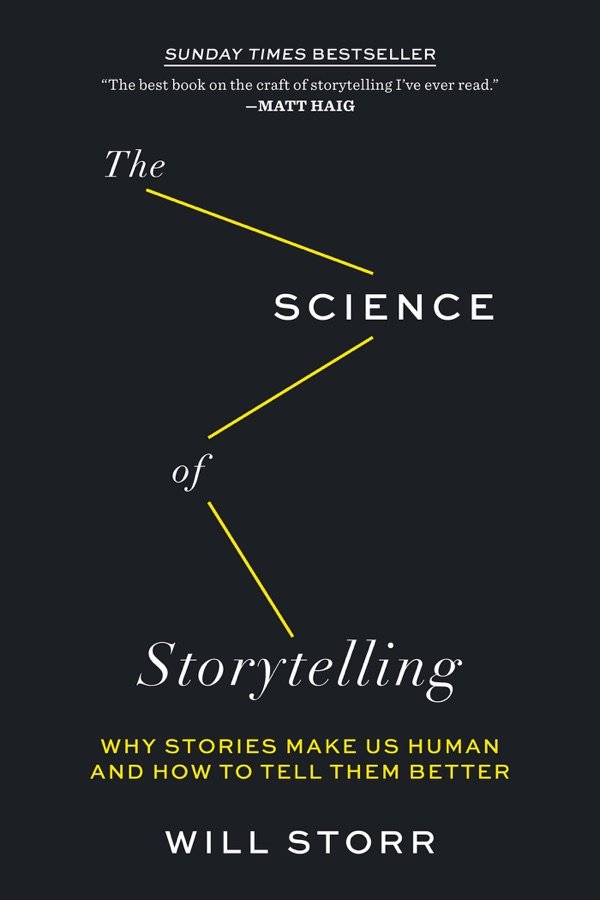
The Science of Storytelling
by Will Storr
When designing a character, it’s often useful to think of them in terms of their theory of control. How have they learned to control the world? When unexpected change strikes, what’s their automatic go-to tactic for wrestling with the chaos? What’s their default, flawed response? The answer, as we’ve just seen, comes from that character’s core beliefs about reality, the precious and fiercely defended ideas around which they’ve formed their sense of self. Good stories are explorations of the human condition; thrilling voyages into foreign minds. They’re not so much about events that take place on the surface of the drama as they are about the characters that have to battle them. Those characters, when we meet them on page one, are never perfect. What arouses our curiosity about them, and provides them with a dramatic battle to fight, is not their achievements or their winning smile. It’s their flaws.
The beliefs we’ll fight to defend are the ones which we’ve formed our identity, values and theory of control around. An attack on these ideas is an attack on the very structure of reality as we experience it. It’s these kinds of beliefs, and these kinds of attacks, that drive our greatest stories.
Brains, concluded the researchers, seem to become spontaneously curious when presented with an ‘information set’ they realise is incomplete. ‘There is a natural inclination to resolve information gaps,’ wrote Loewenstein, ‘even for questions of no importance.’
Because writers are, in effect, generating neural movies in the minds of their readers, they should privilege word order that’s filmic, imagining how their reader’s neural camera will alight upon each component of a sentence.
If there’s a single secret to storytelling then I believe it’s this. Who is this person? Or, from the perspective of the character, Who am I? It’s the definition of drama. It is its electricity, its heartbeat, its fire.
One study concluded that, to make vivid scenes, three specific qualities of an object should be described, with the researcher’s examples including ‘a dark blue carpet’ and ‘an orange striped pencil.’
"When designing a character, it’s often useful to think of them in terms of their theory of control. How have they learned to control the world? When unexpected change strikes, what’s their automatic go-to tactic for wrestling with the chaos? What’s their default, flawed response? The answer, as we’ve just seen, comes from that character’s core beliefs about reality, the precious and fiercely defended ideas around which they’ve formed their sense of self."
"Good stories are explorations of the human condition; thrilling voyages into foreign minds. They’re not so much about events that take place on the surface of the drama as they are about the characters that have to battle them. Those characters, when we meet them on page one, are never perfect. What arouses our curiosity about them, and provides them with a dramatic battle to fight, is not their achievements or their winning smile. It’s their flaws."
"In his paper ‘The Psychology of Curiosity’, Loewenstein breaks down four ways of involuntarily inducing curiosity in humans: (1) the ‘posing of a question or presentation of a puzzle’; (2) ‘exposure to a sequence of events with an anticipated but unknown resolution’; (3) ‘the violation of expectations that triggers a search for an explanation’; (4) knowledge of ‘possession of information by someone else’."
"‘Any scene which does not both advance the plot and standalone (that is, dramatically, by itself, on its own merits) is either superfluous or incorrectly written,’ he wrote. ‘Start, every time, with this inviolable rule: the scene must be dramatic. It must start because the hero has a problem, and it must culminate with the hero finding him or herself either thwarted or educated that another way exists.’"
"The beliefs we’ll fight to defend are the ones which we’ve formed our identity, values and theory of control around. An attack on these ideas is an attack on the very structure of reality as we experience it. It’s these kinds of beliefs, and these kinds of attacks, that drive our greatest stories."
"Brains, concluded the researchers, seem to become spontaneously curious when presented with an ‘information set’ they realise is incomplete. ‘There is a natural inclination to resolve information gaps,’ wrote Loewenstein, ‘even for questions of no importance.’"
"Because writers are, in effect, generating neural movies in the minds of their readers, they should privilege word order that’s filmic, imagining how their reader’s neural camera will alight upon each component of a sentence."
- →Because writers are, in effect, generating neural movies in the minds of their readers, they should privilege word order that’s filmic, imagining how their reader’s neural camera will alight upon each component of a sentence.
Looking for something similar?
Describe your situation. The search finds the right book from the entire library.