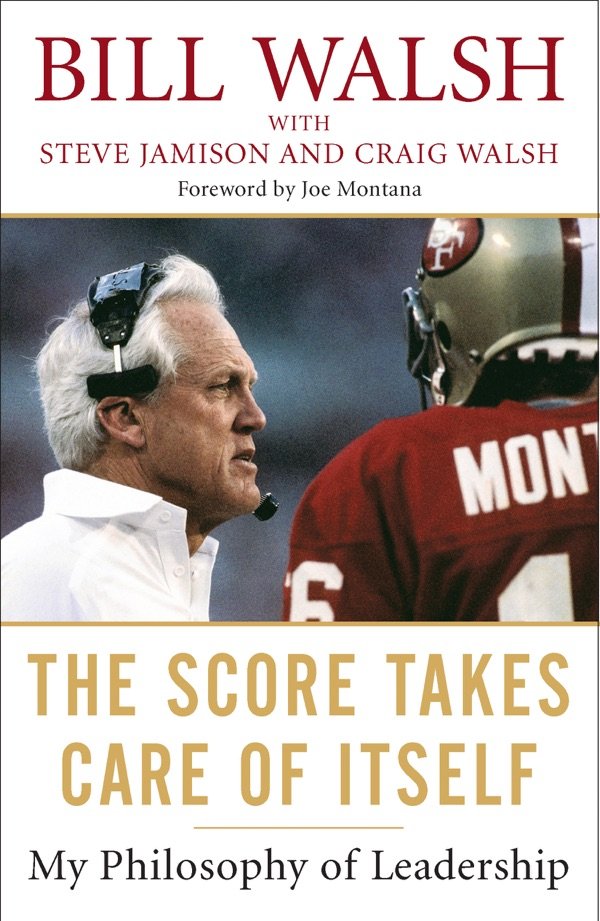
The Score Takes Care of Itself: My Philosophy of Leadership
by Bill Walsh
Expertise is the inventory of knowledge and experience you possess on a particular subject. Formally celebrate and observe the momentous achievement—the victory—and make sure that everyone feels ownership in it. Praise, bonuses, and other rewards can make it special. This is a unique opportunity to strengthen the bond everyone feels to your organization, especially the special role players who get less attention. 2. Allow pats on the back for a limited time. Then formally return to business as usual by letting everyone know the party is over. Nevertheless, don’t tighten down too far. Victory can produce enormous energy—so powerful and overwhelming that in sports grown men will burst out in tears and run around like little children at Christmas. You must channel that powerful force and enthusiasm into the work ahead to solidify and build on the gains made by your team in achieving their recent success. Make sure the power of your victory propels you forward in a controlled manner. 3. Be apprehensive about applause. Instruct your team on the pitfalls of listening to accolades from those outside (and even inside) the organization. The praise can become a hindrance to buckling down to the hard sacrifice that will be required ahead. Ongoing applause can turn the head of the most disciplined and determined member of your team. Watch that it doesn’t turn your own head. 4. Develop a plan for your staff that gets them back into the mode of operation that produced success in the first place. Don’t assume it will happen. Hold meetings to explain what steps must be taken to sustain momentum; refocus personnel by covering in detail why success was achieved; review with them why they prevailed. 5. Address specific situations that need shoring up; focus on the mistakes that were made and things that were not up to snuff in the success. Point out deficiencies and the need to find remedies for them. 6. Be demanding. Do not relax. Hold everyone to even higher expectations. Don’t relax your Standard of Performance. The Standard of Performance is always in a state of refinement to raise performance. That’s your gold standard, the point of reference above everything else, including the won-lost record, Super Bowl titles, shareholder value, quotas, sales, or praise from people who don’t have to get down in the trenches with you and do the real work.
Expertise is the inventory of knowledge and experience you possess on a particular subject.
checklist worth keeping in mind when it comes to persevering, to doing it “your way” at all costs: 1. A leader must never quit. 2. A leader must know when to quit. 3. Proving that you are right or proving that someone is wrong are bad reasons for persisting. 4. Good logic, sound principles, and strong belief are the purest and most productive reasons for pushing forward when things get rough.
Concentrate on what will produce results rather than on the results, the process rather than the prize. 2. Exhibit an inner toughness emanating from four of the most effective survival tools a leader can possess: expertise, composure, patience, and common sense. 3. Maintain your level of professional ethics and all details of your own Standard of Performance. 4. Don’t isolate yourself. Keep
Another was “Commit, explode, recover (if you’re wrong)!” which was shorthand for having a plan of attack, executing it suddenly and powerfully, and then reacting quickly and intelligently to the results of what you’ve done. It was a way of thinking and performing, a philosophy—my philosophy, my approach to competing. It, too, was soon part of our organization’s vernacular and attitude.
Every leader does year-end reviews and comes to conclusions of one sort or another. My observation is that two leaders—coaches—looking at the same information will not see the same thing. The one who’s a more skilled analyst, who digs deeper and wider, will benefit more. It is an endeavor to which I allocated as much energy as my preparation for every game and opponent.
"Expertise is the inventory of knowledge and experience you possess on a particular subject."
"Formally celebrate and observe the momentous achievement—the victory—and make sure that everyone feels ownership in it. Praise, bonuses, and other rewards can make it special. This is a unique opportunity to strengthen the bond everyone feels to your organization, especially the special role players who get less attention. 2. Allow pats on the back for a limited time. Then formally return to business as usual by letting everyone know the party is over. Nevertheless, don’t tighten down too far. Victory can produce enormous energy—so powerful and overwhelming that in sports grown men will burst out in tears and run around like little children at Christmas. You must channel that powerful force and enthusiasm into the work ahead to solidify and build on the gains made by your team in achieving their recent success. Make sure the power of your victory propels you forward in a controlled manner. 3. Be apprehensive about applause. Instruct your team on the pitfalls of listening to accolades from those outside (and even inside) the organization. The praise can become a hindrance to buckling down to the hard sacrifice that will be required ahead. Ongoing applause can turn the head of the most disciplined and determined member of your team. Watch that it doesn’t turn your own head. 4. Develop a plan for your staff that gets them back into the mode of operation that produced success in the first place. Don’t assume it will happen. Hold meetings to explain what steps must be taken to sustain momentum; refocus personnel by covering in detail why success was achieved; review with them why they prevailed. 5. Address specific situations that need shoring up; focus on the mistakes that were made and things that were not up to snuff in the success. Point out deficiencies and the need to find remedies for them. 6. Be demanding. Do not relax. Hold everyone to even higher expectations. Don’t relax your Standard of Performance. The Standard of Performance is always in a state of refinement to raise performance. That’s your gold standard, the point of reference above everything else, including the won-lost record, Super Bowl titles, shareholder value, quotas, sales, or praise from people who don’t have to get down in the trenches with you and do the real work."
"My Standard of Performance—the values and beliefs within it—guided everything I did in my work at San Francisco and are defined as follows: Exhibit a ferocious and intelligently applied work ethic directed at continual improvement; demonstrate respect for each person in the organization and the work he or she does; be deeply committed to learning and teaching, which means increasing my own expertise; be fair; demonstrate character; honor the direct connection between details and improvement, and relentlessly seek the latter; show self-control, especially where it counts most—under pressure; demonstrate and prize loyalty; use positive language and have a positive attitude; take pride in my effort as an entity separate from the result of that effort; be willing to go the extra distance for the organization; deal appropriately with victory and defeat, adulation and humiliation (don’t get crazy with victory nor dysfunctional with loss); promote internal communication that is both open and substantive (especially under stress); seek poise in myself and those I lead; put the team’s welfare and priorities ahead of my own; maintain an ongoing level of concentration and focus that is abnormally high; and make sacrifice and commitment the organization’s trademark."
"MY FIVE DOS FOR GETTING BACK INTO THE GAME: 1. Do expect defeat. It’s a given when the stakes are high and the competition is working ferociously to beat you. If you’re surprised when it happens, you’re dreaming; dreamers don’t last long. 2. Do force yourself to stop looking backward and dwelling on the professional “train wreck” you have just been in. It’s mental quicksand. 3. Do allow yourself appropriate recovery—grieving—time. You’ve been knocked senseless; give yourself a little time to recuperate. A keyword here is “little.” Don’t let it drag on. 4. Do tell yourself, “I am going to stand and fight again,” with the knowledge that often when things are at their worst you’re closer than you can imagine to success. Our Super Bowl victory arrived less than sixteen months after my “train wreck” in Miami. 5. Do begin planning for your next serious encounter. The smallest steps—plans—move you forward on the road to recovery. Focus on the fix. MY FIVE DON’TS: 1. Don’t ask, “Why me?” 2. Don’t expect sympathy. 3. Don’t bellyache. 4. Don’t keep accepting condolences. 5. Don’t blame others."
"Don’t fall prey to overconfidence so that you feel you can or should make change for the sake of change. Change is inevitable, but change is not a casual consideration. When you’re flush with victory, you can take on a mind-set that says, “Hey, let’s try this!” Only in the most desperate situation is change made simply for the sake of change. 8. Use the time immediately following success as an opportunity to make hard decisions, including elevation or demotion of individuals who contributed—or didn’t—to the victory. This window is brief. Use it. 9. Never fall prey to the belief that getting to the top makes everything easy. In fact, what it makes easier is the job of motivating those who want your spot at the top. Achievement, great success, puts a big bull’s-eye on your back. You are now the target—clearly identified—for all your competitors to aim at. 10. Recognize that mastery is a process, not a destination."
"Afford each person the same respect, support, and fair treatment you would expect if your roles were reversed. Deal with people individually, not as objects who are part of a herd—that’s the critical factor. 2. Leadership involves many people, each with their own need for role identity within the organization. Find what a person does best, utilize and emphasize it, and steer clear of his or her weaknesses. 3. Demonstrate a pronounced commitment to employees by providing a work environment that enables them to achieve their maximum potential and productivity."
"You may remember basketball’s Michael Jordan being interviewed after a game. The Chicago Bull would tell the media, “Scotty Pippen did a great job on defense; Dennis [Rodman] got a couple of key rebounds, and our bench really picked up the slack in the third quarter to give us a little breather. It was a great effort by everybody.” What Jordan didn’t mention might be the fact that he had scored fifty-five points, grabbed fifteen rebounds, and had twelve assists. As he matured as an on-court leader, he made everyone part of the victory."
- →In your efforts to create interest in your own product, don’t get carried away with premature promotion—creating a pretty package with hype, spin, and all the rest. First, make sure you’ve got something of quality to promote. Then worry about how you’re going to wrap it in an attractive package. The world’s best promotional tool is a good product.
- →For me to do this I had to have autonomy, the power to quickly make decisions in all relevant areas. Team owner Eddie DeBartolo understood this and named me general manager soon after I became head coach. Equally important, he let everyone in the organization know that I was the boss and that he would not undercut my authority.
- →The lesson I had learned in fumbling through the earlier strike was useful this time around; namely, don’t assume because of odd circumstances that everything will somehow sort itself out. Rather, play for keeps all the time. The clock never stops running; there is never a “time-out” when what you do is somehow less meaningful.
- →Your enthusiasm becomes their enthusiasm; your lukewarm presentation becomes their lukewarm interest in what you’re offering. I came to understand over my years as an assistant coach that when the audience is bored, it’s not their fault. And when they’re plugged in and excited, it’s because of you, the person in charge.
Looking for something similar?
Describe your situation. The search finds the right book from the entire library.