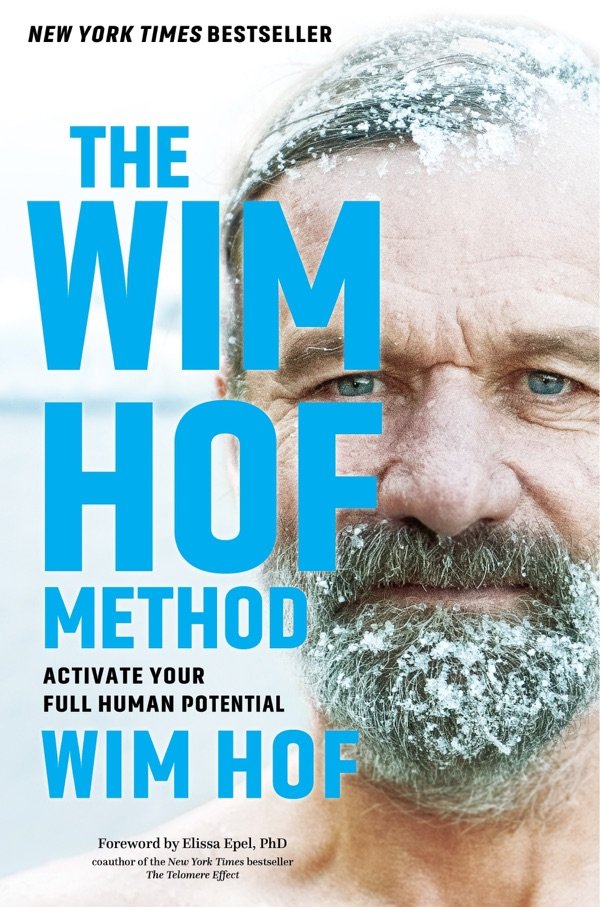
The Wim Hof Method: Activate Your Full Human Potential
by Wim Hof
STEP 1Sit in a meditation posture, lying down, or whichever way is most comfortable for you, in a quiet and safe environment. Make sure you can expand your lungs freely without feeling any constriction. STEP 2Close your eyes and try to clear your mind. Be conscious about your breath and try to fully connect with it. Take thirty to forty deep breaths in through the nose or mouth. Fill up your belly, your chest, all the way up to your head. Don’t force the exhale. Just relax and let the air out. Fully in, letting go. STEP 3At the end of the last breath, draw the breath in once more and fill the lungs to maximum capacity without using any force. Then relax to let the air out. Hold the breath until you feel the urge to breathe again. This is called the retention phase. STEP 4When you feel the urge to breathe, take one deep breath in and hold it for ten to fifteen seconds. This is called the recovery breath. STEP 5Let your breath go and start with a new round. Fully in, letting go. Repeat the full cycle three to four times. To befriend the cold at home or in the wild, follow these steps: 1 First, find someone to share this experience with you. Ice baths and cold plunges are safer and more fun with friends. 2 Prepare yourself by doing one or two rounds of the basic breathing exercise as you visualize the cold water. How will it make you feel? Imagine how you will enter the water, be it a bathtub or a lake, and how you will feel when you do it. Assume a can-do mindset. 3 Confidently enter the water while taking deep, calm breaths. Focus on your breath. Embrace the cold; let it take you to the depths of yourself. Do NOT perform the WHM basic breathing technique. Instead, do long, conscious, exhalations to bring your breath into a controlled, steady rhythm. Take deep breaths through the nose and try to relax. Try letting out a long “Hummmmm” on the exhale. 4 Keep your focus on your breath and your being as you exit the water. Warm up by doing the horse stance exercise while maintaining your inner attention. (See page 118.)
We have shown through scientific evidence and comparative studies that cold exposure, in combination with conscious breathing, meditation, and a positive mental attitude, has far-reaching benefits to human health. Devoted practitioners of the method have been able to reverse diabetes, alleviate the debilitating effects of Parkinson’s disease, lose weight, and achieve remarkable athletic feats.
1 Set a timer for one minute. 2 Settle yourself somewhere comfortable. 3 Breathe in deeply. 4 Breathe out with a sound like “Hum,” “Ah,” or “Om.” Make whatever sounds make you happy. 5 When you run out of air, breathe in deeply and let it out with another “Hum.” 6 Continue until the timer stops. How many times did you breathe in a minute of humming? Maybe four, five, six times? Nice.
This search for external validation, this need to be “the best,” is truly a fool’s errand. Being the best and being the best you can be are quite different things, see. But you can become the best version of yourself when you gain the ability to regulate your own biochemistry, your own energy, and to channel that energy however you see fit. How much energy do you want?
you know, traveling by bicycle is just different. It’s not like traveling by car. Sitting in a car is like watching television; you just sit and watch what is happening outside your window. But when you travel by bicycle, you charge up your feelings, you look around, and everything is amplified because you forge a direct connection with it all.
Do you know what a happy person needs? Nothing. Because he is happy. That is what I want to give to my children, to the beloveds around me, to all the living beings around me. I want to be happy, and I want the same for you. We are all connected by nature. The trees exhale oxygen, and we exhale CO2. We nourish each other. We are one.
"STEP 1Sit in a meditation posture, lying down, or whichever way is most comfortable for you, in a quiet and safe environment. Make sure you can expand your lungs freely without feeling any constriction. STEP 2Close your eyes and try to clear your mind. Be conscious about your breath and try to fully connect with it. Take thirty to forty deep breaths in through the nose or mouth. Fill up your belly, your chest, all the way up to your head. Don’t force the exhale. Just relax and let the air out. Fully in, letting go. STEP 3At the end of the last breath, draw the breath in once more and fill the lungs to maximum capacity without using any force. Then relax to let the air out. Hold the breath until you feel the urge to breathe again. This is called the retention phase. STEP 4When you feel the urge to breathe, take one deep breath in and hold it for ten to fifteen seconds. This is called the recovery breath. STEP 5Let your breath go and start with a new round. Fully in, letting go. Repeat the full cycle three to four times."
"To befriend the cold at home or in the wild, follow these steps: 1 First, find someone to share this experience with you. Ice baths and cold plunges are safer and more fun with friends. 2 Prepare yourself by doing one or two rounds of the basic breathing exercise as you visualize the cold water. How will it make you feel? Imagine how you will enter the water, be it a bathtub or a lake, and how you will feel when you do it. Assume a can-do mindset. 3 Confidently enter the water while taking deep, calm breaths. Focus on your breath. Embrace the cold; let it take you to the depths of yourself. Do NOT perform the WHM basic breathing technique. Instead, do long, conscious, exhalations to bring your breath into a controlled, steady rhythm. Take deep breaths through the nose and try to relax. Try letting out a long “Hummmmm” on the exhale. 4 Keep your focus on your breath and your being as you exit the water. Warm up by doing the horse stance exercise while maintaining your inner attention. (See page 118.)"
"Sit or lie down in a safe, comfortable space. 2 Relax. 3 Feel and visualize your heartbeat. 4 Connect with your heartbeat and try to synchronize your breath with it so that you can feel it everywhere. 5 Now visualize your circulatory system. Visualize that with every inhalation, oxygen-rich blood is flowing from your lungs to your heart, to every part in your body, through a network of blood vessels that could wrap around the earth two and a half times. Imagine how your blood provides oxygen and nutrients to organs and muscles, and transports waste products (like carbon dioxide) to your liver, kidneys, and lungs. 6 Reconnect with your heartbeat and try to synchronize your breath with it again. 7 Make a journey through your body and try to feel the heartbeat in different parts of it. If you focus on your hand, feel the heartbeat there, and if you focus on your feet, feel the blood flow from your ankles to your toes. This is connecting your mind and your body."
"You can do this exercise whenever you feel like it, but it can be an especially powerful exercise to try if you are feeling melancholy, moody, or depressed. Do not force it — feel it! 1 Sit or lie down in a safe, comfortable place. 2 Feel and try to relax every part of your body. Observe and be aware of what you are feeling, seeing, and hearing, without judgment. Just be present. 3 Take twenty deep breaths. Fully in and letting go. 4 On the last breath, breathe in deeply, hold it, press your chin toward your chest, tense your pelvic floor, and direct that tension up your core toward your head. 5 If you are experiencing any physical discomfort, focus your attention there and observe. Tense the muscles in that area. Hold the breath for a maximum of ten seconds. 6 Release the breath and all tension. 7 Repeat two or three times or until you feel better. You don’t need to be an advanced practitioner of the method to get there."
"BREATH 1 While seated or lying down, take 30 to 40 full conscious breaths: Breathe fully in to the belly and the chest, then letting go, without force. 2 On your final exhale, let the air out and hold it out for as long as you can without discomfort. Listen to your body and don’t force it! 3 When you feel the urge to breathe again, take a deep breath in, hold for 10 to 15 seconds. Then release and relax. 4 Repeat the steps above two or three more times, paying attention to how you feel and adjusting your breath as needed. 5 Rest in this elevated state until you are ready to move on with your day. Alternatively, use the energy you just generated for your morning workout or yoga practice. Experiment with what feels right for you."
"If so, the following exercise can be done to activate brown fat tissue (or brown adipose tissue — BAT), which is capable of energy combustion, and your intercostal muscles. The intercostal muscles are several groups of muscles that run between the ribs and help move the chest wall during respiration. Activating them also generates heat. Do as follows: 1 Sit down. 2 Inhale slowly and deeply five or six times, letting your breath go naturally each time. 3 Inhale fully. 4 Relax to exhale. 5 Inhale fully. 6 Hold your breath, for no more than five seconds. 7 Tense your upper-back muscles and chest while you hold your breath — but don’t tense the head. Keep your jaw relaxed. 8 Let go."
"Present within the cells of all forms of life is a chemical called adenosine triphosphate (ATP), which provides the energy to drive many biological processes, including, in humans, muscle contraction. ATP molecules do exist in cells that are in an anaerobic state, without the presence of oxygen, but they multiply exponentially in cells that are in an aerobic state, in the presence of oxygen.1 The more ATP molecules, the more energy. And that energy is useful not only for enhanced athletic performance but also for increased muscular plasticity, which relates to a muscle’s ability to alter its structural and functional properties in accordance with changes in environmental conditions."
- →you know, traveling by bicycle is just different. It’s not like traveling by car. Sitting in a car is like watching television; you just sit and watch what is happening outside your window. But when you travel by bicycle, you charge up your feelings, you look around, and everything is amplified because you forge a direct connection with it all.
- →Do you know what a happy person needs? Nothing. Because he is happy. That is what I want to give to my children, to the beloveds around me, to all the living beings around me. I want to be happy, and I want the same for you. We are all connected by nature. The trees exhale oxygen, and we exhale CO2. We nourish each other. We are one.
- →But the belly goes up when the diaphragm moves — when the lungs expand — and that’s why we call it “belly breathing.” Only it’s not really the belly; it’s the lungs being filled to their utmost capacity. The belly goes up because it needs to make space. Then the upper parts of the lungs get filled up.
- →And because with our conscious breathing we are accelerating the mitochondrial processes and thus our energy levels in the lymphatic system, we are able to rid our bodies of toxins and other waste faster and more efficiently.
Looking for something similar?
Describe your situation. The search finds the right book from the entire library.