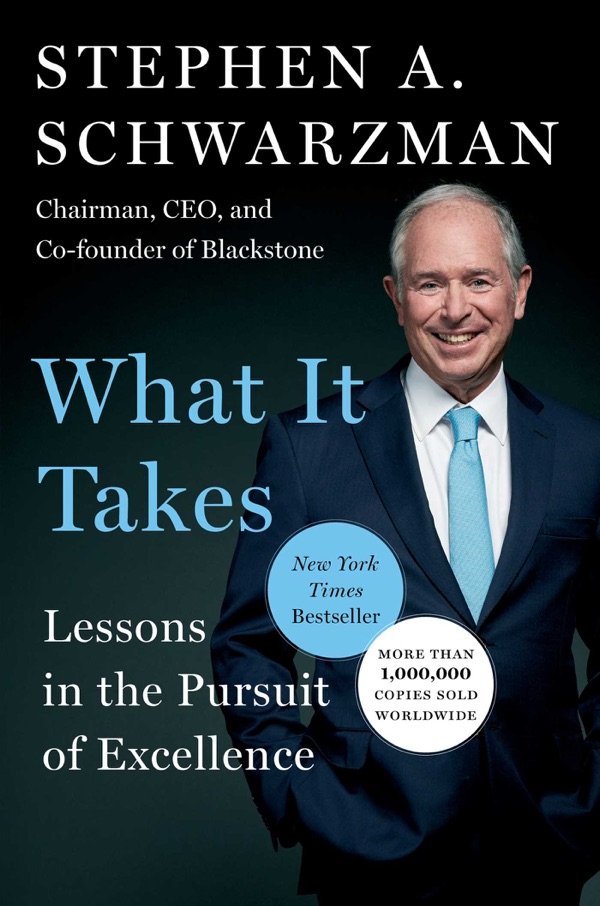
What It Takes: Lessons in the Pursuit of Excellence
by Stephen A. Schwarzman
Teaching, I came to believe, is about more than sharing knowledge. You have to remove the obstacles in people’s way. “The best executives are made, not born. They absorb information, study their own experiences, learn from their mistakes, and evolve.”
Teaching, I came to believe, is about more than sharing knowledge. You have to remove the obstacles in people’s way.
“The best executives are made, not born. They absorb information, study their own experiences, learn from their mistakes, and evolve.”
You are not alone here, so don’t wear the weight of the world. Every tough decision has been made at Blackstone by someone. What may seem new to you, won’t be new to the institution. Just ask for help. We make decisions as a team, and we own the outcome as a team. That applies just as much to the people running our biggest businesses as it does to our most junior staff.
But I made the mistakes of an inexperienced CEO: I let the differences between us brew. I stood my ground on the dilution of our equity because I considered it a moral principle to respect the terms of the original deal. Instead, I should have recognized that when a situation changes and a business is doing extremely well, sometimes you have to make accommodations.
But I made the mistakes of an inexperienced CEO: I let the differences between us brew. I stood my ground on the dilution of our equity because I considered it a moral principle to respect the terms of the original deal. Instead, I should have recognized that when a situation changes and a business is doing extremely well, sometimes you have to make accommodations.
"Teaching, I came to believe, is about more than sharing knowledge. You have to remove the obstacles in people’s way."
"“The best executives are made, not born. They absorb information, study their own experiences, learn from their mistakes, and evolve.”"
"Changing your behavior in the face of changing information is always hard. But when people are doing well, they don’t want to change. They choose to ignore the discordant notes and the tunes you are hearing. They feel threatened by bad news and dread the uncertainty of change and the hard work it demands. This tendency makes them passive and rigid at the very moment they should be most active and flexible. I have always regarded worry as an active, liberating kind of activity. Worrying allows you to articulate the downside in any situation and leads to action to avoid it. We had set up Blackstone to give us reasons to worry, to absorb reams of raw data, so we could develop our intelligence by looking for anomalies and patterns. At its best, worrying is playful, engaging work that requires that you never switch off."
"If you are going to start a business, I told them, I believe it has to pass three basic tests. First, your idea has to be big enough to justify devoting your life to it. Make sure it has the potential to be huge. Second, it should be unique. When people see what you are offering, they should say to themselves, “My gosh, I need this. I’ve been waiting for this. This really appeals to me.” Without that “aha!” you are wasting your time. Third, your timing must be right. The world actually doesn’t like pioneers, so if you are too early, your risk of failure is high. The market you are targeting should be lifting off with enough momentum to help make you successful."
"These discussions had two fundamental rules. The first was that everyone had to speak, so that every investment decision was made collectively. The second was that our focus should be on the potential investment’s weaknesses. Everyone had to find problems that hadn’t been addressed. This process of constructive confrontation could be challenging for the presenter, but we designed it never to be personal. The “only criticism” rule liberated us to critique each other’s proposals without worrying that we might be hurting someone’s feelings."
"If we make an investment and it goes wrong, we all got it wrong, and we are all responsible for fixing it. And when we are right, which is more often the case, we reap the rewards together. Our process forces every person, no matter anyone’s seniority, to act like an owner of the firm, as if our LP’s capital was their own. This arrangement results in an extremely powerful alignment of incentives, and it also turns every deal evaluation into a teaching moment. The success of our process speaks for itself."
"Entrepreneurs often prefer to trust their instincts rather than the more orderly systems that professional managers use. Entrepreneurs often resist any limits placed on those instincts and the energy that brought their company into existence. But eventually it is those limits that create the foundation for the next phase of growth. The turbulence of starting a firm must at some point permit systems to be implemented that allow other people to help drive the organization forward."
- →But I’ve always believed that it’s just as hard to achieve big goals as it is small ones. The only difference is that bigger goals have much more significant consequences. Since you can tackle only one personally defining effort at a time, it’s important to pursue a goal that is truly worthy of the focus it will require to ensure its success.
- →Our people are all different, but they share some common traits: self-confidence, intellectual curiosity, courtesy, an ability to adjust to new situations, emotional stability under pressure, a zero-defect mentality, and an unwavering commitment to behaving with integrity and striving for excellence in all we choose to do.
- →Our people are all different, but they share some common traits: self-confidence, intellectual curiosity, courtesy, an ability to adjust to new situations, emotional stability under pressure, a zero-defect mentality, and an unwavering commitment to behaving with integrity and striving for excellence in all we choose to do.
- →Decisions are much better made through systems designed to protect businesses and organizations than through individuals. We needed rules to depersonalize our investment process. It could never again rely on one person’s abilities, feelings, and vulnerabilities. We needed to review and tighten our process.
Looking for something similar?
Describe your situation. The search finds the right book from the entire library.