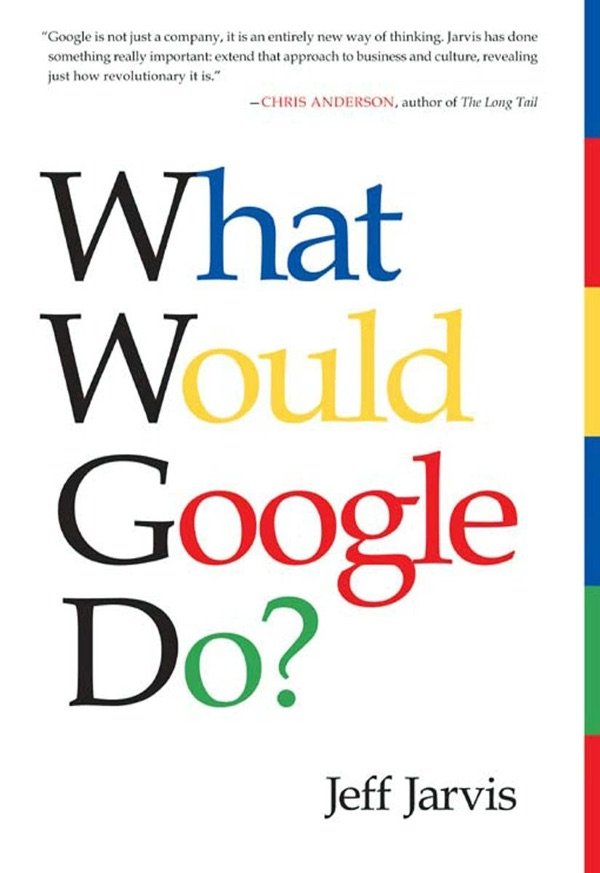
What Would Google Do?: Reverse Engineering Business Strategies for Survival and Success in the Internet Era
by Jeff Jarvis
Houston Chronicle tech columnist Dwight Silverman did what reporters do: He called Dell to ask for its policy on blogs. “Look, don’t touch,” was the official reply. If customers want to talk to Dell, the spokeswoman said, they should talk to the company on its site, on its terms. But Dell’s customers were already talking about Dell away from its site and control, on their own terms. “Bank users, not money,” was Google vice president Marissa Mayer’s advice on building new products and networks. She said in a 2006 talk at Stanford that Google doesn’t worry about business models as it rolls out products. “We worry a lot about whether or not we have users.” That is because on the web, “money follows consumers.”
Houston Chronicle tech columnist Dwight Silverman did what reporters do: He called Dell to ask for its policy on blogs. “Look, don’t touch,” was the official reply. If customers want to talk to Dell, the spokeswoman said, they should talk to the company on its site, on its terms. But Dell’s customers were already talking about Dell away from its site and control, on their own terms.
“Bank users, not money,” was Google vice president Marissa Mayer’s advice on building new products and networks. She said in a 2006 talk at Stanford that Google doesn’t worry about business models as it rolls out products. “We worry a lot about whether or not we have users.” That is because on the web, “money follows consumers.”
Evslin gave a confounding lesson on networks. Explosive web companies—Skype, eBay, craigslist, Facebook, Amazon, YouTube, Twitter, Flickr, and Google itself—don’t charge users as much as the market will bear. They charge as little as they can bear. That is how they maximize growth and value for everyone in the network.
Tom Evslin, the unsung hero of the web who made the internet explode when, as head of AT&T Worldnet, he set pricing for unlimited internet access at a flat $19.95 per month, turning off the ticking clock on internet usage, lowering the cost for users, and addicting us all to the web.
You should be asking: Am I a knowledge company? A data company? A community company? A platform? Where is your value and where is your revenue? Remember that they might not be in the same place; the money may come in through a side door. It’s time for your identity crisis.
"Houston Chronicle tech columnist Dwight Silverman did what reporters do: He called Dell to ask for its policy on blogs. “Look, don’t touch,” was the official reply. If customers want to talk to Dell, the spokeswoman said, they should talk to the company on its site, on its terms. But Dell’s customers were already talking about Dell away from its site and control, on their own terms."
"“Bank users, not money,” was Google vice president Marissa Mayer’s advice on building new products and networks. She said in a 2006 talk at Stanford that Google doesn’t worry about business models as it rolls out products. “We worry a lot about whether or not we have users.” That is because on the web, “money follows consumers.”"
"Evslin gave a confounding lesson on networks. Explosive web companies—Skype, eBay, craigslist, Facebook, Amazon, YouTube, Twitter, Flickr, and Google itself—don’t charge users as much as the market will bear. They charge as little as they can bear. That is how they maximize growth and value for everyone in the network."
"Tom Evslin, the unsung hero of the web who made the internet explode when, as head of AT&T Worldnet, he set pricing for unlimited internet access at a flat $19.95 per month, turning off the ticking clock on internet usage, lowering the cost for users, and addicting us all to the web."
"You should be asking: Am I a knowledge company? A data company? A community company? A platform? Where is your value and where is your revenue? Remember that they might not be in the same place; the money may come in through a side door. It’s time for your identity crisis."
"“In the economy we’re in now, if you’re not a platform, you’ll be commoditized,” he told me. Google will win against Microsoft and Yahoo, he argued, because too many companies have invested too much to build on Google’s platform. That will make them loyal."
"People will contribute their intelligence and time if they know they can build something, have influence, gain control, help a fellow customer (more than a company), and claim ownership."
- →“Bank users, not money,” was Google vice president Marissa Mayer’s advice on building new products and networks. She said in a 2006 talk at Stanford that Google doesn’t worry about business models as it rolls out products. “We worry a lot about whether or not we have users.” That is because on the web, “money follows consumers.”
- →“In the economy we’re in now, if you’re not a platform, you’ll be commoditized,” he told me. Google will win against Microsoft and Yahoo, he argued, because too many companies have invested too much to build on Google’s platform. That will make them loyal.
- →People will contribute their intelligence and time if they know they can build something, have influence, gain control, help a fellow customer (more than a company), and claim ownership.
- →The internet is a three-dimensional space of reciprocal links whose value multiplies with use and time. Google is the chief agent of that value creation.
Looking for something similar?
Describe your situation. The search finds the right book from the entire library.