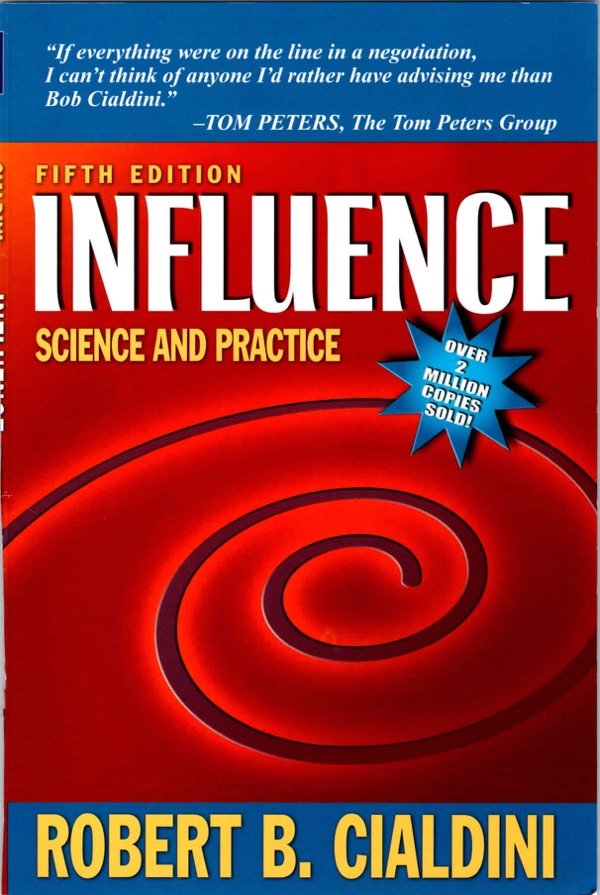
Influence: The Psychology of Persuasion
by Robert B. Cialdini
Think of the implications. People we might ordinarily dislike—unsavory or unwelcome sales operators, disagreeable acquaintances, representatives of strange or unpopular organizations—can greatly increase the chance that we will do what they wish merely by providing us with a small favor prior to their requests. The truly gifted negotiator, then, is one whose initial position is exaggerated enough to allow for a series of reciprocal concessions that will yield a desirable final offer from the opponent, yet is not so outlandish as to be seen as illegitimate from the start.
Think of the implications. People we might ordinarily dislike—unsavory or unwelcome sales operators, disagreeable acquaintances, representatives of strange or unpopular organizations—can greatly increase the chance that we will do what they wish merely by providing us with a small favor prior to their requests.
The truly gifted negotiator, then, is one whose initial position is exaggerated enough to allow for a series of reciprocal concessions that will yield a desirable final offer from the opponent, yet is not so outlandish as to be seen as illegitimate from the start.
The rule says that we should try to repay, in kind, what another person has provided us.
If I can get you to make a commitment (that is, to take a stand, to go on record), I will have set the stage for your automatic and ill-considered consistency with that earlier commitment. Once a stand is taken, there is a natural tendency to behave in ways that are stubbornly consistent with the stand.
There is a principle in human perception, the contrast principle, that affects the way we see the difference between two things that are presented one after another. Simply put, if the second item is fairly different from the first, we will tend to see it as more different than it actually is.
"Think of the implications. People we might ordinarily dislike—unsavory or unwelcome sales operators, disagreeable acquaintances, representatives of strange or unpopular organizations—can greatly increase the chance that we will do what they wish merely by providing us with a small favor prior to their requests."
"The truly gifted negotiator, then, is one whose initial position is exaggerated enough to allow for a series of reciprocal concessions that will yield a desirable final offer from the opponent, yet is not so outlandish as to be seen as illegitimate from the start."
"The rule says that we should try to repay, in kind, what another person has provided us."
"Because even small similarities can be effective in producing a positive response to another and because a veneer of similarity can be so easily manufactured, I would advise special caution in the presence of requesters who claim to be “just like you.” Indeed, it would be wise these days to be careful around salespeople who just seem to be just like you. Many sales training programs now urge trainees to “mirror and match” the customer’s body posture, mood, and verbal style, as similarities along each of these dimensions have been shown to lead to positive results."
"The principles—consistency, reciprocation, social proof, authority, liking, and scarcity—are each discussed in terms of their function in the society and in terms of how their enormous force can be commissioned by a compliance professional who deftly incorporates them into requests for purchases, donations, concessions, votes, assent, etc. It is worthy of note that I have not included among the six principles the simple rule of material self-interest—that people want to get the most and pay the least for their choices."
"What produces the click that activates the whirr of the powerful consistency tape? Social psychologists think they know the answer: commitment. If I can get you to make a commitment (that is, to take a stand, to go on record), I will have set the stage for your automatic and ill-considered consistency with that earlier commitment. Once a stand is taken, there is a natural tendency to behave in ways that are stubbornly consistent with the stand."
"If I can get you to make a commitment (that is, to take a stand, to go on record), I will have set the stage for your automatic and ill-considered consistency with that earlier commitment. Once a stand is taken, there is a natural tendency to behave in ways that are stubbornly consistent with the stand."
- →Think of the implications. People we might ordinarily dislike—unsavory or unwelcome sales operators, disagreeable acquaintances, representatives of strange or unpopular organizations—can greatly increase the chance that we will do what they wish merely by providing us with a small favor prior to their requests.
- →The rule says that we should try to repay, in kind, what another person has provided us.
- →Advertisers love to inform us when a product is the “fastest-growing” or “largest-selling” because they don’t have to convince us directly that the product is good, they need only say that many others think so, which seems proof enough.
- →“The interesting thing is that even when a man enters a clothing store with the express purpose of purchasing a suit, he will almost always pay more for whatever accessories he buys if he buys them after the suit purchase than before.”
Looking for something similar?
Describe your situation. The search finds the right book from the entire library.