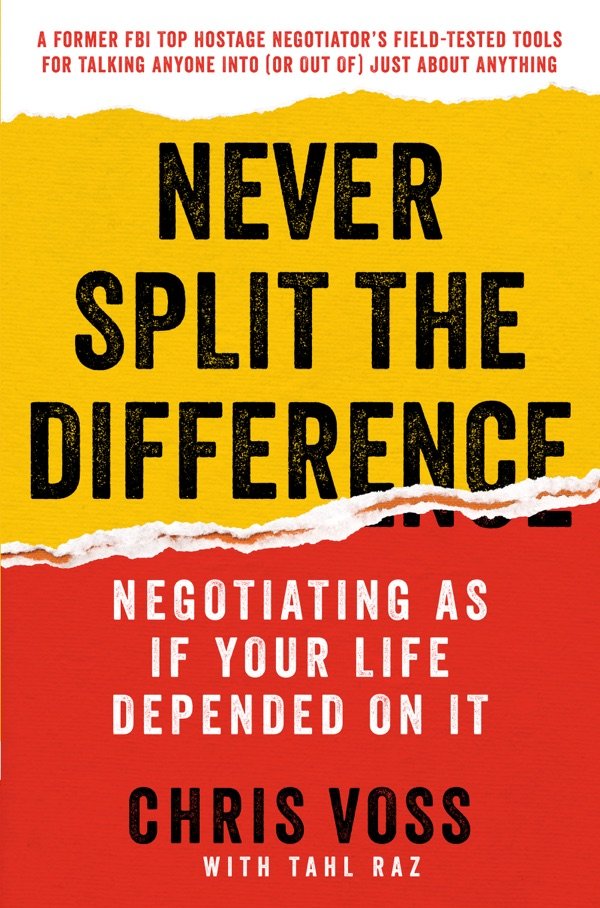
Never Split the Difference: Negotiating As If Your Life Depended On It
by Chris Voss
One, separate the person—the emotion—from the problem; two, don’t get wrapped up in the other side’s position (what they’re asking for) but instead focus on their interests (why they’re asking for it) so that you can find what they really want; three, work cooperatively to generate win-win options; and, four, establish mutually agreed-upon standards for evaluating those possible solutions. What were needed were simple psychological tactics and strategies that worked in the field to calm people down, establish rapport, gain trust, elicit the verbalization of needs, and persuade the other guy of our empathy. We needed something easy to teach, easy to learn, and easy to execute.
One, separate the person—the emotion—from the problem; two, don’t get wrapped up in the other side’s position (what they’re asking for) but instead focus on their interests (why they’re asking for it) so that you can find what they really want; three, work cooperatively to generate win-win options; and, four, establish mutually agreed-upon standards for evaluating those possible solutions.
What were needed were simple psychological tactics and strategies that worked in the field to calm people down, establish rapport, gain trust, elicit the verbalization of needs, and persuade the other guy of our empathy. We needed something easy to teach, easy to learn, and easy to execute.
When people are in a positive frame of mind, they think more quickly, and are more likely to collaborate and problem-solve (instead of fight and resist). It applies to the smile-er as much as to the smile-ee: a smile on your face, and in your voice, will increase your own mental agility.
As I’ve worked with executives and students to develop these skills, I always try to reinforce the message that being right isn’t the key to a successful negotiation—having the right mindset is.
■ People who view negotiation as a battle of arguments become overwhelmed by the voices in their head. Negotiation is not an act of battle; it’s a process of discovery. The goal is to uncover as much information as possible.
"One, separate the person—the emotion—from the problem; two, don’t get wrapped up in the other side’s position (what they’re asking for) but instead focus on their interests (why they’re asking for it) so that you can find what they really want; three, work cooperatively to generate win-win options; and, four, establish mutually agreed-upon standards for evaluating those possible solutions."
"What were needed were simple psychological tactics and strategies that worked in the field to calm people down, establish rapport, gain trust, elicit the verbalization of needs, and persuade the other guy of our empathy. We needed something easy to teach, easy to learn, and easy to execute."
"Psychotherapy research shows that when individuals feel listened to, they tend to listen to themselves more carefully and to openly evaluate and clarify their own thoughts and feelings. In addition, they tend to become less defensive and oppositional and more willing to listen to other points of view, which gets them to the calm and logical place where they can be good Getting to Yes problem solvers."
"When people are in a positive frame of mind, they think more quickly, and are more likely to collaborate and problem-solve (instead of fight and resist). It applies to the smile-er as much as to the smile-ee: a smile on your face, and in your voice, will increase your own mental agility."
"As I’ve worked with executives and students to develop these skills, I always try to reinforce the message that being right isn’t the key to a successful negotiation—having the right mindset is."
"■ People who view negotiation as a battle of arguments become overwhelmed by the voices in their head. Negotiation is not an act of battle; it’s a process of discovery. The goal is to uncover as much information as possible."
"It seems like . . . It sounds like . . . It looks like . . . Notice we said “It sounds like . . .” and not “I’m hearing that . . .” That’s because the word “I” gets people’s guard up. When you say “I,” it says you’re more interested in yourself than the other person, and it makes you take personal responsibility for the words that follow—and the offense they might cause."
- →As I’ve worked with executives and students to develop these skills, I always try to reinforce the message that being right isn’t the key to a successful negotiation—having the right mindset is.
- →Once you understand what a messy, emotional, and destructive dynamic “fairness” can be, you can see why “Fair” is a tremendously powerful word that you need to use with care.
- →Saying “No” makes the speaker feel safe, secure, and in control, so trigger it. By saying what they don’t want, your counterpart defines their space and gains the confidence and comfort to listen to you. That’s why “Is now a bad time to talk?” is always better than “Do you have a few minutes to talk?”
- →Among hundreds of such clients, there’s one single, solitary gentleman who gave the question serious consideration and responded affirmatively. Deadlines are often arbitrary, almost always flexible, and hardly ever trigger the consequences we think—or are told—they will.
Looking for something similar?
Describe your situation. The search finds the right book from the entire library.