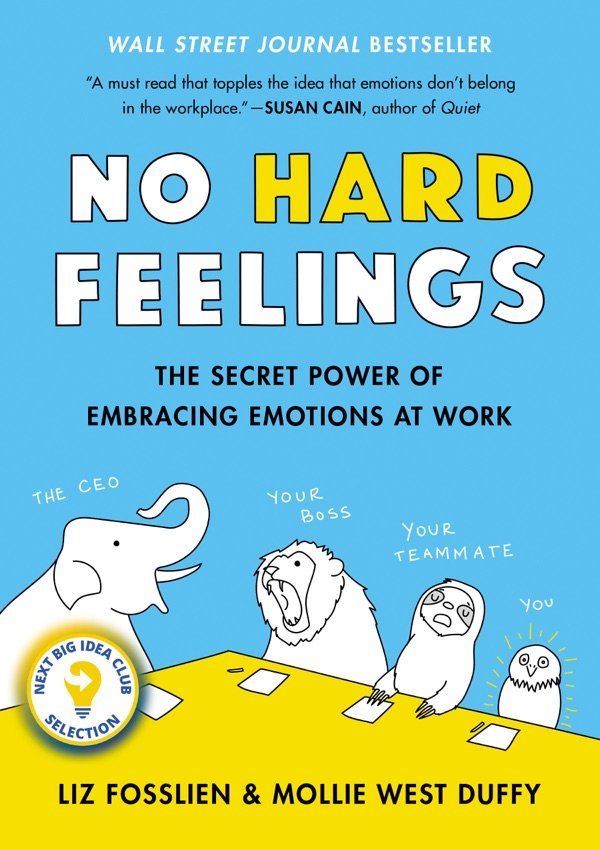
No Hard Feelings: The Secret Power of Embracing Emotions at Work
by Liz Fosslien
You can learn to bring your mind back to the present and stop ruminating. The first step to feeling better is to notice your cognitive distortions, or the dirty tricks your brain plays on you. Team members at Genius, the music-media company where Liz worked, are encouraged to add a “practical suggestion colon” to all criticism.
You can learn to bring your mind back to the present and stop ruminating. The first step to feeling better is to notice your cognitive distortions, or the dirty tricks your brain plays on you.
Team members at Genius, the music-media company where Liz worked, are encouraged to add a “practical suggestion colon” to all criticism.
Paul Santagata, head of industry at Google, leads his teams through an activity called “Just Like Me,” in which he asks team members who are arguing to remember the following: This person has beliefs, perspectives, and opinions, just like me. This person has hopes, anxieties, and vulnerabilities, just like me. This person wants to feel respected, appreciated, and competent, just like me.
Caring too much about a job is unhelpful and unhealthy. It makes small problems seem exceptional and throwaway remarks feel appalling. And it’s not only leaders or women or Virgos who care too much: it’s possible to be overly attached to any job at any level. That’s why we came up with the first new rule of emotion at work: Be less passionate about your job.
“Be less passionate about your job” doesn’t mean “stop caring about work.” It means care more about yourself. It means carve out time for the people you love, for exercise, and for a guilt-free vacation. It means remind yourself that few people look back at their lives and wish they had stayed at the office until 10:00 P.M.
"You can learn to bring your mind back to the present and stop ruminating. The first step to feeling better is to notice your cognitive distortions, or the dirty tricks your brain plays on you."
"Team members at Genius, the music-media company where Liz worked, are encouraged to add a “practical suggestion colon” to all criticism."
"Write out your options. If you’ve written down only two things, take a moment to see if you can introduce an additional alternative. Choices usually aren’t binary. When you limit your decision to yes or no, or A or B, you make the stakes much higher than they might actually be. So if you’ve listed “Stay at my current job” and “Take the new job,” think about whether you could broaden your menu by adding something like “Stay at my current job and ask for a promotion.”"
"Learning by doing is the best way to discover work you find meaningful. The advice to “follow your passion” assumes you know your passion (and that you can easily make a living pursuing it). Pinpointing what you love to do without working is like trying to choose a spouse based only on their Tinder profile. “‘Always produce’ will discover your life’s work the way water, with the aid of gravity, finds the hole in your roof,” writes Paul Graham."
"Paul Santagata, head of industry at Google, leads his teams through an activity called “Just Like Me,” in which he asks team members who are arguing to remember the following: This person has beliefs, perspectives, and opinions, just like me. This person has hopes, anxieties, and vulnerabilities, just like me. This person wants to feel respected, appreciated, and competent, just like me."
"Caring too much about a job is unhelpful and unhealthy. It makes small problems seem exceptional and throwaway remarks feel appalling. And it’s not only leaders or women or Virgos who care too much: it’s possible to be overly attached to any job at any level. That’s why we came up with the first new rule of emotion at work: Be less passionate about your job."
"“Be less passionate about your job” doesn’t mean “stop caring about work.” It means care more about yourself. It means carve out time for the people you love, for exercise, and for a guilt-free vacation. It means remind yourself that few people look back at their lives and wish they had stayed at the office until 10:00 P.M."
- →You can learn to bring your mind back to the present and stop ruminating. The first step to feeling better is to notice your cognitive distortions, or the dirty tricks your brain plays on you.
- →“Be less passionate about your job” doesn’t mean “stop caring about work.” It means care more about yourself. It means carve out time for the people you love, for exercise, and for a guilt-free vacation. It means remind yourself that few people look back at their lives and wish they had stayed at the office until 10:00 P.M.
- →“The worst thing we do is bravely step out of the mold but then stupidly use someone else’s rubric to judge our own lives every day. If you’re going to forge your own path, then do so without judgment. It is a beautiful thing to want something for yourself that originates from you.”
- →Psychologist Nick Wignall schedules five to fifteen minutes every day to write down all his anxieties. He then highlights everything that is (1) an actual problem, (2) urgent (it must be done in the next day or two), and (3) within his control.
Looking for something similar?
Describe your situation. The search finds the right book from the entire library.