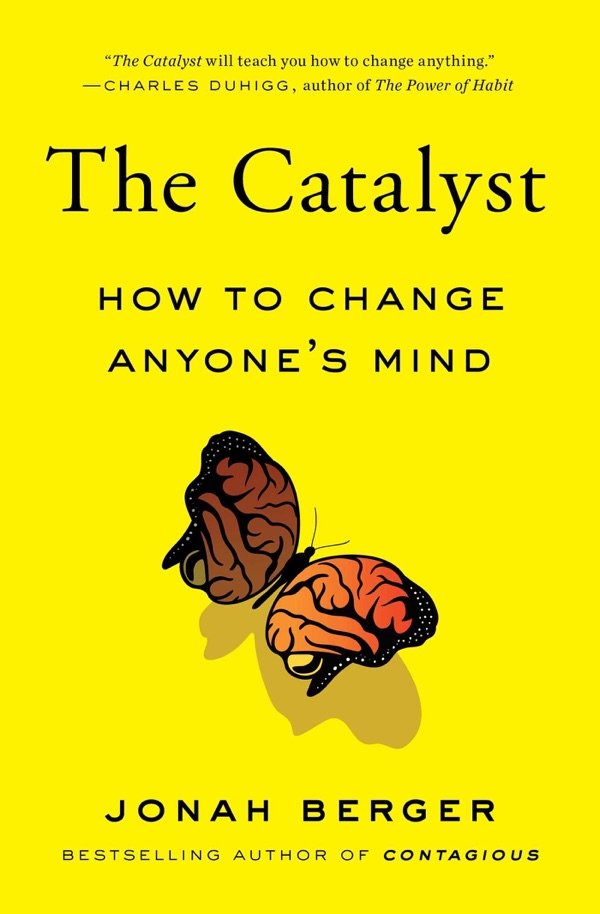
The Catalyst: How to Change Anyone's Mind
by Jonah Berger
Isaac Newton famously noted that an object in motion tends to stay in motion, while an object at rest tends to stay at rest. Sir Isaac focused on physical objects—planets, pendulums, and the like—but the same concepts can be applied to the social world. Just like moons and comets, people and organizations are guided by conservation of momentum. They tend to do what they’ve always done. Distance is the third main roadblock to change. Reactance highlights that people push back when they feel someone is trying to persuade them. But even when just providing information or evidence, distance matters. If things are too far from where people are currently, they fall in the region of rejection and get discounted or ignored.
Isaac Newton famously noted that an object in motion tends to stay in motion, while an object at rest tends to stay at rest. Sir Isaac focused on physical objects—planets, pendulums, and the like—but the same concepts can be applied to the social world. Just like moons and comets, people and organizations are guided by conservation of momentum. They tend to do what they’ve always done.
Distance is the third main roadblock to change. Reactance highlights that people push back when they feel someone is trying to persuade them. But even when just providing information or evidence, distance matters. If things are too far from where people are currently, they fall in the region of rejection and get discounted or ignored.
To reduce reactance, catalysts allow for agency—not by telling people what to do or by being completely hands-off, but by finding the middle ground. By guiding their path. Four key ways to do that are: (1) Provide a menu, (2) ask, don’t tell, (3) highlight a gap, and (4) start with understanding.
Good hostage negotiators take a different tack. They start by listening and building trust. They encourage the suspect to talk through their fears and motivations and who’s waiting for them back home. Even talking about pets in the middle of a tense stand-off, if that is what’s required.
So how can we combat these biases? How do catalysts avoid the region of rejection and encourage people to actually consider what they have to say? Three ways to mitigate distance are to (1) find the movable middle, (2) ask for less, and (3) switch the field to find an unsticking point.
"Isaac Newton famously noted that an object in motion tends to stay in motion, while an object at rest tends to stay at rest. Sir Isaac focused on physical objects—planets, pendulums, and the like—but the same concepts can be applied to the social world. Just like moons and comets, people and organizations are guided by conservation of momentum. They tend to do what they’ve always done."
"Distance is the third main roadblock to change. Reactance highlights that people push back when they feel someone is trying to persuade them. But even when just providing information or evidence, distance matters. If things are too far from where people are currently, they fall in the region of rejection and get discounted or ignored."
"To reduce reactance, catalysts allow for agency—not by telling people what to do or by being completely hands-off, but by finding the middle ground. By guiding their path. Four key ways to do that are: (1) Provide a menu, (2) ask, don’t tell, (3) highlight a gap, and (4) start with understanding."
"Good hostage negotiators take a different tack. They start by listening and building trust. They encourage the suspect to talk through their fears and motivations and who’s waiting for them back home. Even talking about pets in the middle of a tense stand-off, if that is what’s required."
"So how can we combat these biases? How do catalysts avoid the region of rejection and encourage people to actually consider what they have to say? Three ways to mitigate distance are to (1) find the movable middle, (2) ask for less, and (3) switch the field to find an unsticking point."
"But if multiple sources say or do something, it’s harder not to listen. Because now there’s corroborating evidence. Reinforcement. Multiple sources concur. They have the same view, response, or preference. And this consistency means it’s much more likely that you’ll feel the same way."
"Giving people a menu, or asking rather than telling, avoids usurping their sense of control. But another route to self-persuasion is to highlight a gap—a disconnect between someone’s thoughts and actions or a disparity between what they might recommend for others versus do themselves."
- →To reduce reactance, catalysts allow for agency—not by telling people what to do or by being completely hands-off, but by finding the middle ground. By guiding their path. Four key ways to do that are: (1) Provide a menu, (2) ask, don’t tell, (3) highlight a gap, and (4) start with understanding.
- →Good hostage negotiators take a different tack. They start by listening and building trust. They encourage the suspect to talk through their fears and motivations and who’s waiting for them back home. Even talking about pets in the middle of a tense stand-off, if that is what’s required.
- →So how can we combat these biases? How do catalysts avoid the region of rejection and encourage people to actually consider what they have to say? Three ways to mitigate distance are to (1) find the movable middle, (2) ask for less, and (3) switch the field to find an unsticking point.
- →But if multiple sources say or do something, it’s harder not to listen. Because now there’s corroborating evidence. Reinforcement. Multiple sources concur. They have the same view, response, or preference. And this consistency means it’s much more likely that you’ll feel the same way.
Looking for something similar?
Describe your situation. The search finds the right book from the entire library.