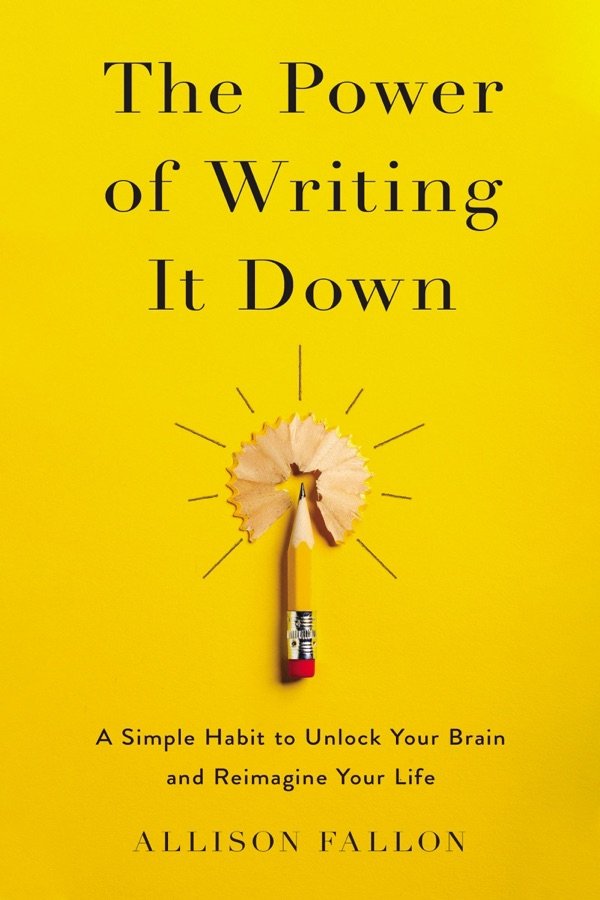
The Power of Writing It Down: A Simple Habit to Unlock Your Brain and Reimagine Your Life
by Allison Fallon
Writing is prayer, spirituality, self-discovery, communication, therapy, connection. The invitation and impulse to write is not just an invitation and impulse to put a few words down on the page. It’s an invitation to take ownership of our lives. Writing helps us gain confidence in ourselves, our ideas, and how we move through the world. The invitation to write is an invitation to find your voice. If you can attach a smell—like a candle or an essential oil—to the feelings you have when you sit down to write, you could bring that smell with you anywhere you go, and when you smell it, you’ll be instantly transported back to the space you made for writing, even when you aren’t “feeling” like going there.
If you can attach a smell—like a candle or an essential oil—to the feelings you have when you sit down to write, you could bring that smell with you anywhere you go, and when you smell it, you’ll be instantly transported back to the space you made for writing, even when you aren’t “feeling” like going there.
Mark Twain is quoted as saying, “the difference between the almost right word and the right word is . the difference between a lightning bug and lightning.”5 This is the invitation writing gives us—to find the exact right words.
The biggest mistake we all make when it comes to trying to produce measurable change in our lives—and Dr. Dispenza agrees with me—is that we get focused on changing outcomes when the system is driven by thoughts and feelings.
Intuitively, we know writing clarifies our thinking, gets us in touch with a higher wisdom, connects us to other people, calms our nerves, and helps us make something usable from even the most horrific situations.
What you have to do is to consider what you think and how you feel about a subject, scribble a few words down on the page, and slowly, over time, watch your perspective and your life transform.
"Writing is prayer, spirituality, self-discovery, communication, therapy, connection. The invitation and impulse to write is not just an invitation and impulse to put a few words down on the page. It’s an invitation to take ownership of our lives. Writing helps us gain confidence in ourselves, our ideas, and how we move through the world. The invitation to write is an invitation to find your voice."
"If you can attach a smell—like a candle or an essential oil—to the feelings you have when you sit down to write, you could bring that smell with you anywhere you go, and when you smell it, you’ll be instantly transported back to the space you made for writing, even when you aren’t “feeling” like going there."
"Mark Twain is quoted as saying, “the difference between the almost right word and the right word is . the difference between a lightning bug and lightning.”5 This is the invitation writing gives us—to find the exact right words."
"The biggest mistake we all make when it comes to trying to produce measurable change in our lives—and Dr. Dispenza agrees with me—is that we get focused on changing outcomes when the system is driven by thoughts and feelings."
"Intuitively, we know writing clarifies our thinking, gets us in touch with a higher wisdom, connects us to other people, calms our nerves, and helps us make something usable from even the most horrific situations."
"What you have to do is to consider what you think and how you feel about a subject, scribble a few words down on the page, and slowly, over time, watch your perspective and your life transform."
"It is to say that writing—if we’re open to it—can have a measurable impact on every area of our lives, including our mental and emotional health. Words are that powerful."
- →Mark Twain is quoted as saying, “the difference between the almost right word and the right word is . the difference between a lightning bug and lightning.”5 This is the invitation writing gives us—to find the exact right words.
- →What you have to do is to consider what you think and how you feel about a subject, scribble a few words down on the page, and slowly, over time, watch your perspective and your life transform.
- →Pennebaker’s research shows that writing for as little as twenty minutes a day for as little as four days in a row can cause a measurable improvement in your mood.
Looking for something similar?
Describe your situation. The search finds the right book from the entire library.