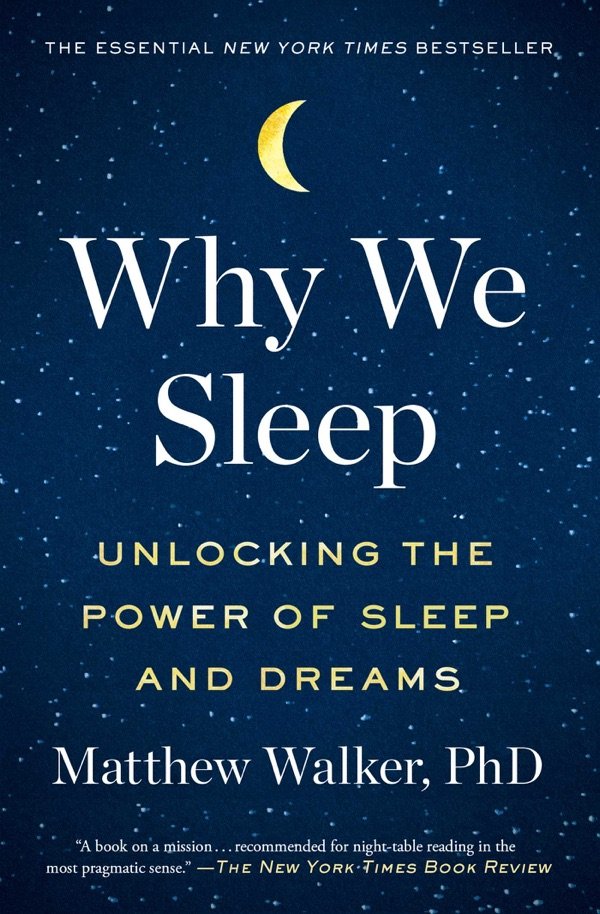
Why We Sleep: Unlocking the Power of Sleep and Dreams
by Matthew Walker
Caffeine has an average half-life of five to seven hours. Let’s say that you have a cup of coffee after your evening dinner, around 7:30 p.m. This means that by 1:30 a.m., 50 percent of that caffeine may still be active and circulating throughout your brain tissue. In other words, by 1:30 a.m., you’re only halfway to completing the job of cleansing your brain of the caffeine you drank after dinner. Plentiful sleep maintains a flourishing microbiome within your gut from which we know so much of our nutritional health begins. Adequate sleep is intimately tied to the fitness of our cardiovascular system, lowering blood pressure while keeping our hearts in fine condition. A balanced diet and exercise are of vital importance, yes. But we now see sleep as the preeminent force in this health trinity. The physical and mental impairments caused by one night of bad sleep dwarf those caused by an equivalent absence of food or exercise.
The upshot of all this work can be summarized as follows: short sleep (of the type that many adults in first-world countries commonly and routinely report) will increase hunger and appetite, compromise impulse control within the brain, increase food consumption (especially of high-calorie foods), decrease feelings of food satisfaction after eating, and prevent effective weight loss when dieting.
To successfully initiate sleep, as described in chapter 2, your core temperature needs to decrease by 2 to 3 degrees Fahrenheit, or about 1 degree Celsius. For this reason, you will always find it easier to fall asleep in a room that is too cold than too hot, since a room that is too cold is at least dragging your brain and body in the correct (downward) temperature direction for sleep.
That older adults simply need less sleep is a myth. Older adults appear to need just as much sleep as they do in midlife, but are simply less able to generate that (still necessary) sleep. Affirming this, large surveys demonstrate that despite getting less sleep, older adults reported needing, and indeed trying, to obtain just as much sleep as younger adults.
First, after waking up in the morning, could you fall back asleep at ten or eleven a.m.? If the answer is “yes,” you are likely not getting sufficient sleep quantity and/or quality. Second, can you function optimally without caffeine before noon? If the answer is “no,” then you are most likely self-medicating your state of chronic sleep deprivation.
As we will discover in chapter 6, a key function of deep NREM sleep, which predominates early in the night, is to do the work of weeding out and removing unnecessary neural connections. In contrast, the dreaming stage of REM sleep, which prevails later in the night, plays a role in strengthening those connections.
"Caffeine has an average half-life of five to seven hours. Let’s say that you have a cup of coffee after your evening dinner, around 7:30 p.m. This means that by 1:30 a.m., 50 percent of that caffeine may still be active and circulating throughout your brain tissue. In other words, by 1:30 a.m., you’re only halfway to completing the job of cleansing your brain of the caffeine you drank after dinner."
"Plentiful sleep maintains a flourishing microbiome within your gut from which we know so much of our nutritional health begins. Adequate sleep is intimately tied to the fitness of our cardiovascular system, lowering blood pressure while keeping our hearts in fine condition. A balanced diet and exercise are of vital importance, yes. But we now see sleep as the preeminent force in this health trinity. The physical and mental impairments caused by one night of bad sleep dwarf those caused by an equivalent absence of food or exercise."
"But did reading on the iPad actually change sleep quantity/quality above and beyond the timing of melatonin? It did, in three concerning ways. First, individuals lost significant amounts of REM sleep following iPad reading. Second, the research subjects felt less rested and sleepier throughout the day following iPad use at night. Third was a lingering aftereffect, with participants suffering a ninety-minute lag in their evening rising melatonin levels for several days after iPad use ceased—almost like a digital hangover effect."
"When it comes to information processing, think of the wake state principally as reception (experiencing and constantly learning the world around you), NREM sleep as reflection (storing and strengthening those raw ingredients of new facts and skills), and REM sleep as integration (interconnecting these raw ingredients with each other, with all past experiences, and, in doing so, building an ever more accurate model of how the world works, including innovative insights and problem-solving abilities)."
"Those who were awake throughout the day became progressively worse at learning, even though their ability to concentrate remained stable (determined by separate attention and response time tests). In contrast, those who napped did markedly better, and actually improved in their capacity to memorize facts. The difference between the two groups at six p.m. was not small: a 20 percent learning advantage for those who slept."
"The upshot of all this work can be summarized as follows: short sleep (of the type that many adults in first-world countries commonly and routinely report) will increase hunger and appetite, compromise impulse control within the brain, increase food consumption (especially of high-calorie foods), decrease feelings of food satisfaction after eating, and prevent effective weight loss when dieting."
"To successfully initiate sleep, as described in chapter 2, your core temperature needs to decrease by 2 to 3 degrees Fahrenheit, or about 1 degree Celsius. For this reason, you will always find it easier to fall asleep in a room that is too cold than too hot, since a room that is too cold is at least dragging your brain and body in the correct (downward) temperature direction for sleep."
- →As we will discover in chapter 6, a key function of deep NREM sleep, which predominates early in the night, is to do the work of weeding out and removing unnecessary neural connections. In contrast, the dreaming stage of REM sleep, which prevails later in the night, plays a role in strengthening those connections.
- →All twelve suggestions are superb advice, but if you can only adhere to one of these each and every day, make it: going to bed and waking up at the same time of day no matter what. It is perhaps the single most effective way of helping improve your sleep, even though it involves the use of an alarm clock.
- →The changes in deep NREM sleep always precede the cognitive and developmental milestones within the brain by several weeks or months, implying a direction of influence: deep sleep may be a driving force of brain maturation, not the other way around.
- →That humans (and all other species) can never “sleep back” that which we have previously lost is one of the most important take-homes of this book, the saddening consequences of which I will describe in chapters 7 and 8.
Looking for something similar?
Describe your situation. The search finds the right book from the entire library.