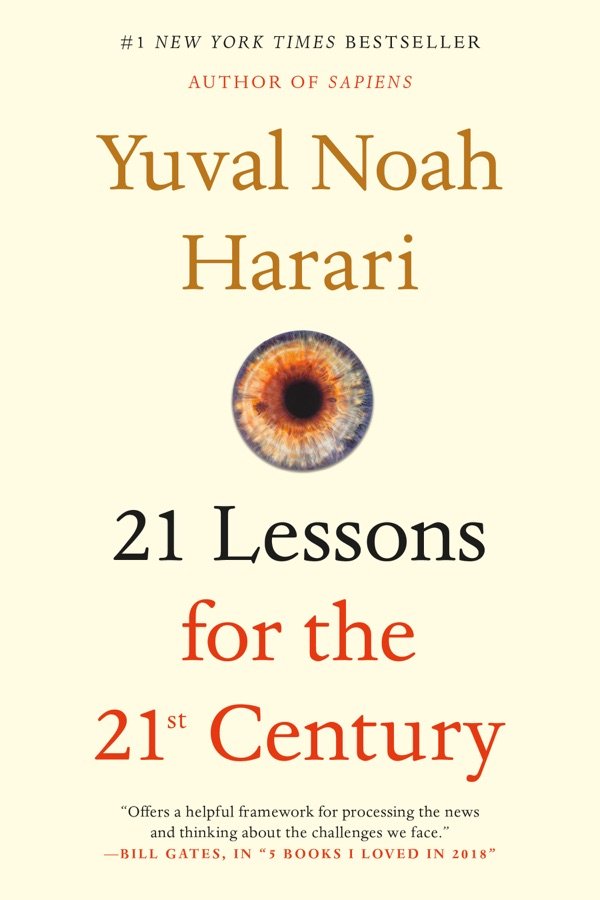
21 Lessons for the 21st Century
von Yuval Noah Harari
In such a world, the last thing a teacher needs to give her pupils is more information. They already have far too much of it. Instead, people need the ability to make sense of information, to tell the difference between what is important and what is unimportant, and above all to combine many bits of information into a broad picture of the world. The merger of infotech and biotech might soon push billions of humans out of the job market and undermine both liberty and equality. Big Data algorithms might create digital dictatorships in which all power is concentrated in the hands of a tiny elite while most people suffer not from exploitation but from something far worse—irrelevance.
In such a world, the last thing a teacher needs to give her pupils is more information. They already have far too much of it. Instead, people need the ability to make sense of information, to tell the difference between what is important and what is unimportant, and above all to combine many bits of information into a broad picture of the world.
The merger of infotech and biotech might soon push billions of humans out of the job market and undermine both liberty and equality. Big Data algorithms might create digital dictatorships in which all power is concentrated in the hands of a tiny elite while most people suffer not from exploitation but from something far worse—irrelevance.
It is debatable whether it is better to provide people with universal basic income (the capitalist paradise) or universal basic services (the communist paradise). Both options have advantages and drawbacks. But no matter which paradise you choose, the real problem is in defining what “universal” and “basic” actually mean.
Both of these cases may seem to smack of racism. But in fact, they are not racist. They are “culturist.” People continue to conduct a heroic struggle against traditional racism without noticing that the battlefront has shifted. Traditional racism is waning, but the world is now full of “culturists.”
Perhaps in the twenty-first century populist revolts will be staged not against an economic elite that exploits people but against an economic elite that does not need them anymore.6 This may well be a losing battle. It is much harder to struggle against irrelevance than against exploitation.
"In such a world, the last thing a teacher needs to give her pupils is more information. They already have far too much of it. Instead, people need the ability to make sense of information, to tell the difference between what is important and what is unimportant, and above all to combine many bits of information into a broad picture of the world."
"The merger of infotech and biotech might soon push billions of humans out of the job market and undermine both liberty and equality. Big Data algorithms might create digital dictatorships in which all power is concentrated in the hands of a tiny elite while most people suffer not from exploitation but from something far worse—irrelevance."
"It is debatable whether it is better to provide people with universal basic income (the capitalist paradise) or universal basic services (the communist paradise). Both options have advantages and drawbacks. But no matter which paradise you choose, the real problem is in defining what “universal” and “basic” actually mean."
"Both of these cases may seem to smack of racism. But in fact, they are not racist. They are “culturist.” People continue to conduct a heroic struggle against traditional racism without noticing that the battlefront has shifted. Traditional racism is waning, but the world is now full of “culturists.”"
"Perhaps in the twenty-first century populist revolts will be staged not against an economic elite that exploits people but against an economic elite that does not need them anymore.6 This may well be a losing battle. It is much harder to struggle against irrelevance than against exploitation."
"This reliance on the heart might prove to be the Achilles’ heel of liberal democracy. For once somebody (whether in Beijing or in San Francisco) gains the technological ability to hack and manipulate the human heart, democratic politics will mutate into an emotional puppet show."
"When a thousand people believe some made-up story for one month, that’s fake news. When a billion people believe it for a thousand years, that’s a religion, and we are admonished not to call it “fake news” in order not to hurt the feelings of the faithful (or incur their wrath)."
- →Potential solutions fall into three main categories: what to do in order to prevent jobs from being lost; what to do in order to create enough new jobs; and what to do if, despite our best efforts, job losses significantly outstrip job creation.
- →These potential advantages of connectivity and updatability are so huge that at least in some lines of work it might make sense to replace all humans with computers, even if individually some humans still do a better job than the machines.
- →So in the twenty-first century religions don’t bring rain, they don’t cure illnesses, they don’t build bombs—but they do get to determine who are “us” and who are “them,” whom we should cure and whom we should bomb.
- →So if you want to know the truth about the universe, about the meaning of life, and about your own identity, the best place to start is by observing suffering and exploring what it is. The answer isn’t a story.
Ähnliche Bücher gesucht?
Beschreibe deine Situation. Die Suche findet das passende Buch aus der gesamten Bibliothek.